
Ruling Parties Compile Draft List of Talking Points on Defense Exports Guidelines
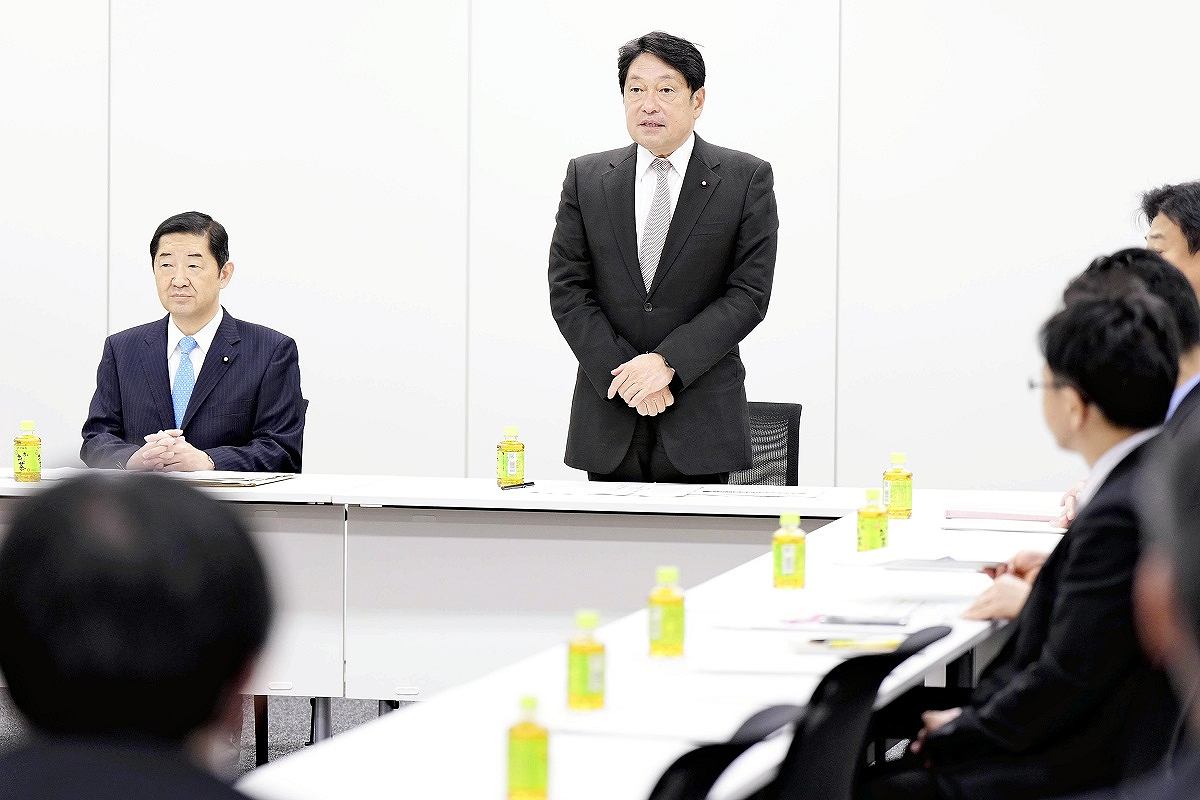
Chairperson of the Liberal Democratic Party’s Research Commission on Security Itsunori Onodera, standing, and Shigeki Sato, left, who chairs Komeito’s foreign relations and national security committee, attend a working team meeting of the ruling parties at the Diet in April.
15:39 JST, July 1, 2023
The Liberal Democratic Party and its ruling coalition partner Komeito have compiled a draft document listing issues to be discussed toward the easing of defense equipment export restrictions.
In light of Russia’s invasion of Ukraine, the draft states that support for invaded countries should be included in a key defense document that currently restricts defense equipment exports.
A working team of the ruling parties met Friday to thrash out which issues would be included in the list and confirmed that the final document would be completed on Wednesday.
Military exports are restricted under the current operational guidelines of the Three Principles on Transfer of Defense Equipment and Technology.
A chasm exists between the LDP, which advocates a drastic easing of the operational guidelines, and Komeito, which wants to keep changes to a minimum.
The working team is focused only on compiling a list of issues. A final decision on possible changes to the operational guidelines will not be made until autumn at the earliest.
The two parties have largely agreed to include in the three principles support for “countries that have been subjected to invasion, the use of force or the threat of force in violation of international law.”
The draft calls on the government to clarify what “providing assistance” entails.
The provision of defense equipment to Ukraine is based on Article 116-3 of the Self-Defense Forces Law, which states that unused equipment can be transferred to governments in developing regions.
The draft states that the provision “should not be limited to equipment that is no longer used.” According to the draft, “consideration should be given to the introduction of legislative measures.”
Regarding jointly developed equipment, the draft states that “the majority of the working team members agreed that the discussion should be directed toward enabling the direct transfer of such equipment from Japan to third countries.”
Japan, Britain and Italy are jointly developing a next-generation fighter jet, but the current guidelines do not allow its export from Japan to third countries other than Britain and Italy.
With the transfer of used F-15 fighter jet engines in mind, the draft also noted that there were opinions that the transfer of parts should be made possible.







Most Read
Popular articles in the past 24 hours
-

Tokyo Skytree's Elevator Stops, Trapping 20 People; All Rescued (...
-

China, India Tapping into Promising African Market; Beijing Annou...
-

Milano Cortina 2026: Miura-Kihara Duo, Other Japanese Figure Skat...
-

Japan’s Major Real Estate Firms Expanding Overseas Businesses to ...
-
Japan, Pacific Island Nations to Work on Deepening Cooperation
-

Ukrainian Ambassador Closely Watching Japan’s Revision of Defense...
-
Emperor Turns 66 Ahead of Disaster Milestones
-
Tokyo Skytree to Close on Monday for Safety Checks after 20 Peopl...
Popular articles in the past week
-

Japan PM Takaichi’s Cabinet Resigns en Masse
-

Man Infected with Measles Reportedly Dined at Restaurant in Tokyo...
-

Sanae Takaichi Elected Prime Minister of Japan; Keeps All Cabinet...
-

Japan's Govt to Submit Road Map for Growth Strategy in March, PM ...
-

Bus Carrying 40 Passengers Catches Fire on Chuo Expressway; All E...
-

Milano Cortina 2026: Figure Skaters Riku Miura, Ryuichi Kihara Pa...
-

Japan, U.S. Name 3 Inaugural Investment Projects; Reached Agreeme...
-

U.S. Firm to Build Training Hub in Fukushima N-plant for Debris R...
Popular articles in the past month
-
Japan PM Takaichi’s Cabinet Resigns en Masse
-

Japan Institute to Use Domestic Commercial Optical Lattice Clock ...
-

Israeli Ambassador to Japan Speaks about Japan’s Role in the Reco...
-
Man Infected with Measles Reportedly Dined at Restaurant in Tokyo...
-

Videos Plagiarized, Reposted with False Subtitles Claiming ‘Ryuky...
-

Man Infected with Measles May Have Come in Contact with Many Peop...
-

Prudential Life Insurance Plans to Fully Compensate for Damages C...
-

Woman with Measles Visited Hospital in Tokyo Multiple Times Befor...
Top Articles in Politics
-
Japan PM Takaichi’s Cabinet Resigns en Masse
-
Sanae Takaichi Elected Prime Minister of Japan; Keeps All Cabinet Appointees from Previous Term
-
Japan’s Govt to Submit Road Map for Growth Strategy in March, PM Takaichi to Announce in Upcoming Policy Speech
-

LDP Wins Historic Landslide Victory
-

LDP Wins Landslide Victory, Secures Single-party Majority; Ruling Coalition with JIP Poised to Secure Over 300 seats (UPDATE 1)
JN ACCESS RANKING
-
Japan PM Takaichi’s Cabinet Resigns en Masse
-
Japan Institute to Use Domestic Commercial Optical Lattice Clock to Set Japan Standard Time
-
Israeli Ambassador to Japan Speaks about Japan’s Role in the Reconstruction of Gaza
-
Man Infected with Measles Reportedly Dined at Restaurant in Tokyo Station
-
Videos Plagiarized, Reposted with False Subtitles Claiming ‘Ryukyu Belongs to China’; Anti-China False Information Also Posted in Japan