
English-language Kabuki, Kyogen Entertain Audiences in Tokyo; Portland State University Professor Emeritus, Graduates Perform
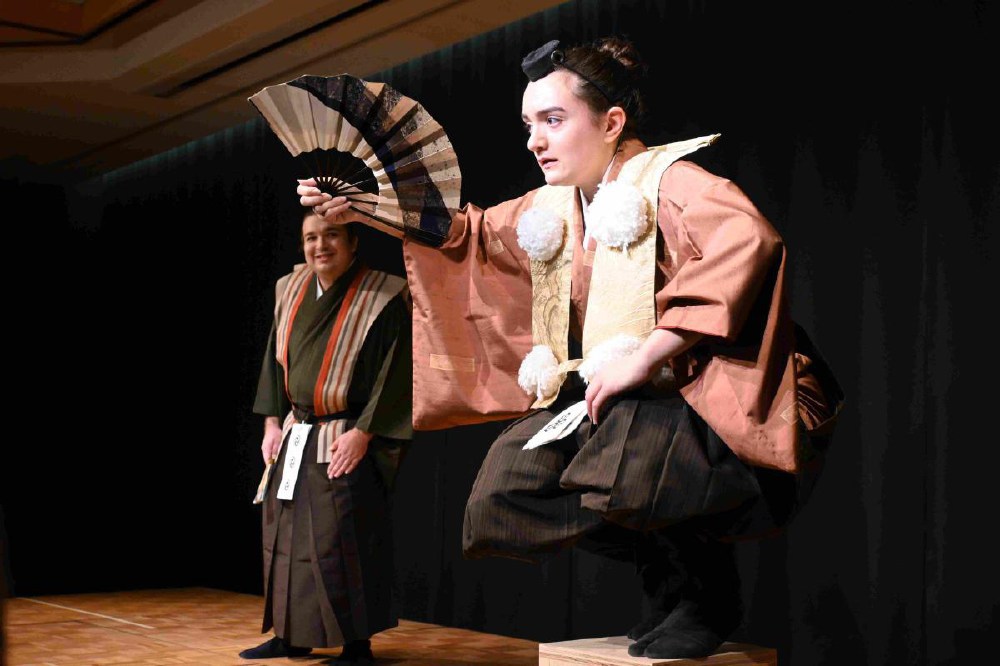
A scene from the kyogen play “The Mountain Wizard and the Persimmons,” performed at Setagaya Literary Museum on Sunday
17:36 JST, November 24, 2025
An event featuring English-language kyogen and kabuki was held on Sunday at the Setagaya Literature Museum in Setagaya Ward, Tokyo.
The powerful performances, complete with traditional costumes and makeup, drew enthusiastic applause from the audience of about 100 people.
The event was organized by Laurence Kominz, a student of Donald Keene and professor emeritus at Portland State University (PSU) in Oregon, and Kominz’s former students, who are graduates of the university.
It was held as part of the Donald Keene Exhibition, which is currently taking place at the museum.
Five PSU alumni performed, including one who played the Japanese flute and did makeup. Three of the five are currently teaching English at elementary, junior high and high schools in Mie, Toyama, and Yamaguchi Prefectures on the JET Program, which is run by Japan’s Education, Culture, Sports, Science and Technology ministry and others.
The kyogen performed were “The Mountain Wizard and the Persimmons” and the Komai dance “Kyoto Children.” In the former, a hungry monk, returning home after completing his training in a mountain, climbs a persimmon tree in a field to eat the fruit but is spotted by the field’s owner.
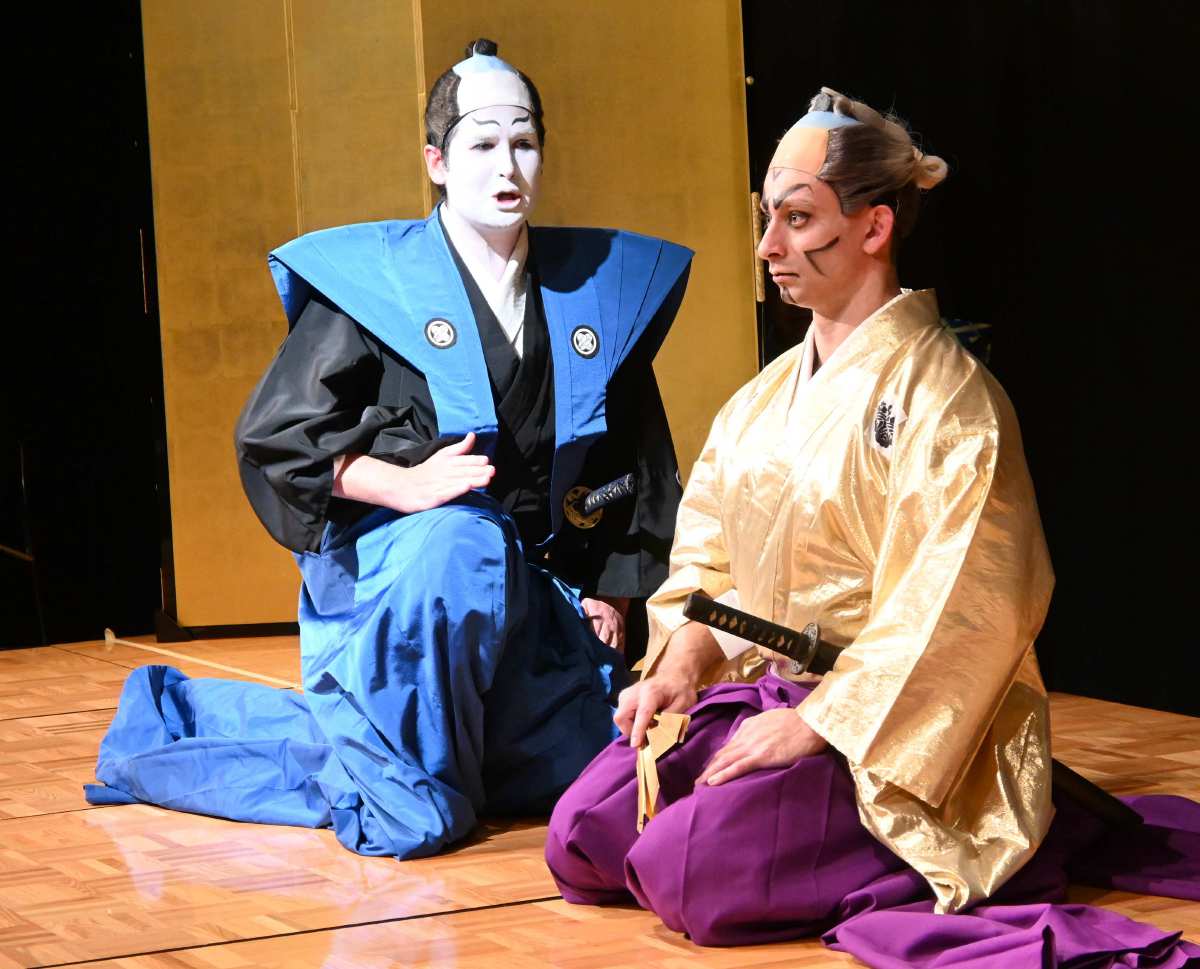
A scene from the kabuki play “The Forty Seven Ronin”
The kabuki performance featured a scene from “The Forty Seven Ronin,” titled “The Attack in the Palace.” The performances were all highly polished.
“Translations for stage performance differ from translations for reading,” Kominz, who has produced English versions of both kyogen and kabuki plays, explained at the venue. In translations for reading, difficult words or cultural contexts can be explained in footnotes. On stage, however, the meaning must be conveyed through the actors’ lines and movements.
Kominz noted that it is therefore sometimes necessary to paraphrase rather than provide a literal translation.
However, there are exceptions. In the kyogen performed on the day, for example, onomatopoeic sounds like animal cries were kept in Japanese, as American audiences find Japanese onomatopoeia very entertaining.
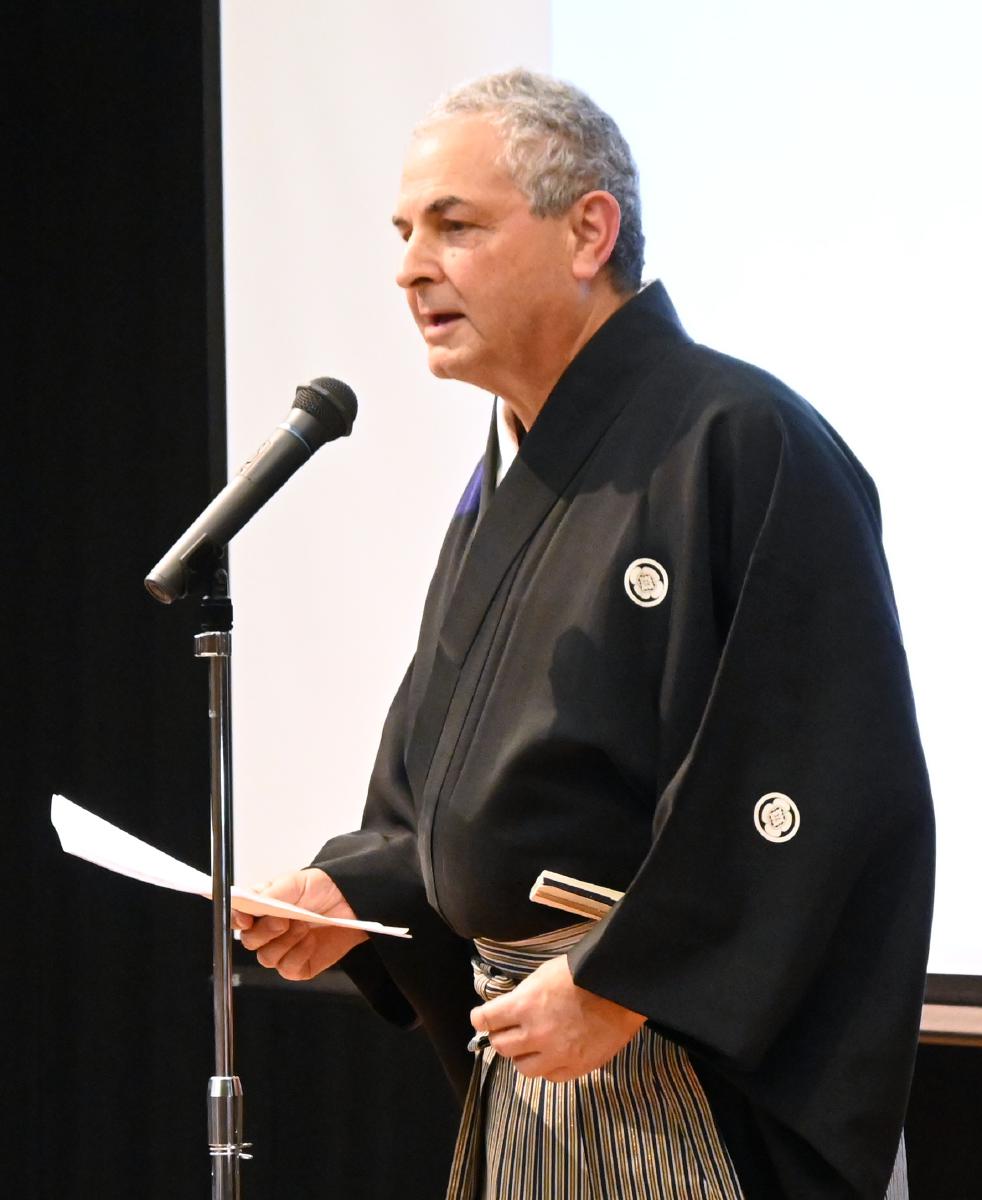
Laurence Kominz, a professor emeritus at Portland State University, explains the English translation for the stage performance.
Keene came to Japan in the summer of 1953 and frequently attended performances of noh, kabuki and bunraku. In Kyoto, he became a disciple of a kyogen master and even took to the stage himself. In the United States, he became the foremost authority on Japanese traditional performing arts and literature.
Kominz, who studied under Keene at Columbia University Graduate School, has taught Japanese literature at PSU for about 40 years, focusing on traditional Japanese plays and performing arts. He has staged kabuki and kyogen performances with students throughout his career. Even after retiring in 2022, he remains active as an emeritus professor, continuing to instruct students.
“When I first met Kominz 40 years ago, the only stage costumes he had were seven or eight yukata,” Kominz’s wife, Toshimi Tanaka, said at the venue, recalling how she supported her husband as costume manager. “Thirty years later, in the 2016 performance of “Forty Seven Ronin,” we were able to put on a three-hour show with 50 student performers, 60 roles and 80 costumes.”
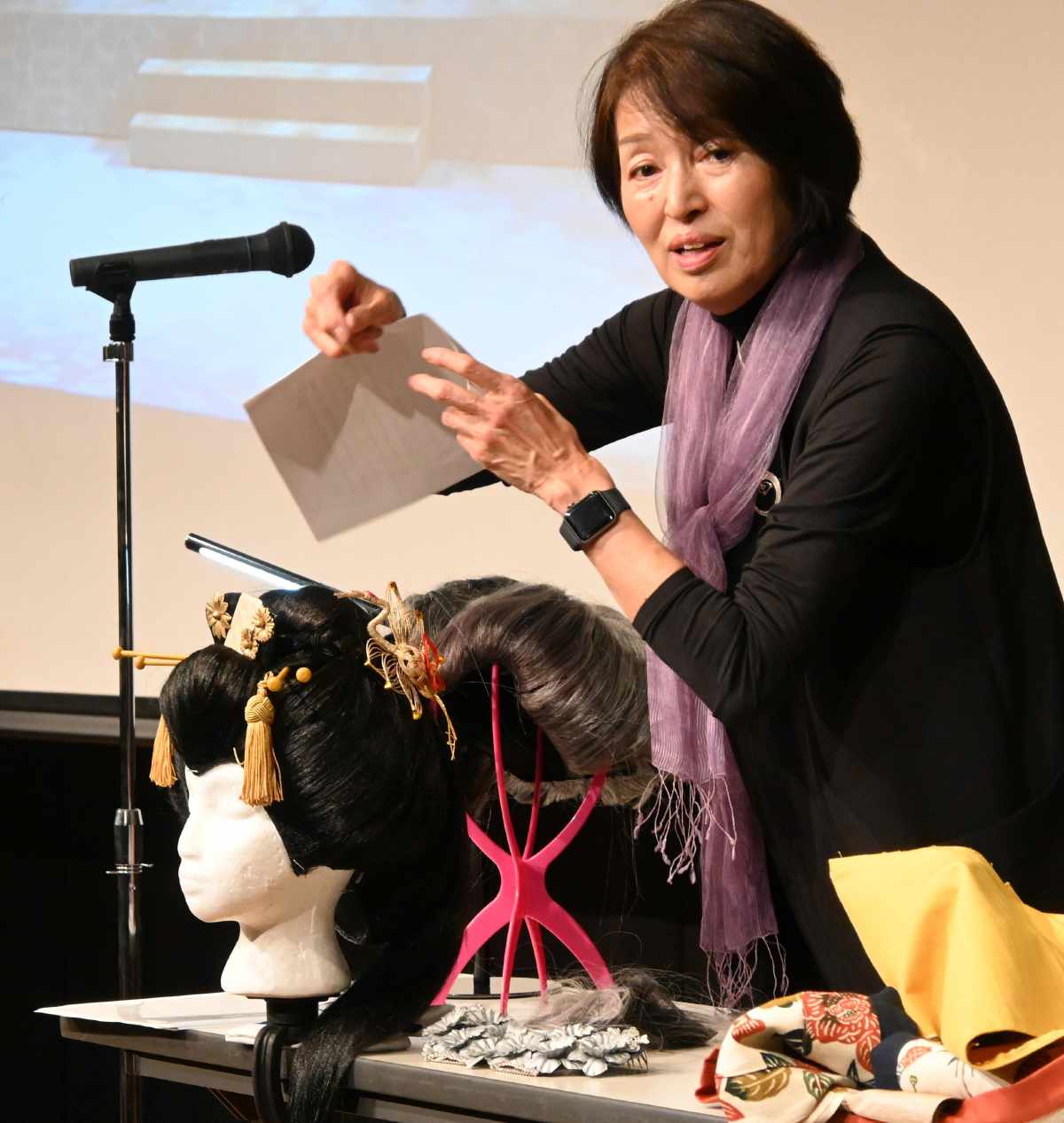
Toshimi Tanaka explains that creativity and ingenuity are important when preparing traditional Japanese costumes, such as those used in kabuki and kyogen, in the United States.
She said it is not easy to prepare traditional Japanese costumes in the United States. Tanaka, with the help of other Japanese women, made whatever she couldn’t find herself. She also adapted various everyday items, such as using decorations from New Year’s osechi dishes or curtain tassels for hair ornaments on wigs.
“I believe my role is to show the next generation of students that you can build a stage with creativity and ingenuity,” Tanaka said.
The audience asked the former students, “Is there anything tough about performing traditional Japanese arts?” They answered in unison, “Seiza [sitting on your heels] is tough,” prompting laughter throughout the venue.
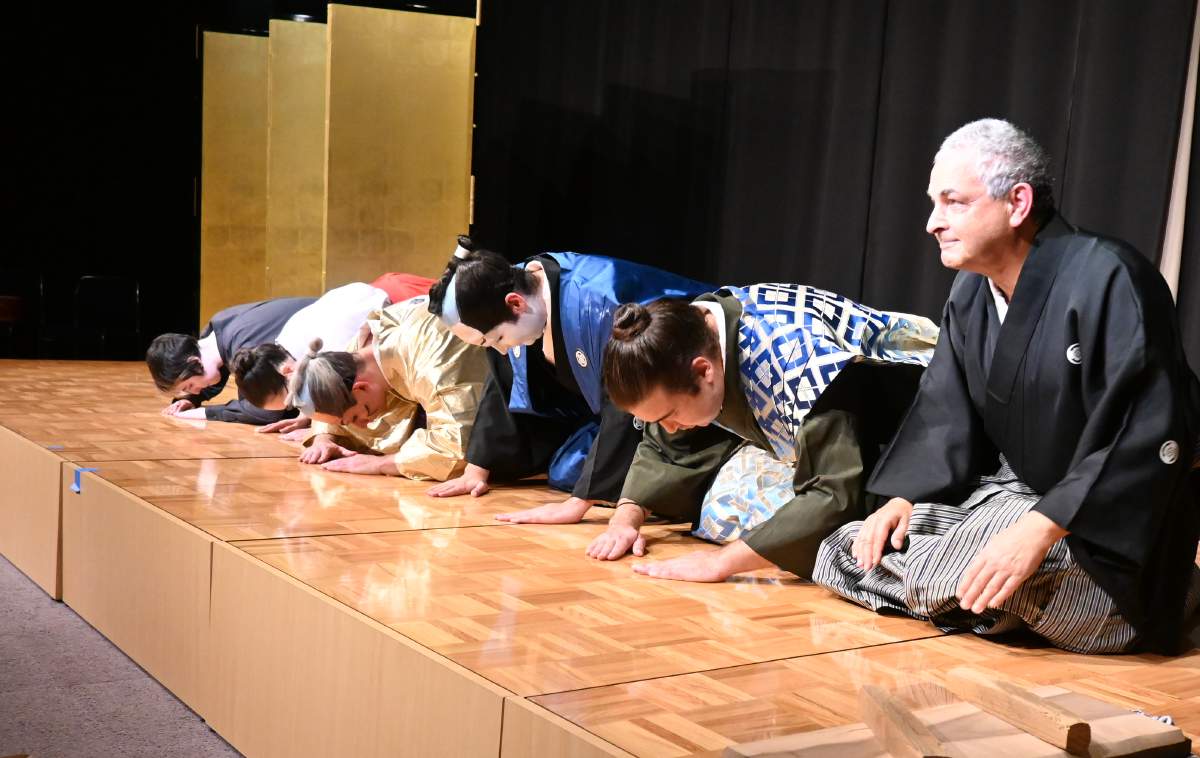
Laurence Kominz, right, and the graduate performers taking a group bow at the end of the stage performance





Most Read
Popular articles in the past 24 hours
-

My Spendthrift Mother Constantly Asks Me for Money
-
Japanese Students Use Traditional Pickle to Create Novel Wagashi ...
-
‘Dry Bonsai’ Gives New Life to Withered Trees, Allows Free Artist...
-

A Packed Bus Plunges off a Nepal Highway, Killing 19 and Injuring...
-

McDonald's Japan Raises Prices; Big Mac to Cost ¥500, Double Chee...
-

Nepal Bus Crash Kills 19 People, Injures 25 Including One Japanes...
-

Astellas Collaborates with Vir to Develop Its Experimental Prosta...
-

Japan’s Nikkei Stock Average Rises as AI-Related Stocks Shine; Co...
Popular articles in the past week
-

Producer Behind Pop Group XG Arrested for Cocaine Possession
-

Japan PM Takaichi’s Cabinet Resigns en Masse
-

Sanae Takaichi Elected Prime Minister of Japan; Keeps All Cabinet...
-

Japan's Govt to Submit Road Map for Growth Strategy in March, PM ...
-

Bus Carrying 40 Passengers Catches Fire on Chuo Expressway; All E...
-

U.S. Firm to Build Training Hub in Fukushima N-plant for Debris R...
-

Japan, U.S. Name 3 Inaugural Investment Projects; Reached Agreeme...
-

Riku-Ryu Pair Wins Gold Medal: Their Strong Bond Leads to Major C...
Popular articles in the past month
-
Producer Behind Pop Group XG Arrested for Cocaine Possession
-
Japan PM Takaichi’s Cabinet Resigns en Masse
-

Japan Institute to Use Domestic Commercial Optical Lattice Clock ...
-

Man Infected with Measles Reportedly Dined at Restaurant in Tokyo...
-

Israeli Ambassador to Japan Speaks about Japan’s Role in the Reco...
-

Videos Plagiarized, Reposted with False Subtitles Claiming ‘Ryuky...
-

Man Infected with Measles May Have Come in Contact with Many Peop...
-

Prudential Life Insurance Plans to Fully Compensate for Damages C...
Top Articles in JN Specialities
-
Exhibition Shows Keene’s Interactions with Showa-Era Writers in Tokyo, Features Newspaper Columns, Related Materials
-

The Japan News / Weekly Edition (2/20-2/26)
-

Step Back in Time at Historical Estate Renovated into a Commercial Complex in Tokyo
-

The Japan News / Weekly Edition (1/30-2/5)
-
Senior Japanese Citizens Return to University to Gain Knowledge, Find New Career, Make Friends
JN ACCESS RANKING
-
Producer Behind Pop Group XG Arrested for Cocaine Possession
-
Japan PM Takaichi’s Cabinet Resigns en Masse
-
Japan Institute to Use Domestic Commercial Optical Lattice Clock to Set Japan Standard Time
-
Man Infected with Measles Reportedly Dined at Restaurant in Tokyo Station
-
Israeli Ambassador to Japan Speaks about Japan’s Role in the Reconstruction of Gaza