
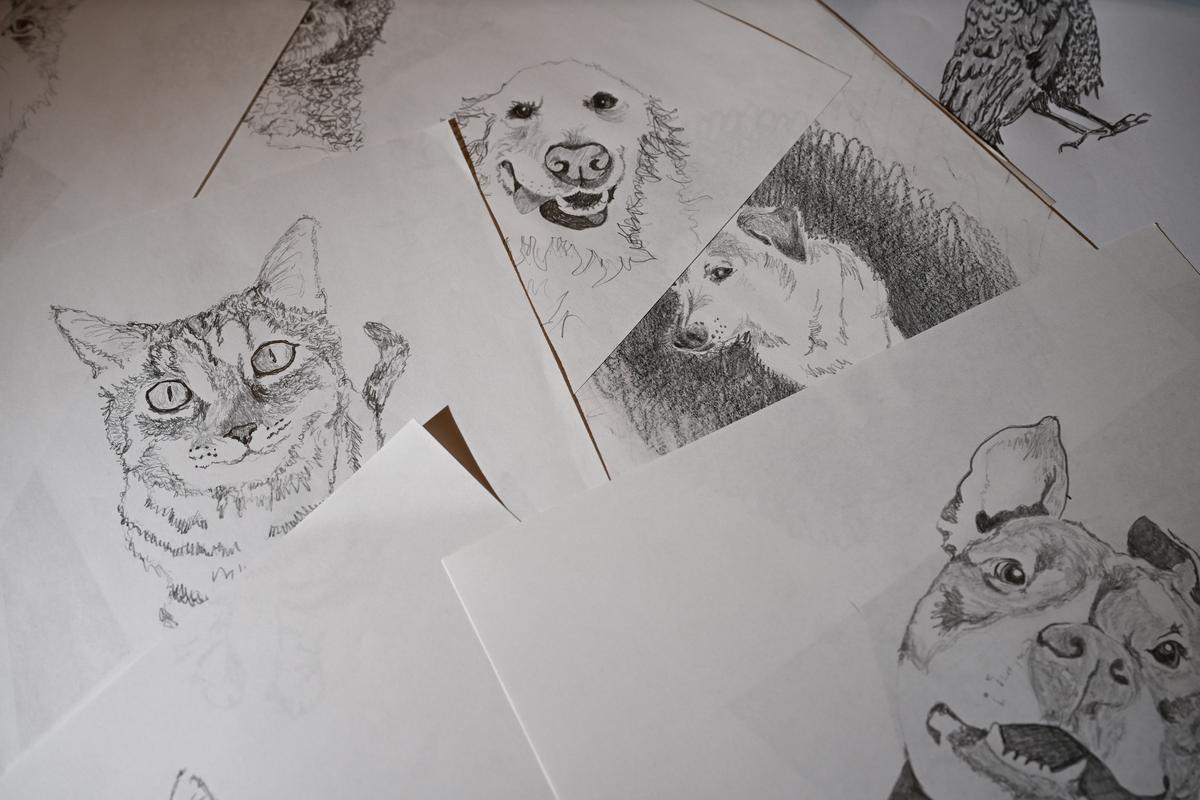
Some of the pet portraits Mortimer has drawn.
12:50 JST, October 29, 2025
RocketBear spent Jan. 21 as he spends most days – lazing around on the couch, scratching at the door to go outside, scratching at the door to come back inside.
The beloved family dog didn’t know that a new president was sworn in the day before, or that one of his first acts in office had been to pause the work his owner dedicated her life to.
And when longtime USAID employee Denise Mortimer gazed at the 7-year-old, longhaired Weimaraner after a long, anxiety-filled day at work, she found his obliviousness oddly comforting. So much so, she got out a piece of paper and a pencil and started sketching him.
Over the months that followed, as President Donald Trump and his allies attacked the agency where she’d worked for almost two decades, as she learned she was losing her job getting electricity to more people in Africa, as she worried about paying her mortgage and her kids’ college tuition, as she despaired over USAID’s dismantling, Mortimer kept drawing. First, RocketBear. Then the pets of her colleagues who were losing their jobs. And finally, the pets of workers at other agencies, who were also being let go.
Mortimer went from someone who last took an art class in college to someone who drew every day.
Soon, she had a collection – and an idea.
She started an Instagram account and posted a sketch of RocketBear standing behind a handful of flowers. In the caption, she wrote: “The dismantling of USAID made my human companion very sad. For some reason, she decided to draw me, which made her feel better. The next time she felt sad, she drew another dog. Given how many times she was sad, she ended up drawing a lot of dogs.”
She posted another pet the next day, and the next. Now the account, @rocketbearproject, features dozens of black-and-white drawings. Mostly, it’s cats and dogs. But there’s also the odd bird – and one bearded dragon named Beardo. Mortimer, who draws at a desk in her sunny kitchen, where jars of pencils stand at the ready, jokes that she would love to draw someone’s pet rock. In the caption beside the animals are blurbs describing the work once done by their owners.
Accompanying a sketch of two curly-haired dogs: “Our names are Ruby and Lily. Our human companion worked for USAID in India, Ecuador, Peru, and Colombia. She supported environmental sustainability and promoted democracy while we sat under her deck and watched her work. We like to think we helped.”
Next to a cat scratching a post: “Meow! My name is Daisy. My human companion worked at Voice of America (VOA) where she created daily news content delivered in the Indonesian language to keep people informed about American society and current events.”
“So often we hear that America’s divided and there’s no crossing the line; it’s us versus them and red versus blue,” said Mortimer, 53, who lives in Takoma Park. “But I was like, ‘Well, if there’s one thing everyone agrees on, it’s pets, right? And we love them.’ So, I thought they could be sort of the ambassadors to tell the story of the really important and powerful and impactful work the government was doing but no longer is doing.”
Or in other words: “The dogs could basically humanize what was happening.”
One drawing shows Modi, who was rescued from the streets of Tbilisi, Georgia, by a USAID employee and “transformed from a stray, flea-covered mutt to a globe trotting diplomatic dog.” Her owner spent years crisscrossing the globe with the agency, most recently leading efforts to help communities access electricity for the first time. As USAID was taken apart, he and his wife both lost their jobs and were forced to suddenly return to the U.S. from what was supposed to be a years-long assignment abroad. Since then, they’ve been racked with stress over how to provide for their young children and stung by the demonization of an agency that had long enjoyed bipartisan support.
“We went from being really financially stable and in a good place to being thrown into the wilderness and facing a great deal of financial instability,” said the former USAID worker, who spoke on the condition of anonymity because of fear of career reprisal while still job hunting.
Looking at the drawing of Modi for the first time, he was struck by an appreciation for Mortimer “channeling her energy into a creative project that acknowledges what happened, but also can bring a little bit of joy to people.”
An 11-year-old shih tzu named Rico stares out from another drawing, accompanied by a caption saying that his dad works at the National Academies of Sciences but won’t for much longer, as the Trump administration continues making cuts.
“Without his work – and the work of others like him – the people who build and maintain roads, bridges, and transit in your community will have much less information,” the caption continues.
Rico’s owner, Paul Mackie, is in his final weeks as a communications director at the National Academies of Sciences, where he shares transit research findings with federal and state decision-makers. He decided to be part of Mortimer’s project in hopes of spreading the word about the work that’s being lost. That research, he said, “is the backbone of building this country’s prosperity and our safety, and that research infrastructure is withstanding a major trial right now.”
As a professional communicator, did he think pets could tell the stories of the government employees whose work and livelihoods are on the chopping block? “I think anything is worth a try,” Mackie said with a resigned laugh.
When he scrolled through the lineup of cats and dogs on Instagram, he was hooked. Before his family talked him into taking Rico home, he didn’t really consider himself a “pet person.” Now he can’t imagine life without a shih tzu as his side. He was amazed by how Mortimer was able to re-create his dog on paper, right down to the “googly eyes.”
“It captures Rico’s total vibe,” Mackie said. “You can almost feel it breathing.”
Mortimer emails snapshot of the pet sketches to their owners. If they want the original artwork, she makes it available in a pay-what-you-can system. The images have brought a bit of levity in a time that, for many, has been marred by uncertainty.
Lauren DiVenanzo and her family had to abruptly leave Sri Lanka with their three children when her husband lost his job as a Foreign Service officer for USAID. The sketch of their 10-year-old dog, Covy, a Rhodesian ridgeback that joined the family while they were doing a stint in South Africa, appeared in their mailbox during the peak of an anxious stretch.
“It was something that put a smile on our faces during a really, really hard time,” said DiVenanzo, who once worked with Mortimer at USAID.
The family has since settled into life in Vermont and consider themselves lucky: DiVenanzo kept her job and her husband found a new one, though they feel a strong sense of survivor’s guilt. The drawing of Covy has yet to arrive at their new home. DiVenanzo said it is “probably on a pallet in the middle of the ocean” with the rest of their belongings, still in transit from the home they packed up.
When it finally shows up, DiVenanzo said she plans to frame it and put it on the wall alongside portraits of her children.
“I imagine in 20 years it’ll be something people ask about,” she said, “and I’ll get to tell the story.”
For her part, Mortimer still feels anger and grief when she thinks about what happened to USAID – all the work that is no longer happening, the human impact in countries where the agency provided critical services. The end of her team’s project, which helped bring electricity to millions in Africa with a goal of boosting economic growth and combating poverty. The daunting task of finding a new job in a region teeming with talent, when her field had contracted so suddenly.
So she keeps drawing.
“I draw because it’s good for me. I draw because it’s good for the person,” she said. “And I draw because I now hope that it’s helping to tell this story.”
On a recent morning, Mortimer stood in the colorful kitchen of her home, flipping through a stack of sketches. She pulled out some of the different concepts she was considering for her hundredth post, which she would hit days later.
There was RocketBear’s face poking out of one of the zeros in “100.” There was RocketBear in color.
The real RocketBear, long-legged and silky-haired, loped around the house. He was the same as he always was. He wanted to be outside; he wanted to be inside. He pawed at things, and Mortimer quipped, “He’s my muse, but he can still be annoying.”






Most Read
Popular articles in the past 24 hours
-

My Spendthrift Mother Constantly Asks Me for Money
-

Japanese Students Use Traditional Pickle to Create Novel Wagashi ...
-
‘Dry Bonsai’ Gives New Life to Withered Trees, Allows Free Artist...
-

McDonald's Japan Raises Prices; Big Mac to Cost ¥500, Double Chee...
-

Nepal Bus Crash Kills 19 People, Injures 25 Including One Japanes...
-

Astellas Collaborates with Vir to Develop Its Experimental Prosta...
-

Japan’s Nikkei Stock Average Rises as AI-Related Stocks Shine; Co...
-

Early-Blooming Kawazu Cherry Blossoms Create Sea of Pink at Park ...
Popular articles in the past week
-

Producer Behind Pop Group XG Arrested for Cocaine Possession
-

Japan PM Takaichi’s Cabinet Resigns en Masse
-

Sanae Takaichi Elected Prime Minister of Japan; Keeps All Cabinet...
-

Japan's Govt to Submit Road Map for Growth Strategy in March, PM ...
-

Bus Carrying 40 Passengers Catches Fire on Chuo Expressway; All E...
-

U.S. Firm to Build Training Hub in Fukushima N-plant for Debris R...
-

Japan, U.S. Name 3 Inaugural Investment Projects; Reached Agreeme...
-

Riku-Ryu Pair Wins Gold Medal: Their Strong Bond Leads to Major C...
Popular articles in the past month
-
Producer Behind Pop Group XG Arrested for Cocaine Possession
-
Japan PM Takaichi’s Cabinet Resigns en Masse
-

Japan Institute to Use Domestic Commercial Optical Lattice Clock ...
-

Man Infected with Measles Reportedly Dined at Restaurant in Tokyo...
-

Israeli Ambassador to Japan Speaks about Japan’s Role in the Reco...
-

Videos Plagiarized, Reposted with False Subtitles Claiming ‘Ryuky...
-

Man Infected with Measles May Have Come in Contact with Many Peop...
-

Prudential Life Insurance Plans to Fully Compensate for Damages C...
Top Articles in News Services
-
Survey Shows False Election Info Perceived as True
-

Hong Kong Ex-Publisher Jimmy Lai’s Sentence Raises International Outcry as China Defends It
-
Japan’s Nikkei Stock Average Touches 58,000 as Yen, Jgbs Rally on Election Fallout (UPDATE 1)
-
Japan’s Nikkei Stock Average Falls as US-Iran Tensions Unsettle Investors (UPDATE 1)
-

Trump Names Former Federal Reserve Governor Warsh as the Next Fed Chair, Replacing Powell
JN ACCESS RANKING
-
Producer Behind Pop Group XG Arrested for Cocaine Possession
-
Japan PM Takaichi’s Cabinet Resigns en Masse
-
Japan Institute to Use Domestic Commercial Optical Lattice Clock to Set Japan Standard Time
-
Man Infected with Measles Reportedly Dined at Restaurant in Tokyo Station
-
Israeli Ambassador to Japan Speaks about Japan’s Role in the Reconstruction of Gaza