
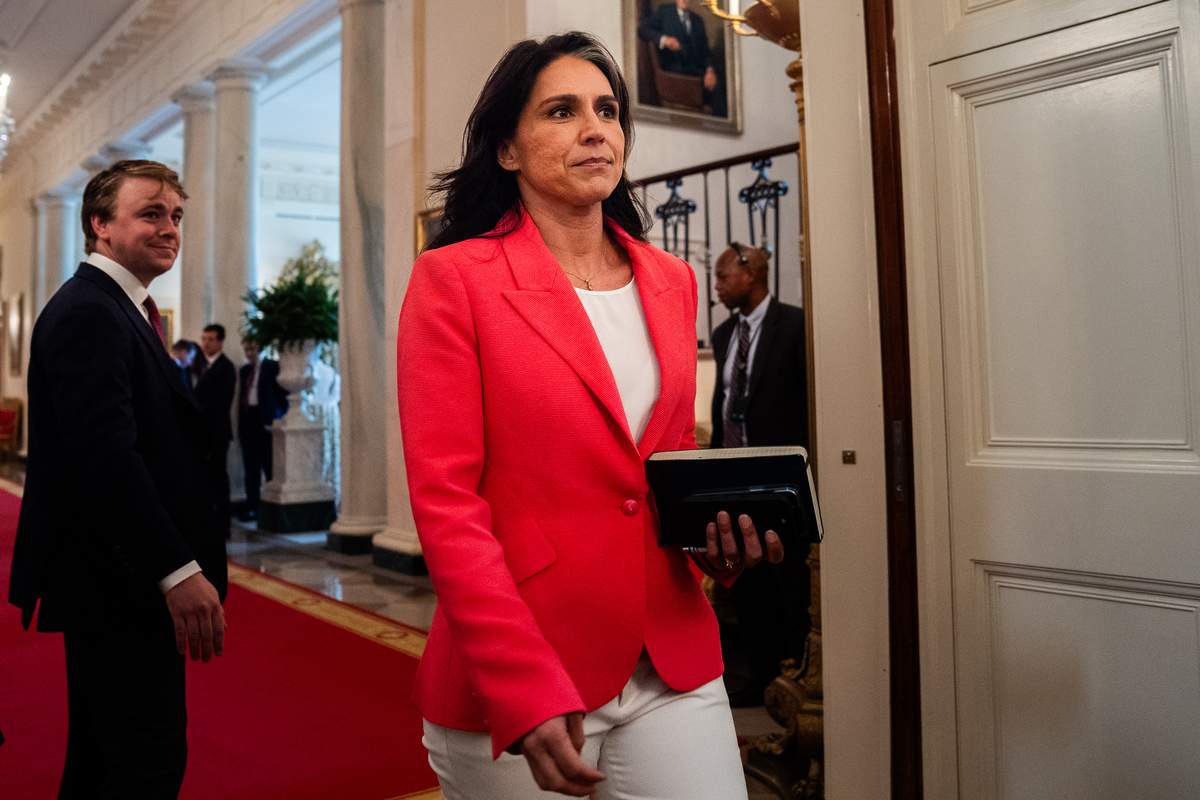
Director of National Intelligence Tulsi Gabbard in August at the White House.
12:08 JST, October 25, 2025
The top Democrats on the House and Senate intelligence committees demanded details of U.S. spy agencies’ role in lethal attacks on drug boats in the Caribbean Sea and Pacific Ocean, complaining in a letter Friday to Director of National Intelligence Tulsi Gabbard that they have received “virtually no information” on the topic since the strikes began, despite repeated requests.
In the letter, Rep. Jim Himes (D-Connecticut) and Sen. Mark R. Warner (D-Virginia) questioned whether lawyers at U.S. spy agencies have weighed in on the legality of the attacks, which critics say violate U.S. and international law.
“To the extent that [intelligence] personnel are assisting DOD activities in this space, they must do so knowing that they are supporting legally authorized operations,” the pair wrote to Gabbard, referring to intelligence support on Pentagon-conducted strikes.
Little is known publicly about the role of the CIA and its sister agencies in the 10 strikes, which are conducted by U.S. Special Operations forces on boats the Trump administration says are ferrying drugs for narcotics traffickers. Various spy agencies are contributing intelligence, according to current and former U.S. officials.
The publicly disclosed attacks have killed at least 40 people, according to the administration. The operations, which began in the Caribbean in early September, expanded this week to the eastern Pacific.
CIA personnel are part of a Pentagon-led group tracking drug boats in the Caribbean but are not involved in decisions about which targets are to be struck, said two former U.S. officials with knowledge of the matter who, like others, spoke on the condition of anonymity to discuss sensitive operations.
President Donald Trump has authorized the CIA to conduct covert operations in Venezuela, escalating the pressure on President Nicolás Maduro amid a U.S. military buildup in the Caribbean.
Himes and Warner said the congressional intelligence committees, which are supposed to keep tabs on secretive spy agencies, have not been given information on key topics. That includes which agencies are providing support for the boat strikes, how many resources and personnel are dedicated to the topic, and whether they are collecting and analyzing intelligence in the strikes’ aftermath to determine the type and quantity of drugs that may have been aboard the boats.
“This is a clear violation of the legal obligation to keep the intelligence committees fully and currently informed,” they wrote.
Gabbard’s office did not immediately respond to a request for comment.
Trump has suggested repeatedly in recent days that he may order armed strikes on land-based targets within Venezuela. He has sent conflicting signals about whether he would first notify Congress or seek its approval.
On Thursday, he appeared to rule out seeking approval for future military action. “I don’t think we’re going to necessarily ask for a declaration of war,” he told reporters. “I think we’re just going to kill people that are bringing drugs into our country.”
He did say he would notify Congress before undertaking any operations on land. “We’re going to tell them what we’re going to do and I think they’ll probably like it, except for the radical left lunatics,” Trump said.
Trump has claimed the authority to conduct drug strikes, notifying Congress that the United States is engaged in a “non-international armed conflict” with drug cartels that it has designated as terrorist organizations and that pose a national security threat.
The White House has declined to release – or so far share with Congress – an opinion by the Justice Department’s Office of Legal Counsel that the administration says provides legal justification for the strikes.
Earlier this month, a senior Pentagon lawyer nominated to be the Army general counsel, Charles L. Young, told the Senate Armed Services Committee that the opinion was written by a “working group” of lawyers from the CIA, White House, Pentagon and State departments. He told the lawmakers it was not in his “discretion” to release it, and only the president could do so.
In an interview, Himes said he had not heard directly from CIA officials about any legal concerns. “I personally have extreme misgivings in the absence of any facts or arguments from the administration,” he said.
The lawmakers’ letter comes amid questions about the extent to which military and intelligence operators, or lawyers and commanders involved in the strikes, could have any legal exposure. One aide to a Democratic member of the Senate Armed Services Committee told The Washington Post that committee staff have been “hearing from inside the Pentagon that individuals have been raising liability issues.”
Some junior officers have asked military lawyers, known as judge advocates general or JAGs, for written sign-off before taking part in strikes, said two people familiar with the matter. It does not appear that such memos were furnished, said one of the people.
Todd Huntley, a former Navy JAG who heads the National Security Law program at Georgetown University, said those most exposed legally from a practical standpoint are probably military commanders or civilians in the chain of command who have approved strikes or targets and might be named in a prosecution brought in another country.
Another national security law expert, Mark Nevitt, an associate law professor at Emory University and a former Navy JAG, said international criminal prosecution is “highly, highly unlikely.” He pointed out that the U.S. is not a party to the International Criminal Court, and while some countries could try to bring charges under their domestic laws, they are not likely to succeed.
Congress, Nevitt said, must push back “forcefully on illegal orders” and make clear that the president cannot treat criminal suspects as combatants.
The concerns about the strikes’ legality are compounded by the fact that career military and civilian lawyers in the Defense Department and lawyers at other agencies who might otherwise be involved in the deliberations have left government or been excluded from the discussions. At the White House, the entire National Security Council legal team – about half a dozen lawyers – has been emptied out as personnel ended their assignments and they were not replaced.
They include Paul Ney Jr., a former Pentagon general counsel who served briefly as NSC legal adviser and was let go in a mass purge in May as part of an effort to downsize the NSC. Lawyers at the NSC, State Department, Justice Department and the Pentagon earlier this year questioned the legal basis for military strikes on cartels without authorization from Congress, and for a while were able to forestall action, according to several people familiar with the matter.






Most Read
Popular articles in the past 24 hours
-

My Spendthrift Mother Constantly Asks Me for Money
-

Japanese Students Use Traditional Pickle to Create Novel Wagashi ...
-

‘Dry Bonsai’ Gives New Life to Withered Trees, Allows Free Artist...
-

McDonald's Japan Raises Prices; Big Mac to Cost ¥500, Double Chee...
-

Nepal Bus Crash Kills 19 People, Injures 25 Including One Japanes...
-

Astellas Collaborates with Vir to Develop Its Experimental Prosta...
-

Japan’s Nikkei Stock Average Rises as AI-Related Stocks Shine; Co...
-

Early-Blooming Kawazu Cherry Blossoms Create Sea of Pink at Park ...
Popular articles in the past week
-

Producer Behind Pop Group XG Arrested for Cocaine Possession
-

Japan PM Takaichi’s Cabinet Resigns en Masse
-

Sanae Takaichi Elected Prime Minister of Japan; Keeps All Cabinet...
-

Japan's Govt to Submit Road Map for Growth Strategy in March, PM ...
-

Bus Carrying 40 Passengers Catches Fire on Chuo Expressway; All E...
-

U.S. Firm to Build Training Hub in Fukushima N-plant for Debris R...
-

Japan, U.S. Name 3 Inaugural Investment Projects; Reached Agreeme...
-

Riku-Ryu Pair Wins Gold Medal: Their Strong Bond Leads to Major C...
Popular articles in the past month
-
Producer Behind Pop Group XG Arrested for Cocaine Possession
-
Japan PM Takaichi’s Cabinet Resigns en Masse
-

Japan Institute to Use Domestic Commercial Optical Lattice Clock ...
-

Man Infected with Measles Reportedly Dined at Restaurant in Tokyo...
-

Israeli Ambassador to Japan Speaks about Japan’s Role in the Reco...
-

Videos Plagiarized, Reposted with False Subtitles Claiming ‘Ryuky...
-

Man Infected with Measles May Have Come in Contact with Many Peop...
-

Prudential Life Insurance Plans to Fully Compensate for Damages C...
Top Articles in News Services
-
Survey Shows False Election Info Perceived as True
-
Hong Kong Ex-Publisher Jimmy Lai’s Sentence Raises International Outcry as China Defends It
-
Japan’s Nikkei Stock Average Touches 58,000 as Yen, Jgbs Rally on Election Fallout (UPDATE 1)
-
Japan’s Nikkei Stock Average Falls as US-Iran Tensions Unsettle Investors (UPDATE 1)
-
Trump Names Former Federal Reserve Governor Warsh as the Next Fed Chair, Replacing Powell
JN ACCESS RANKING
-
Producer Behind Pop Group XG Arrested for Cocaine Possession
-
Japan PM Takaichi’s Cabinet Resigns en Masse
-
Japan Institute to Use Domestic Commercial Optical Lattice Clock to Set Japan Standard Time
-
Man Infected with Measles Reportedly Dined at Restaurant in Tokyo Station
-
Israeli Ambassador to Japan Speaks about Japan’s Role in the Reconstruction of Gaza