
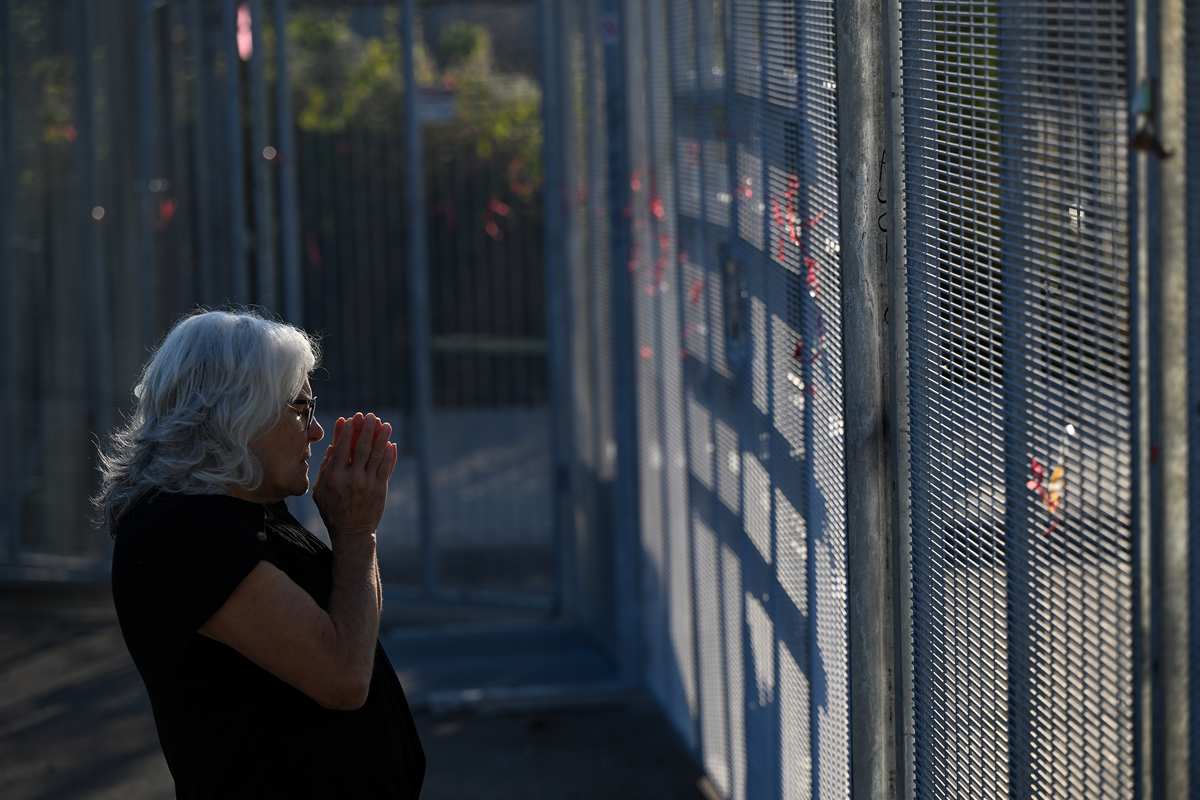
A woman prays outside the Immigration and Customs Enforcement facility in Broadview, Illinois, on Sept. 30.
13:17 JST, October 16, 2025
BROADVIEW, Ill. – A woman handed out Taylor Swift-style friendship bracelets with a number for protesters to call if they are arrested. Other demonstrators held signs declaring “ICE out of Chicago” and “Stop this kidnapping, melt the ICE.” Several wore gas masks, just in case.
Across the street, Vince Jones, 54, sat on a foldable chair and watched as the community he has called home for 25 years once again became a national headline.
“Never in a million years would you think that we’d be getting all this attention,” he said. “It’s really not our fight. But the fight has been brought to us.”
That fight is between President Donald Trump, Illinois Gov. JB Pritzker (D) and Chicago Mayor Brandon Johnson (D). And over the last month, the feud has often played out in Broadview, a quiet suburb that is home to an Immigration and Customs Enforcement processing facility where most of those detained in “Operation Midway Blitz” are initially taken.
Since the Department of Homeland Security’s operation began in early September, Broadview has been the sight of weekly protests and clashes. Demonstrators have tried to block vehicles from entering the ICE facility. And federal agents have used tear gas, rubber bullets and at times their own hands to forcefully repel protesters and journalists. A federal judge blocked the Trump administration Thursday from deploying National Guard troops here for now, deciding that their presence, if anything, would lead to more unrest.
For the leaders and residents in this village of some 8,000 people, the chaos has taken a toll.
The Broadview Police Department has opened three criminal investigations into ICE’s alleged conduct over the past month. One of those investigations involves a CBS reporter who said a masked federal agent fired a pepper ball at her truck. She said that the attack was unprovoked and that the fumes sickened her. The department is also investigating two incidents involving a protester allegedly hit but not seriously injured by ICE vehicles, said Broadview Police Chief Thomas Mills.
DHS says that the protesters are “violent rioters” assaulting law enforcement officers and that Broadview’s leaders are choosing to “smear ICE” and launch “a bogus criminal investigation.” DHS Assistant Secretary Tricia McLaughlin said that no CBS employee was targeted and that an officer fired a pepper ball in front of the vehicle in question after directing it to stop and turn around.
Mills, who previously worked for the Chicago Police Department, said in an interview that the past few weeks have exhausted his 24-person department and pulled resources away from other responsibilities in the community, including at area schools. Days off are being canceled, and officers – many of them in their first job in law enforcement – are working 16-hour days.
“My job is to protect everyone’s First Amendment rights, but mainly, you know, it’s to protect the residents and the business owners and everyone affiliated with the village of Broadview,” he said. “Every time we have to dedicate any type of extra resources over there, it is a strain to the village.”
The village’s mayor, Katrina Thompson, described the past month as “overwhelming.” Thompson said some senior citizens living in Broadview are afraid because they grew up in the South during the civil rights movement and the violence they are seeing “brings that trauma back.” Other residents who live nearby said their children are frightened. One mother is considering moving.
Jones said he wants to know when it will stop.
“It seems like there is no end in sight – with the protests, just the whole climate,” he said Friday, as law enforcement officers watching the protesters stood nearby. “Are we supposed to go through this during the holiday season, too?”
A ‘siege’ in Broadview
Broadview lies 12 miles west of downtown Chicago and has been home to an ICE facility housed in a nondescript two-story brick building for decades. Protests have been common and have mostly consisted of prayer vigils that draw a handful of people. The facility isn’t designed to house immigrants for long periods of time; rather, it is meant to serve as an intake location where people are held for a few hours and then sent to detention centers.
When Thompson learned in late August that ICE planned to kick off a new operation the following month, she put out a letter to residents. The immigration facility in their community would be the “primary processing location” for the effort, Thompson wrote, and ICE planned to keep the building open seven days a week for 45 days.
“This effort may draw protests and demonstrations, like those seen earlier this year in Los Angeles, where property damage and assaults against law enforcement were reported,” Thompson warned. She asked for patience. “… Together, we will ensure Broadview remains a safe, thriving, and supportive community for all.”
Days after Operation Midway Blitz began, protesters – many of them not from Broadview – arrived in the village. Images of ICE and Border Patrol agents aggressively arresting not only undocumented immigrants with violent criminal backgrounds but also people who were regarded as peaceful members of the Chicagoland community had begun circulating.
Mills described the morning of Sept. 12 in a declaration he submitted as part of Illinois’ lawsuit to stop the Trump administration from deploying the National Guard. He said there were 80 to 100 protesters singing and chanting. Around 10 a.m., about 20 to 30 federal agents parked across the street and walked toward the building. The mood changed, and the protesters got louder.
“The agents were dressed in camouflage tactical gear and had masks covering their faces,” he wrote. “September 12 was the first day that I recall seeing federal agents on scene dressed in that manner. It was a very noticeable shift in my mind.”
He said some protesters stood in the driveway as ICE vehicles carrying detained migrants attempted to enter or leave. At one point, federal agents told the crowd to disperse and threatened to use chemical agents if they did not. About 30 minutes later, they deployed tear gas and pepper spray.
After that day, Mills said, the protests grew.
A week later, clashes erupted again. Kat Abughazaleh, a 26-year-old Democratic candidate running for Illinois’ 9th Congressional District, was thrown to the ground by an armed and masked federal agent outside the ICE facility, according to video footage posted on her social media. DHS accused protesters of assaulting law enforcement, throwing tear gas cans, slashing tires of cars and blocking the entrance to the building. The agency also claimed Broadview police had refused to answer “multiple calls for assistance,” which David Ormsby, a Broadview spokesperson, denied.
“The violent targeting of law enforcement in Illinois by lawless rioters is despicable and Governor JB Pritzker and Mayor Brandon Johnson must call for it to end,” McLaughlin said at the time.
But Mills, whose department has been continuously recording the area where protesters gather since Sept. 13, said ICE’s use of tear gas and pepper spray has “often been arbitrary and indiscriminate.” In his court filing, he described the agency’s use of chemical agents as “unlike anything I have seen before.”
He said that was despite the fact that, throughout the protests that month, the ICE facility continued to operate and that he was “not aware of any occasion on which an ICE vehicle was actually prevented from entering or exiting.”
Many of the protesters described excessive use of force by federal agents. The Rev. Michael Woolf, senior minister at Lake Street Church of Evanston, said he was demonstrating outside Broadview when U.S. Customs and Border Protection official Gregory Bovino, who is leading his agency’s enforcement operation in Chicago, showed up. Illinois State Police began to push people back from the curb. He said that at one point a federal agent grabbed his neck and twisted his nipple “as hard as they could.”
“This is while I’m in a clergy collar,” Woolf added.
McLaughlin responded that “officers do not twist people’s nipples or use undue force” and are “well trained in crowd control tactics.”
Broadview’s mayor wrote to ICE’s field office director, Russell Hott, in late September that the “relentless deployment” of tear gas and rubber bullets was endangering residents and harming first responders. Thompson also accused ICE of illegally placing an eight-foot-tall fence across the street in front of the building, blocking access for firefighters and creating a public hazard. DHS has contended it is needed to protect the facility.
“In effect, you are making war on my community,” she said. “And it has to stop.”
Acting ICE director Todd M. Lyons responded with a letter of his own. He said there had been “physical attempts” to breach the facility that could not be dismissed as “peaceful protest.” He said there were “direct threats” to the lives and safety of federal officers. The agency shared a video published by a conservative media outlet that captured a man yelling, “Shoot ICE.”
“The only siege in Broadview is the one being waged against the United States government,” he wrote.
A village on edge
Earlier this month, Trump authorized the activation of 300 National Guard troops against Pritzker’s wishes after heavily armed federal agents shot a woman in another Chicago community. By Thursday morning, a half-dozen of the troops were outside the Broadview facility. But hours later, U.S. District Judge April M. Perry blocked Trump from activating the soldiers.
Perry noted at a hearing that the administration’s description of the events at Broadview did not “in any way, shape or form” reflect that shared by the village’s police chief, nor Illinois State Police.
“This leaves the court in the position of making a credibility determination,” Perry said. While the judge said she didn’t doubt there had been assaults, acts of vandalism and other hostility toward DHS officials, several instances of alleged violence or criminal behavior by protesters were later dismissed by federal grand juries or their narratives undercut by judicial rulings.
“DHS’s perception of events are simply unreliable,” Perry said.
The Trump administration is challenging the ruling, but a federal appeals court said Saturday that it will not allow Trump to deploy the National Guard in Illinois.
A day after Perry’s ruling, about 100 people gathered outside the ICE facility again. In interviews, protesters cited different motivations. Jim Bloyd, a 65-year-old retired public health worker, said he found ICE’s actions “shocking and unconscionable” and described them as “abducting” neighbors and family members. Nancy Goodman, 72, a retired museum exhibit developer, said she wanted to protest immigration detention and the administration’s “poor treatment of migrants.”
“This village is an unwilling victim, and they’ve been very open to letting the protests happen,” Goodman said, while carrying a sign that said “Close ICE Concentration Camps.”
Brandon Lee, a spokesperson for the Illinois Coalition for Immigrant and Refugee Rights, said he believes Broadview has become such a flash point in part because “there aren’t many sites where you can physically protest ICE.”
ICE’s use of the facility has changed during Operation Midway Blitz, but government figures obtained by the Deportation Data Project show that shift had begun even before surge teams arrived in Chicago. Immigrants have been staying at Broadview for longer periods of time since Trump took office again in January. On average, people spent nearly 11 hours there this year through the end of July – almost twice as long as those who were processed at the facility last year.
The data shows a sizable number of people have been sent to Broadview for even longer periods of time. Last year, 88 people stayed at Broadview for 12 hours or more. That number has ballooned to more than 800 since Jan. 20. In June, 77 people stayed at Broadview for at least three days. More recent figures are not available.
“It’s a processing center. Under their own policies it’s intended to be 12 hours or less,” said Mark Fleming, associate director of federal litigation for the National Immigrant Justice Center. “They don’t have medical. … There’s no beds, there’s no food service, and so that’s just started to cause really, really significant harm to immigrants.”
McLaughlin said that in late June ICE began permitting the use of “hold rooms” for up to 72 hours and that such facilities are operated in compliance with national detention standards. She said “any claim there are subprime conditions” is false.
Residents in the Broadview area say they are ready to give up their front-row ticket to ICE’s surge in Chicago. The village’s mayor lamented seeing a recent photo of one protester on his car’s sunroof with a case of beer. She also worries about the trash people are leaving behind. Jones, who was watching the protest on Friday, said he and his neighbors are in disbelief. Relatives living in other parts of the country call to say they’ve seen Broadview on the news.
“It’s unbelievable that a community of 8,000 could be on the national stage for something like this,” he said. “When is it going to stop?”





Most Read
Popular articles in the past 24 hours
-

My Spendthrift Mother Constantly Asks Me for Money
-

Japanese Students Use Traditional Pickle to Create Novel Wagashi ...
-

‘Dry Bonsai’ Gives New Life to Withered Trees, Allows Free Artist...
-

McDonald's Japan Raises Prices; Big Mac to Cost ¥500, Double Chee...
-

Nepal Bus Crash Kills 19 People, Injures 25 Including One Japanes...
-

Astellas Collaborates with Vir to Develop Its Experimental Prosta...
-

Japan’s Nikkei Stock Average Rises as AI-Related Stocks Shine; Co...
-

Early-Blooming Kawazu Cherry Blossoms Create Sea of Pink at Park ...
Popular articles in the past week
-

Producer Behind Pop Group XG Arrested for Cocaine Possession
-

Japan PM Takaichi’s Cabinet Resigns en Masse
-

Sanae Takaichi Elected Prime Minister of Japan; Keeps All Cabinet...
-

Japan's Govt to Submit Road Map for Growth Strategy in March, PM ...
-

Bus Carrying 40 Passengers Catches Fire on Chuo Expressway; All E...
-
U.S. Firm to Build Training Hub in Fukushima N-plant for Debris R...
-

Japan, U.S. Name 3 Inaugural Investment Projects; Reached Agreeme...
-

Riku-Ryu Pair Wins Gold Medal: Their Strong Bond Leads to Major C...
Popular articles in the past month
-
Producer Behind Pop Group XG Arrested for Cocaine Possession
-
Japan PM Takaichi’s Cabinet Resigns en Masse
-

Japan Institute to Use Domestic Commercial Optical Lattice Clock ...
-

Man Infected with Measles Reportedly Dined at Restaurant in Tokyo...
-

Israeli Ambassador to Japan Speaks about Japan’s Role in the Reco...
-

Videos Plagiarized, Reposted with False Subtitles Claiming ‘Ryuky...
-

Man Infected with Measles May Have Come in Contact with Many Peop...
-

Prudential Life Insurance Plans to Fully Compensate for Damages C...
Top Articles in News Services
-
Survey Shows False Election Info Perceived as True
-
Hong Kong Ex-Publisher Jimmy Lai’s Sentence Raises International Outcry as China Defends It
-
Japan’s Nikkei Stock Average Touches 58,000 as Yen, Jgbs Rally on Election Fallout (UPDATE 1)
-
Japan’s Nikkei Stock Average Falls as US-Iran Tensions Unsettle Investors (UPDATE 1)
-
Trump Names Former Federal Reserve Governor Warsh as the Next Fed Chair, Replacing Powell
JN ACCESS RANKING
-
Producer Behind Pop Group XG Arrested for Cocaine Possession
-
Japan PM Takaichi’s Cabinet Resigns en Masse
-
Japan Institute to Use Domestic Commercial Optical Lattice Clock to Set Japan Standard Time
-
Man Infected with Measles Reportedly Dined at Restaurant in Tokyo Station
-
Israeli Ambassador to Japan Speaks about Japan’s Role in the Reconstruction of Gaza