
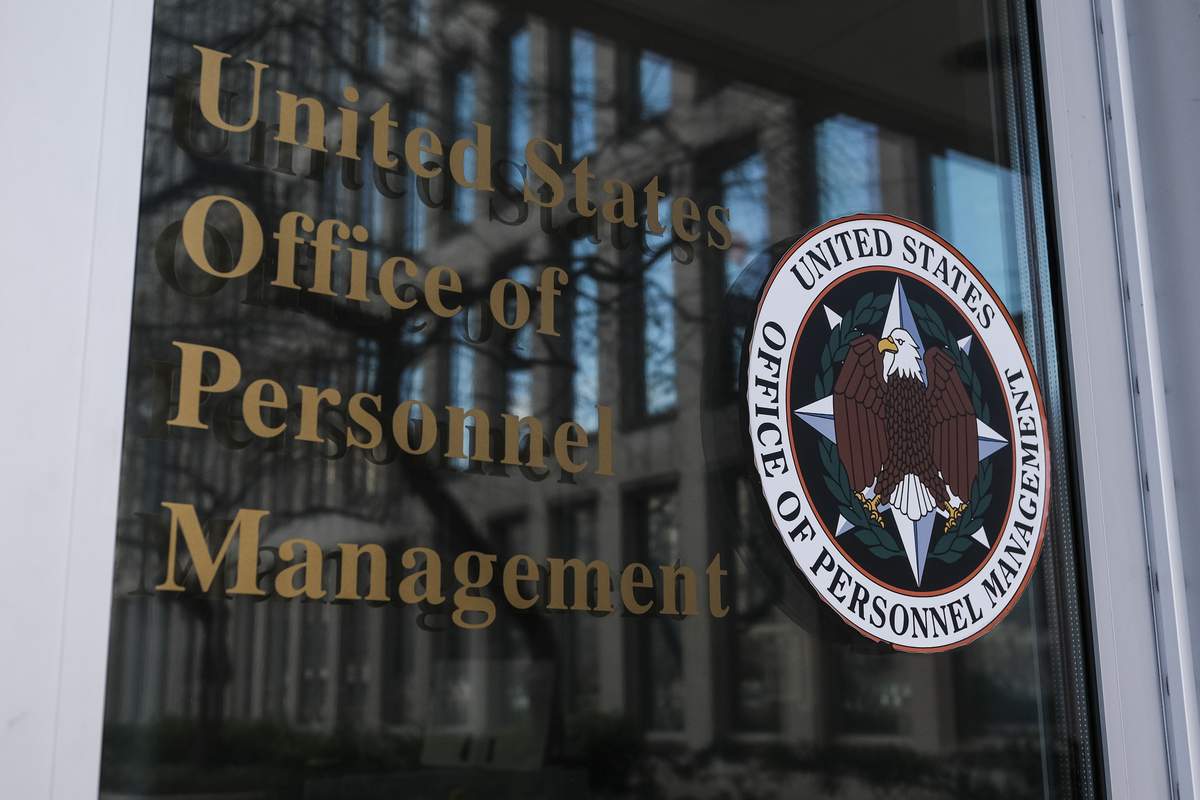
The Office of Personnel Management has a growing backlog amid a reduced workforce.
15:43 JST, October 14, 2025
A historic wave of retirements and other departures has swept through the federal workforce in recent months, putting enormous strain on agencies as they cope with a new government shutdown and administration layoffs.
This mass exodus – unprecedented in its scale – includes 154,000 federal employees who accepted buyout offers and were largely removed from the payroll as of the end of last month. Some of those are among nearly 105,000 employees who took regular retirement during the fiscal year that ended in September, an 18 percent surge from the previous year.
Tens of thousands of the cases are still awaiting processing, creating a crisis for already understaffed human resources offices across the government and the Office of Personnel Management.
With a significantly reduced workforce of its own, OPM has a growing backlog and worsening wait times, raising alarms about the government’s ability to smoothly handle this unprecedented personnel shift, according to documents and interviews with HR representatives and departed federal workers.
Complicating the efforts, the government shutdown that began on Oct. 1 has furloughed some workers who handle paperwork and payroll, meaning the departing employees who would be receiving their documentation and final annuity payments around this time are experiencing further delays, according to documents and workers.
OPM Director Scott Kupor said in an interview with The Washington Post that he remains optimistic about his agency’s ability to get through the backlog. He said that OPM is in touch with other agencies about how to streamline the process and that HR workers at other agencies will be detailed to his office to help with the workload.
“I’m excited about the work we’re doing, but the reality is, as you know, is there is a big volume that’s coming in a short period of time, and so we’re going to have to do everything we can to make sure that we continue to invest in those efforts that are going to significantly improve the efficiency of the process,” Kupor said.
The agency said it is processing more than 35,000 retirements. In the last fiscal year, OPM processed 104,800 immediate retirement cases, compared with 88,608 the year prior.
In the spring, OPM’s retirement processing times initially stayed under 50 days after Elon Musk’s U.S. DOGE Service offered all federal employees the option to take a buyout in February. But the wait time in recent months has surged to 76 days as of September.
Kupor said he doesn’t anticipate the government shutdown further delaying processing times because OPM’s retirement services division is considered essential staff. However, some agencies’ HR offices have warned that it could slow down final payments.
One federal worker who took a buyout to leave the U.S. International Development Finance Corporation was told before the shutdown that they should not expect annuity payments as long as the shutdown continued.
“While the backlog at OPM means delays in adjudicating/finalizing the annuity and reduced payments in the interim, the shutdown will mean further delays,” an email from the agency’s HR office said.
Emails obtained by The Post show that agencies’ in-house HR offices are themselves struggling to handle personnel issues.
One letter sent to a retiring National Institutes of Health employee in July noted that a “high volume” of retirement cases among other issues meant that processing would be delayed. “To stay focused … our office temporarily paused outgoing communications,” the letter stated.
And within the General Services Administration, workers who were supposed to be fired in March were left lingering on paid administrative leave for half a year because “HR was too overwhelmed … to process their layoffs,” according to an employee there, who like some others spoke on the condition of anonymity to discuss matters they were not authorized to speak about publicly.
OPM has also moved toward fully digitizing the retirement process for government workers, which has long been done through extensive paperwork. After Musk’s DOGE highlighted a Pennsylvania mine where the government has stored its retirement records since 1960, OPM appointees have made it a priority to end the practice of keeping paper records of retirements.
The agency rolled out a new system called the Online Retirement Application, though it did so as thousands of federal workers were already in the process of retiring. Several workers described how they had to start over after already filling out paperwork.
Rob Shriver, a former OPM director in the Biden administration, said the agency was developing the online system when he was there and had not yet automated where documentation is stored. He said the agency required more staffing to build that infrastructure and handle more retirement claims, and he expressed concern that the staffing cuts have complicated those efforts.
Shriver, who leads Democracy Forward’s Civil Service Strong – which hosts town halls and webinars for federal workers – said he often hears complaints about the customer service experience and wait times.
“We heard real concerns from folks about when they would be getting their annuity, when they would get a correct annuity calculation. They weren’t hearing anything,” Shriver said. “They were trying to get answers from OPM, and they just weren’t able to get through.”
Kupor said that distributing payments has been a priority for the agency, and more departing workers are getting part of their payments earlier. About 75 percent of workers are now getting automatic interim pay while they wait for their claim to be processed, up from 50 percent, Kupor said.
The government is spending about 16 percent more on federal employee retirements so far this year compared with last year, according to the Penn Wharton Budget Model using daily Treasury Department statements.
OPM itself is also shedding workers. Kupor said the agency is down about one-third from its more than 3,000 employees on Jan. 20 – mostly through deferred resignations, early retirements or other buyouts.
Departures have left remaining OPM staff bent beneath a staggering onslaught of work necessitated by the Trump administration’s rapid slashing away at government, said two employees familiar with the internal struggles.
One of the OPM employees described a chaotic, ongoing mess.
“No strategic direction, no strategic plan, statutorily required duties gone by the wayside, no backups for things people did when they left … budget questions that can’t be answered, big holes in institutional knowledge, no ability to backfill priority positions,” the employee said.
Kupor said that he thinks his staff is working “more efficiently now at lower numbers of head count.”
The second employee said OPM’s retirement services arm is answering fewer than 15 percent of calls from federal retirees and their families. “They are already telling people processing will be delayed,” the employee said. OPM said the arm remains at the same staffing level.
The agency has said it is increasingly using automated, self-service phone options to handle routine questions.
Two former federal workers who left government service this year said they have found it difficult to reach OPM.
One of them, Jessica Bradley Rushing, left a job at the State Department this year – twice. In March, she chose to take the Trump administration’s deferred resignation offer, which meant she would be paid through Sept. 30, her exit date. Then in July, she was suddenly fired and told her last day was Sept. 9, she said.
Over the summer, Bradley Rushing tried repeatedly to reach OPM – among several other HR agents and offices she thought could help – to figure out what was happening. It took two months and at least a half dozen emails before she heard back: The firing was a mistake, and she would be paid through the end of September after all.
“They finally confirmed it … the day before the RIF separation date,” she said. “I’m just so disappointed and disgusted with how it all went.”
A former FDA scientist who also resigned this year faced similar challenges reaching a human being at OPM, he said. The scientist, who spoke on the condition of anonymity for fear of retribution, retired after his agency refused to let him work remotely despite a doctor’s letter saying in-person attendance posed a health risk.
He had a lot of questions about why his pension payments were slow in coming and how much they would total. He began calling OPM to get answers, he said. But no one picked up, he said – instead, he was greeted with a tinny recording telling him the agency was busy and that he should try again later.
Sometimes, he accepted a callback option, then waited hours, he said. After more than five attempts, he finally secured someone for a conversation – only to find it unhelpful.
“The first rep I talked with couldn’t answer any questions,” he said. “I called on another day and finally got someone who knew what they were doing and answered my questions.”
The two employees said they cannot imagine how their agency is going to fare with the current wave of cases. “It will be a huge burden,” one said.









Most Read
Popular articles in the past 24 hours
-

My Spendthrift Mother Constantly Asks Me for Money
-

Japanese Students Use Traditional Pickle to Create Novel Wagashi ...
-

‘Dry Bonsai’ Gives New Life to Withered Trees, Allows Free Artist...
-

McDonald's Japan Raises Prices; Big Mac to Cost ¥500, Double Chee...
-

Nepal Bus Crash Kills 19 People, Injures 25 Including One Japanes...
-

Astellas Collaborates with Vir to Develop Its Experimental Prosta...
-

Japan’s Nikkei Stock Average Rises as AI-Related Stocks Shine; Co...
-

Early-Blooming Kawazu Cherry Blossoms Create Sea of Pink at Park ...
Popular articles in the past week
-

Producer Behind Pop Group XG Arrested for Cocaine Possession
-

Japan PM Takaichi’s Cabinet Resigns en Masse
-

Sanae Takaichi Elected Prime Minister of Japan; Keeps All Cabinet...
-

Japan's Govt to Submit Road Map for Growth Strategy in March, PM ...
-

Bus Carrying 40 Passengers Catches Fire on Chuo Expressway; All E...
-

U.S. Firm to Build Training Hub in Fukushima N-plant for Debris R...
-

Japan, U.S. Name 3 Inaugural Investment Projects; Reached Agreeme...
-

Riku-Ryu Pair Wins Gold Medal: Their Strong Bond Leads to Major C...
Popular articles in the past month
-
Producer Behind Pop Group XG Arrested for Cocaine Possession
-
Japan PM Takaichi’s Cabinet Resigns en Masse
-

Japan Institute to Use Domestic Commercial Optical Lattice Clock ...
-

Man Infected with Measles Reportedly Dined at Restaurant in Tokyo...
-

Israeli Ambassador to Japan Speaks about Japan’s Role in the Reco...
-

Videos Plagiarized, Reposted with False Subtitles Claiming ‘Ryuky...
-

Man Infected with Measles May Have Come in Contact with Many Peop...
-

Prudential Life Insurance Plans to Fully Compensate for Damages C...
Top Articles in News Services
-

Survey Shows False Election Info Perceived as True
-
Hong Kong Ex-Publisher Jimmy Lai’s Sentence Raises International Outcry as China Defends It
-
Japan’s Nikkei Stock Average Touches 58,000 as Yen, Jgbs Rally on Election Fallout (UPDATE 1)
-
Japan’s Nikkei Stock Average Falls as US-Iran Tensions Unsettle Investors (UPDATE 1)
-

Trump Names Former Federal Reserve Governor Warsh as the Next Fed Chair, Replacing Powell
JN ACCESS RANKING
-
Producer Behind Pop Group XG Arrested for Cocaine Possession
-
Japan PM Takaichi’s Cabinet Resigns en Masse
-
Japan Institute to Use Domestic Commercial Optical Lattice Clock to Set Japan Standard Time
-
Man Infected with Measles Reportedly Dined at Restaurant in Tokyo Station
-
Israeli Ambassador to Japan Speaks about Japan’s Role in the Reconstruction of Gaza