
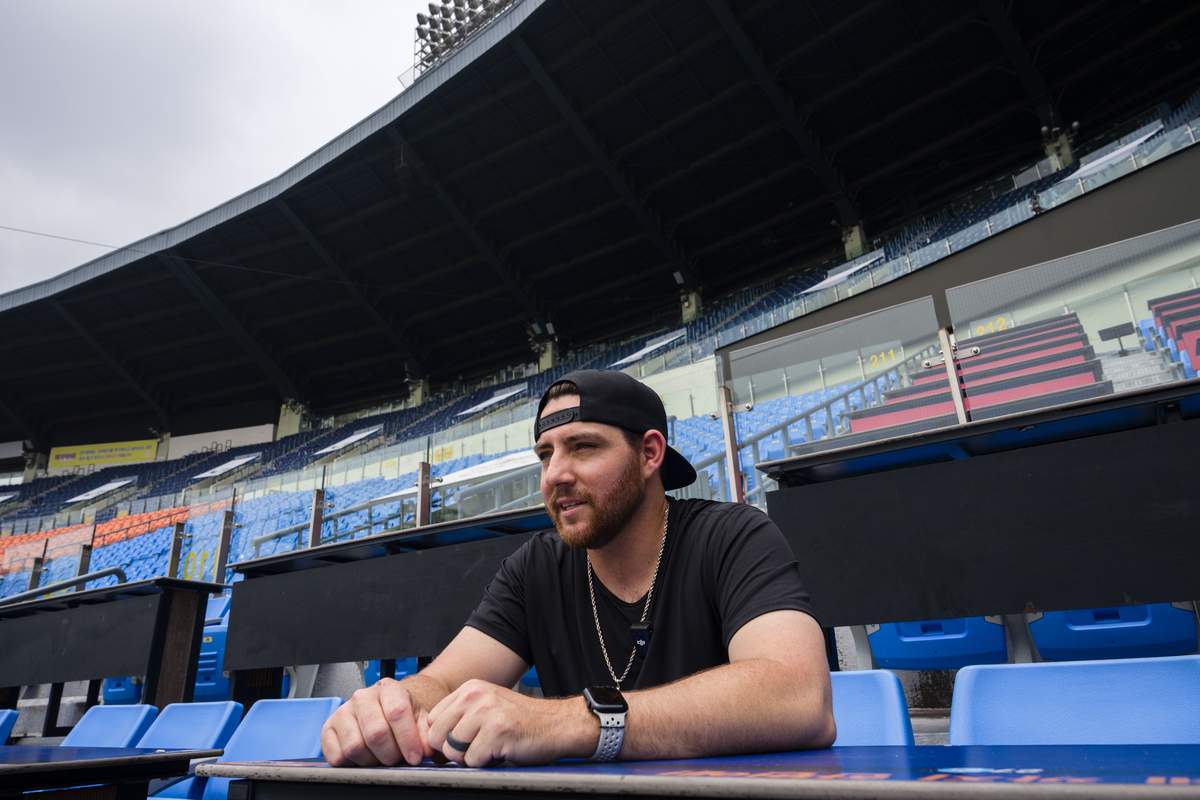
Austin Dean, first baseman for the LG Twins of the KBO League, looks out from the stands of Jamsil Baseball Stadium in Seoul on July 7.
15:03 JST, October 13, 2025
SEOUL – Back home, Dustin Nippert threw a hard fastball and had a promising career but couldn’t quite stick in the major leagues. As an outfielder, Austin Dean was up and down from Class AAA to the majors. Jameel Warney was a center with solid post moves but wasn’t a good fit for the NBA.
All three left the United States for South Korea to keep their professional sports careers alive. They’ve each had several successful seasons, won championships and earned awards.
“My wife and son, we love it here,” said Dean, a first baseman for the LG Twins of the Korea Baseball Organization. “We love Seoul. It’s just been really different from what it would be like in the States. It’s just been a really amazing time.”
That “amazing” life abroad is not without its challenges, said Younghan Cho, a professor of Korean studies at Hankuk University of Foreign Studies in Seoul, who has published widely on global sports, fans and celebrity.
“Foreign players are often seen as mercenaries, and if they don’t achieve immediate success or suffer an injury, they face the pressure of immediate dismissal,” Cho wrote in an email. Overseas athletes have to overcome not only the geographical distance from their home country but also racial and cultural differences, he added.
But Nippert, Dean and Warney say that with a little open-mindedness and some patience with the culture, life as a foreign athlete can be a good one.
Pitching deity
South Korean fans called him “Ni-neunim,” Korean shorthand for “Nippert God” – and no wonder, as the 44-year-old is in consideration for the most successful foreign player in KBO history.
Nippert played eight seasons in South Korea, all but one with the Doosan Bears. He retired in 2018 with a record of 102-51; he was the first foreign pitcher to win 100 games. The 6-foot-8, hard-throwing right-hander helped the Bears win the Korean Series championship in 2015, and he became just the fourth foreign player in KBO history to win the league MVP award in 2016.
Nippert said his hometown of Beallsville, Ohio, isn’t a one-stoplight town; it’s a one-stop-sign town. When he got to Asia, he didn’t know how to use chopsticks. He said the other players teased him, asking him whether he needed a fork.
Nippert first credits his success to his teammates, then to his openness to the culture and life abroad. He watched several teammates from overseas arrive in Asia and expect special treatment because they had played in the major leagues.
“Those guys are out within a couple months,” Nippert said. “The guys who are successful are open-minded. They’re willing to make adjustments to play here.”
The nature of the role – one of three foreign players allowed on the team, capped by league rules – created its own pressure. He was brought over with the expectation that he would help the team win immediately. “If you perform well, they’re going to take care of you,” Nippert said.
He was successful enough that he maintains a presence in South Korean culture, including appearances on TV programs, such as the hit Netflix series “Physical: 100.” Sometimes, people stop him and say they recognize him from TV. He reminds them he was once a baseball player.
Despite all of this success, and perhaps in small part because of it, Nippert still wonders whether he could have had more of a major league career.
“I’d be lying if I didn’t say I had regrets of not trying to go back to the States,” he said. He pointed to the upward trajectory of the careers of other KBO players who returned to the United States to play, including pitchers Merrill Kelly and Erick Fedde.
Loyalty kept him here. “In my mind, if the team took care of me, then I’m not going to leave them,” Nippert said.
Today, he owns and operates a baseball academy in a Seoul suburb, where he coaches children aged 6 and up. He has two boys, Levi and Owen, with his second wife, a Korean national. He said the boys, who are often Dad’s interpreter, are as interested in netting dragonflies and grasshoppers as they are in catching pop flies.
Nippert owns land in Kentucky and Ohio, and he has plans to develop a cattle farm. His goal is to keep his business in South Korea while allowing his family to experience the rural life of his childhood. He hopes his sons can continue to share time on both continents.
“They’re Korean American,” Nippert said. “I always want them to understand this is where they come from and this is also part of their life.”
South Korea has been good to him, and he has made a life for himself and his family. “If people are thinking about coming to Korea, just do it,” Nippert said. “If you’re a player and you’re thinking about playing here, or you might want to come here with your family, do it. It’s a great experience.”
Big in Korea
Dean, 31, was raised in the Houston area and had some success in MLB. Drafted by the Miami Marlins in the fourth round in 2012, he also played for the St. Louis Cardinals and the San Francisco Giants. But his career in the States never caught fire, always up and down between Class AAA and the majors. After signing with the LG Twins, he’s now on his third annual contract with the team – each worth well over $1 million.
Before he came over, his agent talked with him and said this could be “a once-in-a-lifetime experience.”
“He goes, ‘If you hate it, you don’t have to do it again,’” Dean said. “And it ended up being one of the best decisions I’ve ever done. It made me fall in love with baseball all over again.”
Playing in the KBO League has been his big league experience, he added. “I’ve loved every second of being here.”
In 2023, Dean, a stocky 6 feet tall, helped the Twins prevail in the Korean Series, the country’s equivalent to the World Series; won a Golden Glove, the award given to the best overall player at each position; and made the all-star team. Last year, he set the franchise record for RBI with 132 and won another Golden Glove as well as a spot as an all-star. The Twins finished atop the KBO standings this year to secure a spot in the Korean Series.
Undersized for the U.S. infield, Dean played outfield before he came over. His manager in South Korea soon recognized that his stature and skills translated well to playing first base in the KBO’s small-ball style of play, with a lot of bunting and base stealing and a slower pace.
“I love being over there,” Dean said. “You’ve got to stay engaged in every play.”
Overall, the country has surprised him. “We didn’t know what we were getting ourselves into,” said Dean, who has been impressed by how developed South Korea is.
Compared with the Houston area, he said he feels much safer when he’s with his family. He can go outside with his wife and son even late at night and doesn’t have to keep checking over his shoulder.
“Just the safety aspect of it, which is just so sad to say about our home country,” Dean said.
Life bonds
Arguably, the best foreign player in the Korean Basketball League for several years has been Seoul SK Knights center Warney. The 31-year-old big man has earned MVP honors among foreign players four times during his six-year career here.
At 6-foot-8, the Plainfield, New Jersey, native may have been considered too small to play as a center in the NBA. In the KBL, he dominates. Warney took the Knights to a championship in 2022. This year, he topped the league in scoring and helped his team to the finals, where it lost to the Changwon LG Sakers in a seven-game series.
Compared with stints in the NBA G League – the development circuit where most players are trying to advance to the next level – where Warney said there’s little to no team chemistry, he has enjoyed playing for the Knights.
“The people who come here want to win a championship,” he said. “It’s their end goal.”
In the G League, he recalled that sometimes 300 people would show up; the Knights can play in front of 8,000 fans or more.
“We’re their guys. We’re their superstars,” he said.
Also, the pay is good. Warney had announced his retirement after the 2024-25 season, but after returning to the negotiating table, he decided to re-sign with the Knights for 2025-26 on a $700,000 contract that makes him the league’s highest-paid player.
“They gave me an offer that was very hard to refuse,” Warney said.
Off the hardwood, he said he made it through the initial period of loneliness and isolation that comes with living as a foreigner. His first season was at the start of the coronavirus pandemic, when he was forced to quarantine, and the country eventually imposed strict social distancing rules and the bars and restaurants closed at 9 p.m.
Warney said that the longer he has spent here, the more the country has opened up to him. He found his favorite coffee shops and places he likes.
High on the list are Itaewon – the Seoul district famous for its international flavor – and the Everland amusement park near his home in Yongin, a satellite city outside the capital. He’s not too tall to go on the rides, but sometimes he gets a whole bench to himself.
He bought a Ford Taurus, and although South Korea has efficient public transportation, he finds that driving has expanded his life.
“I figured out who I am here,” Warney said. “I know the things I like to do here. It took a long time to realize that this is my new home – or my second home.”
Koreans believe in the concept of “jeong,” which loosely means a bond formed over shared experiences. Warney said he feels jeong with his friends here.
“We built a lot of relationships,” he said. “When they really like you and feel indebted to you, they’ll do anything for you.”
The same goes for the fans.
“They send you messages every day telling you they love you and to keep playing hard,” Warney said. “They always have your back. Those messages really help you when you’re in a down moment, when you’re missing home. It reminds you that you have a little nice family around here, too, that can help you through the dark times.”








Most Read
Popular articles in the past 24 hours
-

My Spendthrift Mother Constantly Asks Me for Money
-

Japanese Students Use Traditional Pickle to Create Novel Wagashi ...
-
‘Dry Bonsai’ Gives New Life to Withered Trees, Allows Free Artist...
-

McDonald's Japan Raises Prices; Big Mac to Cost ¥500, Double Chee...
-

Nepal Bus Crash Kills 19 People, Injures 25 Including One Japanes...
-

Astellas Collaborates with Vir to Develop Its Experimental Prosta...
-

Japan’s Nikkei Stock Average Rises as AI-Related Stocks Shine; Co...
-

Early-Blooming Kawazu Cherry Blossoms Create Sea of Pink at Park ...
Popular articles in the past week
-

Producer Behind Pop Group XG Arrested for Cocaine Possession
-

Japan PM Takaichi’s Cabinet Resigns en Masse
-

Sanae Takaichi Elected Prime Minister of Japan; Keeps All Cabinet...
-

Japan's Govt to Submit Road Map for Growth Strategy in March, PM ...
-

Bus Carrying 40 Passengers Catches Fire on Chuo Expressway; All E...
-

U.S. Firm to Build Training Hub in Fukushima N-plant for Debris R...
-

Japan, U.S. Name 3 Inaugural Investment Projects; Reached Agreeme...
-

Riku-Ryu Pair Wins Gold Medal: Their Strong Bond Leads to Major C...
Popular articles in the past month
-
Producer Behind Pop Group XG Arrested for Cocaine Possession
-
Japan PM Takaichi’s Cabinet Resigns en Masse
-

Japan Institute to Use Domestic Commercial Optical Lattice Clock ...
-

Man Infected with Measles Reportedly Dined at Restaurant in Tokyo...
-

Israeli Ambassador to Japan Speaks about Japan’s Role in the Reco...
-

Videos Plagiarized, Reposted with False Subtitles Claiming ‘Ryuky...
-

Man Infected with Measles May Have Come in Contact with Many Peop...
-

Prudential Life Insurance Plans to Fully Compensate for Damages C...
Top Articles in News Services
-

Survey Shows False Election Info Perceived as True
-
Hong Kong Ex-Publisher Jimmy Lai’s Sentence Raises International Outcry as China Defends It
-
Japan’s Nikkei Stock Average Touches 58,000 as Yen, Jgbs Rally on Election Fallout (UPDATE 1)
-
Japan’s Nikkei Stock Average Falls as US-Iran Tensions Unsettle Investors (UPDATE 1)
-

Trump Names Former Federal Reserve Governor Warsh as the Next Fed Chair, Replacing Powell
JN ACCESS RANKING
-
Producer Behind Pop Group XG Arrested for Cocaine Possession
-
Japan PM Takaichi’s Cabinet Resigns en Masse
-
Japan Institute to Use Domestic Commercial Optical Lattice Clock to Set Japan Standard Time
-
Man Infected with Measles Reportedly Dined at Restaurant in Tokyo Station
-
Israeli Ambassador to Japan Speaks about Japan’s Role in the Reconstruction of Gaza