
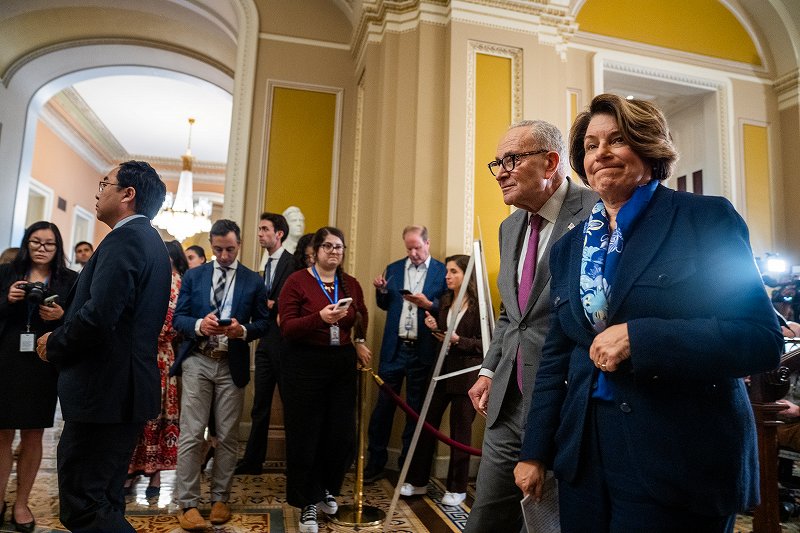
Senate Minority Leader Charles E. Schumer (D-N.Y.) and Sen. Amy Klobuchar (D-Minn.) depart after speaking with reporters on Tuesday at the Capitol.
10:36 JST, October 12, 2025
U.S. Congress’s impasse over funding the government has now left federal agencies partially shuttered for more than 10 days, with no end clearly in sight. Yet the vibes on Capitol Hill were almost standard operating procedure.
Thursday night, senators debated and voted on a defense-spending bill. Then, at 9:35 p.m., the Senate closed up shop for the week. Senators went home for the holiday weekend, with next votes slated for Tuesday evening.
And before 11 a.m. Friday, House leaders sent notice they had formally canceled legislative session next week. For the next few days, at least, the halls of Congress will be quiet.
For longtime members of Congress, from both parties, this has been a very unusual government shutdown. There has been little sense of any frantic need to resolve the matter, very few late nights in the Senate and a House that has stood defiantly closed to try to force Democrats into caving to Republican demands.
“There’s less argument about things to fight about in this shutdown than any I’ve seen, and at the same time, the least intensity about getting it resolved,” said Sen. Jerry Moran (R-Kansas).
Moran first ran for a House seat in 1996, the year congressional Republicans clashed with President Bill Clinton in a series of shutdowns over efforts to cut Medicare spending. He was a first-term senator in 2013, when the GOP battled President Barack Obama, and well into his second term in 2018 and 2019 when Democrats and President Donald Trump clashed over border issues in two shutdowns.
All of those seemed like events that completely consumed the attention of Washington, and the country.
“This shutdown makes no sense to me,” Moran said.
Voters also don’t seem worked up. Sen. Gary Peters (D-Michigan), who was in the House during the 2013 shutdown and in his first Senate term during the 2018 shutdown and 2019 partial closures, said that he is unaware of any surge in calls or emails from constituents about the shutdown.
“It doesn’t seem to be as much as what we’ve had in the past. That’s just my gut feeling,” Peters said.
Democrats with very liberal credentials report that their supporters are fired up right now, but not directly about the shuttering of some government services or the furloughed federal employees.
“The high volume of calls is around health care, people calling to say I can’t make it if the Republican cuts double my health insurance premiums,” Sen. Elizabeth Warren (D-Massachusetts) said. “So that’s what’s really driving up the volume.”
Democrats are trying to force Trump and Republicans into extending tax credits that help add millions of people to the ACA’s insurance roll, and have been very vocal about price hikes likely to result if the subsidies aren’t extended.
While some conservatives oppose any extension at all, many Republicans are open to negotiating some changes to a policy they viewed as too generous. Many Republicans say the shutdown needs to end before those negotiations can begin, but that they too want to avoid what is expected to be a massive jump in health care premiums in a few weeks.
“I think we need to do something. I mean, we can’t just, you know, sit back and say, good luck,” Sen. Josh Hawley (R-Missouri) told reporters. He has engaged in some discreet talks with Senate Democrats about how to fix the health care tax credit issue and believes it can be resolved, once Democrats agree to reopen the government.
Hawley got sworn into his first term in early January 2019, in the middle of a five-week partial shutdown. He recalled working late nights and with a growing sense of urgency, especially as unpaid air traffic security workers called out sick.
“There was sort of a crisis mentality, which doesn’t seem to be the case at the moment,” Hawley said.
With such low intensity of feelings, among lawmakers and voters, this shutdown is threatening to go on for a much longer time than previous ones. In the past, one side clearly lost in the court of public opinion and after a couple weeks would largely surrender, reopening all agencies.
So far neither side seems to have a clear edge. Most polls show Trump and Republicans getting blamed more than Democrats for the shutdown, including a Washington Post poll that put the blame at 47 percent on the GOP and 30 percent on the minority party.
Others found a little less blame for Republicans and a large bloc blaming both sides equally.
Past shutdowns saw far more legislative activity early on. Back in 2013, a little more than an hour after the shutdown started at 12:01 a.m., House Republicans held an overnight vote to fund the government. Later that day, they began holding votes to narrowly open portions of the government – one to help veterans, another to open National Parks.
They kept doing that for days and forced dozens of House Democrats to join them in voting for these popular programs, even as those bills died in the Democratic-controlled Senate. The House speaker, John A. Boehner (R-Ohio), and majority leader, Eric I. Cantor (R-Virginia), held news conferences and blitzed the media trying to shape public opinion.
Boehner forced weekend voting sessions to stress the gravity of the situation.
House Speaker Mike Johnson (R-Louisiana) has taken the direct opposite approach from the 2013 GOP leaders, believing that closing down his chamber could serve as leverage to force Senate Democrats to vote with Republicans for a funding plan up to Thanksgiving.
The House last voted the morning of Sept. 19, on a resolution honoring the slain conservative activist Charlie Kirk. Johnson has held almost daily news conferences in the Capitol, usually in the late morning, and then an hour or two later House Minority Leader Hakeem Jeffries (D-New York) usually holds a rebuttal.
The Senate has also been locked in its version of the “Groundhog Day” movie. Its members have seen a near-daily routine of dueling votes on the House-passed provision to fund the government and a Democratic alternative to fund the agencies an even shorter time, with more health care measures attached to it.
Both fail to reach the 60 votes needed to clear a filibuster, as just three members of the Democratic caucus side with Republicans, over and over.
The current schedule calls for another vote at 5:30 p.m. Tuesday on the GOP plan, which if past is prologue, will receive just 55 votes.
With failure so predictable on the funding fight, the Senate has moved on to other matters. Senators have approved dozens of presidential nominees, debated Trump’s war powers and advanced legislation to repeal some federal regulations.
On Thursday, in an odd show of bipartisan comity in these otherwise tense times, the leaders of the Senate Armed Services Committee announced a deal to move their military policy bill to the floor.
Senators voted deep into the night, past 9 p.m., on dozens of proposed amendments, and eventually approved the plan 77-20.
It was the sort of back and forth that’s been missing, so far at least, from the shutdown debate.
Peters pointed out another missing element to the intensity of this showdown: the president.
In October 2013, for example, Obama convened a meeting of the top Democratic and Republican congressional leaders on the second night of the shutdown. On the eighth day, he came to the White House briefing room to explain his conversation earlier that day with Boehner and then fielded questions from the media, among other regular events highlighting the shutdown’s impact.
A review of Trump’s daily calendar shows plenty of meetings with world leaders since the shutdown started, a trip to his golf course in Virginia, an event honoring the Navy’s 250th anniversary and a cabinet meeting.
He has not been doing events designed to push the GOP message on the shutdown, aside from a few freewheeling events where White House reporters get to ask questions on any topic. And he hasn’t spoken with Democratic leaders since a bipartisan gathering in the Oval Office Sept. 29.
That presidential distance from the shutdown has paused efforts by rank-and-file Democrats to negotiate a compromise with open-minded Senate Republicans. As Democrats know, Trump holds enormous sway over the GOP and must ultimately sign the legislation.
“Folks are wary of negotiating when you don’t know what the president’s going to do, because the Republicans are just going to rubber stamp whatever he says,” Peters said.
Peters suggested that the general public will start paying more attention, and possibly parceling out clear blame, the longer this goes on and services start to get impacted.
But Moran thinks that the public has baked in congressional dysfunction so much that voters will not really blame anyone, once the government reopens.
“I think it’s true in every shutdown when it’s over, people don’t really assign blame. They just want the government to work,” he said.








Most Read
Popular articles in the past 24 hours
-

My Spendthrift Mother Constantly Asks Me for Money
-

Japanese Students Use Traditional Pickle to Create Novel Wagashi ...
-

‘Dry Bonsai’ Gives New Life to Withered Trees, Allows Free Artist...
-

McDonald's Japan Raises Prices; Big Mac to Cost ¥500, Double Chee...
-

Nepal Bus Crash Kills 19 People, Injures 25 Including One Japanes...
-

Astellas Collaborates with Vir to Develop Its Experimental Prosta...
-

Japan’s Nikkei Stock Average Rises as AI-Related Stocks Shine; Co...
-

Early-Blooming Kawazu Cherry Blossoms Create Sea of Pink at Park ...
Popular articles in the past week
-

Producer Behind Pop Group XG Arrested for Cocaine Possession
-

Japan PM Takaichi’s Cabinet Resigns en Masse
-

Sanae Takaichi Elected Prime Minister of Japan; Keeps All Cabinet...
-

Japan's Govt to Submit Road Map for Growth Strategy in March, PM ...
-

Bus Carrying 40 Passengers Catches Fire on Chuo Expressway; All E...
-

U.S. Firm to Build Training Hub in Fukushima N-plant for Debris R...
-

Japan, U.S. Name 3 Inaugural Investment Projects; Reached Agreeme...
-

Riku-Ryu Pair Wins Gold Medal: Their Strong Bond Leads to Major C...
Popular articles in the past month
-
Producer Behind Pop Group XG Arrested for Cocaine Possession
-
Japan PM Takaichi’s Cabinet Resigns en Masse
-

Japan Institute to Use Domestic Commercial Optical Lattice Clock ...
-

Man Infected with Measles Reportedly Dined at Restaurant in Tokyo...
-

Israeli Ambassador to Japan Speaks about Japan’s Role in the Reco...
-

Videos Plagiarized, Reposted with False Subtitles Claiming ‘Ryuky...
-

Man Infected with Measles May Have Come in Contact with Many Peop...
-

Prudential Life Insurance Plans to Fully Compensate for Damages C...
Top Articles in News Services
-
Survey Shows False Election Info Perceived as True
-

Hong Kong Ex-Publisher Jimmy Lai’s Sentence Raises International Outcry as China Defends It
-
Japan’s Nikkei Stock Average Touches 58,000 as Yen, Jgbs Rally on Election Fallout (UPDATE 1)
-
Japan’s Nikkei Stock Average Falls as US-Iran Tensions Unsettle Investors (UPDATE 1)
-
Trump Names Former Federal Reserve Governor Warsh as the Next Fed Chair, Replacing Powell
JN ACCESS RANKING
-
Producer Behind Pop Group XG Arrested for Cocaine Possession
-
Japan PM Takaichi’s Cabinet Resigns en Masse
-
Japan Institute to Use Domestic Commercial Optical Lattice Clock to Set Japan Standard Time
-
Man Infected with Measles Reportedly Dined at Restaurant in Tokyo Station
-
Israeli Ambassador to Japan Speaks about Japan’s Role in the Reconstruction of Gaza