
10:15 JST, October 5, 2025
JERUSALEM – Israel paused its ground offensive in Gaza City on Saturday and prepared to send a delegation to Egypt for indirect talks with Hamas, Israeli officials said, after Hamas announced it would accept President Donald Trump’s 20-point peace plan and release all Israeli hostages, subject to conditions and negotiations.
The messages from Hamas and Israeli leaders, combined with what Israeli officials called a “reduction” in bombing to facilitate the initial step of Trump’s proposal, suggested both sides were under more pressure than at any point in recent months to reach a ceasefire. Still, there remained substantial gaps between their positions and a significant possibility that the fragile détente would break down.
Negotiations are expected to begin Monday over the fine points of Trump’s plan, which was heavily shaped by Prime Minister Benjamin Netanyahu before it was unveiled on Monday, and which Hamas says must be amended to reflect its input.
Hamas leaders have expressed a willingness to hand over hostages. They hold about 48, of whom 20 are believed to still be alive. But they have offered conflicting messages about whether they would relinquish their weapons – a step Netanyahu considers nonnegotiable and which Trump’s proposal requires.
Another sticking point could be Netanyahu’s insistence that even upon the release of all Israeli hostages, the Israel Defense Forces might not leave Gaza until concluding that other demands, including the disarmament of Hamas and overall security in Gaza, have been met. Hamas has long conditioned further hostage releases on Israel’s full withdrawal from Gaza and a permanent end to the war.
An Israeli official, speaking on the condition of anonymity to discuss internal deliberations, said Saturday that Israel had agreed only to pull back, after all hostages are released, to a “yellow line” inside Gaza that Israel inserted into Trump’s proposal. Any future steps included in Trump’s sweeping plan, which calls for the eventual, full withdrawal from Gaza and a credible pathway toward a unified Palestinian state, “will be discussed during the negotiations,” the Israeli official said.
Israel told the United States that it would demand to stay “for the coming years” in a buffer zone around the Gaza perimeter and along the Philadelphi Corridor along the enclave’s border with Egypt, the Israeli public broadcaster reported late Saturday.
Netanyahu, in an national address, reiterated that Hamas must first release all hostages while Israeli forces remained “deep inside the Gaza Strip.”
“In the second stage,” he said, “Hamas will be disarmed, and the Strip will be demilitarized. This will happen either diplomatically through Trump’s plan or militarily by us.”
Netanyahu said he hoped a deal could be reached within a few days to release all hostages.
Hamas remained vague on the points in Trump’s plan that the group sought to negotiate, but in recent days, some leaders from Hamas and other Palestinian resistance groups have likened the proposal, which was drafted by the Americans and Israelis without any Palestinian input, to a surrender.
Before the group issued its conditional acceptance of Trump’s proposal on Friday, Hamas political bureau members Khaled Mashal and Mousa Abu Marzouk, who are seen as relative moderates within the group, had to urge others to give negotiations a chance, according to an Arab official with knowledge of the discussions. Turkish President Recep Tayyip Erdogan promised Hamas leader Khalil al-Hayya in a lengthy phone call that Hamas’s views would be adequately represented in the talks, according to the official, who spoke on the condition of anonymity to discuss the sensitive talks.
Ibrahim al-Madhoun, a Gazan political analyst who is close to Hamas, said the movement widely agreed on a willingness to relinquish any role in governing Gaza. If the external Hamas political leadership agreed on disarming, he said, Izz-al-Din al-Haddad, the commander of the militant wing inside Gaza, would not resist.
“The Izz al-Din Qassam Brigades will abide by any decisions approved by the political leadership,” Madhoun said.
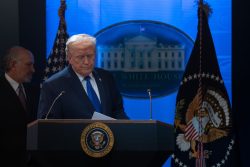
Trump welcomed Hamas’s initial acceptance on Friday night and called on Israel to “immediately” halt its bombing campaign, saying he believed that Hamas was ready to make peace. On Saturday, Trump said he “appreciated” that Israel has stopped its bombing.
But Israel continued conducting airstrikes well into Saturday, according to medical workers, residents and journalists inside Gaza. Israeli officials said the military had ordered a “reduction in the level of fire but not a full ceasefire.”
Five people were killed overnight, bringing the toll to 66 dead over the previous 24 hours, Zaher Waheidi of the Gaza Health Ministry said at midday Saturday. Hours later, an Israeli airstrike in Gaza City killed 17 people, including seven children, according to the Palestinian Civil Defense. The IDF said it “struck a Hamas terrorist” who posed a threat to its troops in the area. The IDF said it “regrets any harm caused to uninvolved civilians and works to mitigate harm to uninvolved civilians as much as possible.”
The onus is now on Netanyahu, who has said that Israel would end the war if all hostages were returned and Hamas disarmed. Israeli officials and government advisers have said in recent weeks that they did not believe Hamas would agree to either condition. But Hamas’s response on Friday, agreeing to release all hostages and asking to discuss the terms of the Israeli withdrawal, could test Netanyahu’s willingness to end the war.
“If Hamas is truly willing to release all of the hostages, then Prime Minister Netanyahu – under pressure from President Trump as well as a majority of Israelis who support the war ending on that basis – will have to decide if doing so is still a sufficient basis alone,” said Jonathan Panikoff, a Middle East analyst at the Atlantic Council.
As Israeli forces moved to what officials said was a defensive posture, Mahmoud Basal, a spokesman for Gaza Civil Defense, warned people in Gaza City against trying to move to Israeli-controlled areas, where strikes continued and emergency services could not reach. Israel this week again cut off northern Gaza from the south as it escalated its assault on the capital.
After two years of war, Palestinians in Gaza viewed the developments with pessimism. Two previous ceasefires have collapsed. When Israel broke the last one, in March, it accused Hamas of refusing to negotiate in good faith. Netanyahu ordered a more intense military campaign and a two-month siege that led to a spike in starvation deaths and what analysts called a man-made famine in parts of Gaza.
Scholars and an independent U.N. commission have called Israel’s actions during the war a genocide.
Haroun Alkarneb, a journalist who was displaced from Rafah, in the southern Gaza Strip, said he didn’t expect the current proposal to end the war.
“Many agreements have been made and, in the end, there is no seriousness in the agreement,” he said. He was skeptical Hamas would hand over all of the hostages because it would lose its bargaining power, and he doubted Israel would commit to ending its campaign.
Even if a ceasefire succeeded, he said, he had no home to return to – Israel razed his neighborhood when it took over the border city, he said.
“There is no trust, and we are tired from all the agreements failing,” he said. “Oh God, we are tired.”
– – –
Berger and Soroka reported from Tel Aviv. Suzan Haidamous and Adam Chamseddine in Beirut, Siham Shamalakh in Cairo and Hazem Balousha in Toronto contributed to this report.








Most Read
Popular articles in the past 24 hours
-

My Spendthrift Mother Constantly Asks Me for Money
-

Japanese Students Use Traditional Pickle to Create Novel Wagashi ...
-

‘Dry Bonsai’ Gives New Life to Withered Trees, Allows Free Artist...
-

McDonald's Japan Raises Prices; Big Mac to Cost ¥500, Double Chee...
-

Nepal Bus Crash Kills 19 People, Injures 25 Including One Japanes...
-

Astellas Collaborates with Vir to Develop Its Experimental Prosta...
-

Japan’s Nikkei Stock Average Rises as AI-Related Stocks Shine; Co...
-

Early-Blooming Kawazu Cherry Blossoms Create Sea of Pink at Park ...
Popular articles in the past week
-

Producer Behind Pop Group XG Arrested for Cocaine Possession
-

Japan PM Takaichi’s Cabinet Resigns en Masse
-

Sanae Takaichi Elected Prime Minister of Japan; Keeps All Cabinet...
-

Japan's Govt to Submit Road Map for Growth Strategy in March, PM ...
-

Bus Carrying 40 Passengers Catches Fire on Chuo Expressway; All E...
-

U.S. Firm to Build Training Hub in Fukushima N-plant for Debris R...
-

Japan, U.S. Name 3 Inaugural Investment Projects; Reached Agreeme...
-

Riku-Ryu Pair Wins Gold Medal: Their Strong Bond Leads to Major C...
Popular articles in the past month
-
Producer Behind Pop Group XG Arrested for Cocaine Possession
-
Japan PM Takaichi’s Cabinet Resigns en Masse
-

Japan Institute to Use Domestic Commercial Optical Lattice Clock ...
-

Man Infected with Measles Reportedly Dined at Restaurant in Tokyo...
-

Israeli Ambassador to Japan Speaks about Japan’s Role in the Reco...
-

Videos Plagiarized, Reposted with False Subtitles Claiming ‘Ryuky...
-

Man Infected with Measles May Have Come in Contact with Many Peop...
-

Prudential Life Insurance Plans to Fully Compensate for Damages C...
Top Articles in News Services
-

Survey Shows False Election Info Perceived as True
-

Hong Kong Ex-Publisher Jimmy Lai’s Sentence Raises International Outcry as China Defends It
-
Japan’s Nikkei Stock Average Touches 58,000 as Yen, Jgbs Rally on Election Fallout (UPDATE 1)
-
Japan’s Nikkei Stock Average Falls as US-Iran Tensions Unsettle Investors (UPDATE 1)
-

Trump Names Former Federal Reserve Governor Warsh as the Next Fed Chair, Replacing Powell
JN ACCESS RANKING
-
Producer Behind Pop Group XG Arrested for Cocaine Possession
-
Japan PM Takaichi’s Cabinet Resigns en Masse
-
Japan Institute to Use Domestic Commercial Optical Lattice Clock to Set Japan Standard Time
-
Man Infected with Measles Reportedly Dined at Restaurant in Tokyo Station
-
Israeli Ambassador to Japan Speaks about Japan’s Role in the Reconstruction of Gaza