
Treasury Department Proposes Trump Coin to Mark 250th Anniversary of U.S.
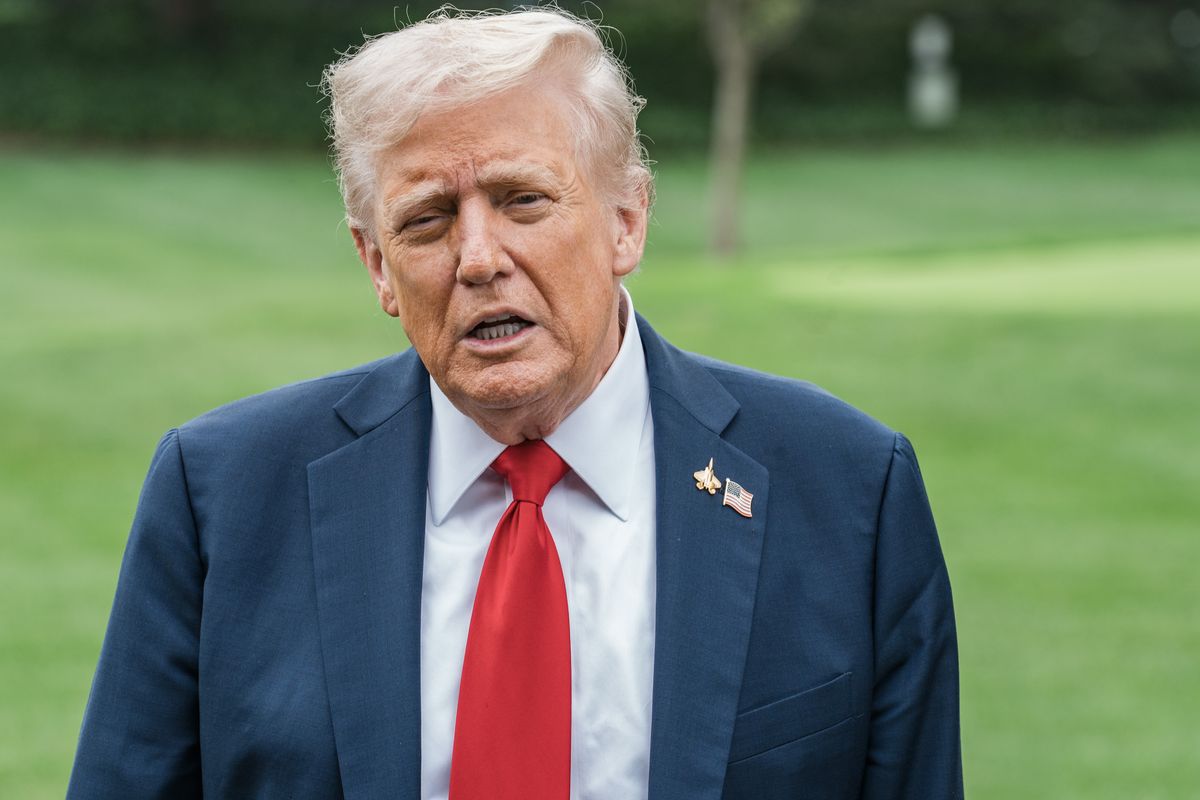
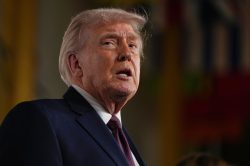
President Donald Trump talks to reporters after returning to the White House from a gathering of military leaders on Tuesday.
12:00 JST, October 4, 2025
Trump administration officials have proposed minting a $1 coin featuring President Donald Trump’s image on it to mark the 250th anniversary of the founding of the United States next year, a plan that could violate the law.
According to draft images that circulated online Friday, one side of the coin would feature Trump’s profile, along with the words “LIBERTY,” “IN GOD WE TRUST,” and “1776-2026.” The other side of the coin would feature Trump standing with a clenched right fist in front of an American flag and the words “FIGHT FIGHT FIGHT” – a reference to the 2024 assassination attempt at his campaign rally in Butler, Pennsylvania.
In a post on X, U.S. Treasurer Brandon Beach confirmed the images were real.
“No fake news here,” Beach wrote. “These first drafts honoring America’s 250th Birthday and @POTUS are real. Looking forward to sharing more soon, once the obstructionist shutdown of the United States government is over.”
A Treasury Department spokesperson, who spoke on the condition of anonymity to discuss plans that had not been finalized, said the images represented a “first draft.”
“Under the historic leadership of President Donald J. Trump, our nation is entering its 250th anniversary stronger, more prosperous and better than ever before,” the person said. “While a final $1 dollar coin design has not yet been selected to commemorate the United States’ semiquincentennial, this first draft reflects well the enduring spirit of our country and democracy, even in the face of immense obstacles. We look forward to sharing more soon.”
Under a law passed in 2020, the Treasury Department can mint $1 coins during 2026 to mark the 250th anniversary “with designs emblematic of the U.S. semiquincentennial.” However, according to U.S. code, “[o]nly the portrait of a deceased individual may appear on United States currency and securities” – a law that sprung from a Colonial-era tradition against putting current presidents on American coins to distance themselves from the British monarchy.
In addition, the 2020 law states that “[n]o head and shoulders portrait or bust of any person, living or dead, and no portrait of a living person may be included in the design on the reverse of any coin” produced for the semiquincentennial, which could be violated by having Trump’s image on both sides of the coin.
Anthony Michael Kreis, a constitutional law professor at the Georgia State University College of Law, said it is unlikely that U.S. code would not also apply to the 250th anniversary coins, which would still be considered legal tender.
“Fundamentally, I can’t imagine that that section of code, which says you can’t have a living person engraved on currency, is treating paper money or coins or special coins any differently. It all falls under that umbrella of legal tender,” Kreis told The Washington Post.
Kreis also noted that the Trump administration may believe it can satisfy the requirements for the semiquincentennial coin – which is supposed to feature an image emblematic of the 250th anniversary of American independence – by putting “1776-2026” on one side of the coin.
“I think no matter what their justifications are, they’re either flagrantly in violation of the law, or you’re splitting the hairs so finely that you’re rendering out the meaning of the law. … The idea that we would have a living person on coinage is kind of anathema right now to our system generally,” he said.
In 2005, President George W. Bush signed the Presidential $1 Coin Act, directing the U.S. Mint to issue a line of dollar coins honoring past U.S. presidents in the order they served – but only those who had been deceased for at least two years. The U.S. Mint suspended issuing those presidential coins in 2011.


Related Tags





Most Read
Popular articles in the past 24 hours
-

My Spendthrift Mother Constantly Asks Me for Money
-

Japanese Students Use Traditional Pickle to Create Novel Wagashi ...
-

‘Dry Bonsai’ Gives New Life to Withered Trees, Allows Free Artist...
-

McDonald's Japan Raises Prices; Big Mac to Cost ¥500, Double Chee...
-

Nepal Bus Crash Kills 19 People, Injures 25 Including One Japanes...
-

Astellas Collaborates with Vir to Develop Its Experimental Prosta...
-

Japan’s Nikkei Stock Average Rises as AI-Related Stocks Shine; Co...
-

Early-Blooming Kawazu Cherry Blossoms Create Sea of Pink at Park ...
Popular articles in the past week
-

Producer Behind Pop Group XG Arrested for Cocaine Possession
-

Japan PM Takaichi’s Cabinet Resigns en Masse
-

Sanae Takaichi Elected Prime Minister of Japan; Keeps All Cabinet...
-

Japan's Govt to Submit Road Map for Growth Strategy in March, PM ...
-

Bus Carrying 40 Passengers Catches Fire on Chuo Expressway; All E...
-

U.S. Firm to Build Training Hub in Fukushima N-plant for Debris R...
-

Japan, U.S. Name 3 Inaugural Investment Projects; Reached Agreeme...
-

Riku-Ryu Pair Wins Gold Medal: Their Strong Bond Leads to Major C...
Popular articles in the past month
-
Producer Behind Pop Group XG Arrested for Cocaine Possession
-
Japan PM Takaichi’s Cabinet Resigns en Masse
-

Japan Institute to Use Domestic Commercial Optical Lattice Clock ...
-

Man Infected with Measles Reportedly Dined at Restaurant in Tokyo...
-

Israeli Ambassador to Japan Speaks about Japan’s Role in the Reco...
-

Videos Plagiarized, Reposted with False Subtitles Claiming ‘Ryuky...
-

Man Infected with Measles May Have Come in Contact with Many Peop...
-

Prudential Life Insurance Plans to Fully Compensate for Damages C...
Top Articles in News Services
-
Survey Shows False Election Info Perceived as True
-

Hong Kong Ex-Publisher Jimmy Lai’s Sentence Raises International Outcry as China Defends It
-
Japan’s Nikkei Stock Average Touches 58,000 as Yen, Jgbs Rally on Election Fallout (UPDATE 1)
-
Japan’s Nikkei Stock Average Falls as US-Iran Tensions Unsettle Investors (UPDATE 1)
-
Trump Names Former Federal Reserve Governor Warsh as the Next Fed Chair, Replacing Powell
JN ACCESS RANKING
-
Producer Behind Pop Group XG Arrested for Cocaine Possession
-
Japan PM Takaichi’s Cabinet Resigns en Masse
-
Japan Institute to Use Domestic Commercial Optical Lattice Clock to Set Japan Standard Time
-
Man Infected with Measles Reportedly Dined at Restaurant in Tokyo Station
-
Israeli Ambassador to Japan Speaks about Japan’s Role in the Reconstruction of Gaza