
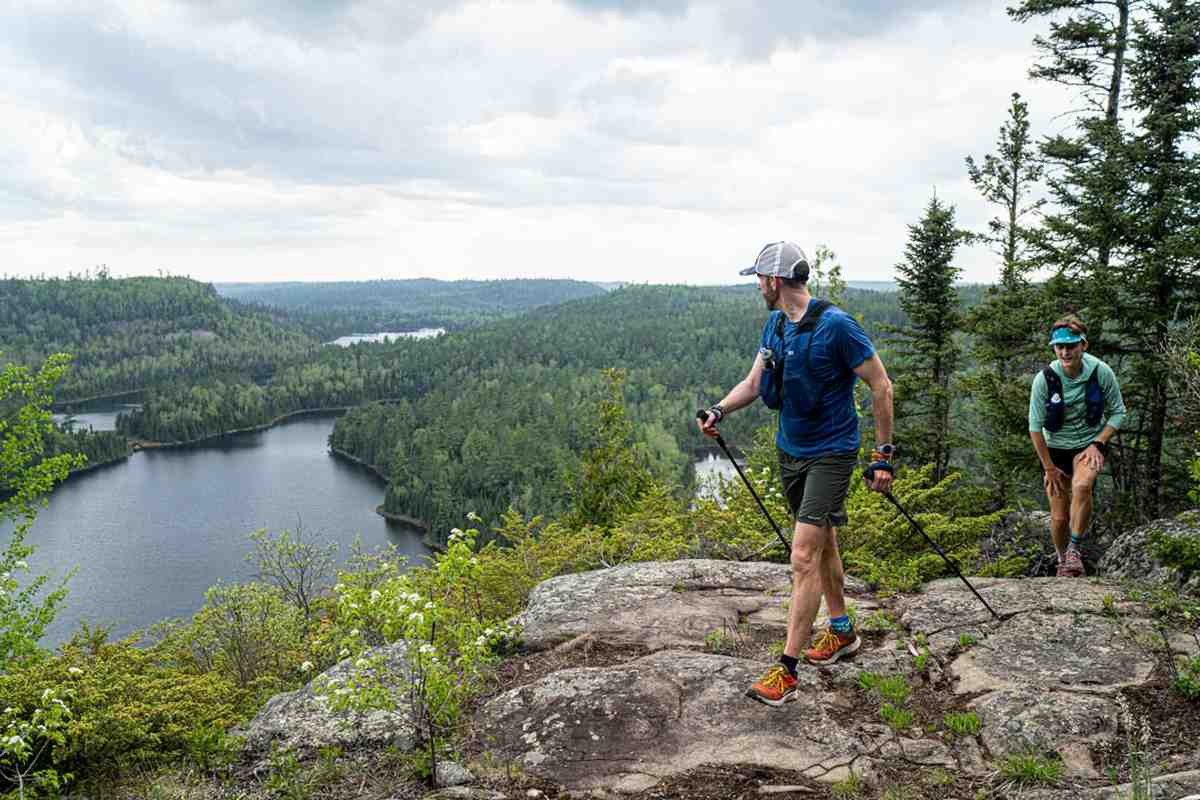
Conservation advocate Alex Falconer runs across the Boundary Waters Canoe Area Wilderness to raise awareness for efforts to stop a proposed copper-nickel mine nearby, on May 22, 2021.
13:55 JST, September 30, 2025
ELY, Minn. – Becky Rom has been fighting to protect the famed Boundary Waters Canoe Area Wilderness since she was in middle school.
As the granddaughter of a miner and the daughter of a pioneer in outdoor recreation, the 76-year-old national chair of the advocacy group Save the Boundary Waters has provided a link to a bygone era when the region was a true frontier. As a child, her family even had a pet wolf named Wisini, after one of the Boundary Waters’ iconic lakes.
Now Rom is preparing to let younger activists take over – at a time when the Trump administration is poised to make massive shifts to how public lands are managed. The outcome has implications for the future of mining in long-protected areas across the United States, from Arizona to Alaska.
“What we see now is an administration that is interested in mining everywhere no matter the environmental consequences,” said Justin Pidot, a law professor at the University of Arizona. “They’re moving at a breakneck pace and once mining actually begins, once you break ground, it becomes harder and harder to pull back.”
President Donald Trump has taken unprecedented steps to boost mining for copper, nickel and rare earth minerals, while also green-lighting a uranium mine and expanding coal mines. The federal government is prepared to execute a land swap to allow the Resolution Copper mine in Arizona to move forward after being stalled for more than a decade, and House Republicans have approved a 200-mile road through Alaskan wilderness that would allow access to copper and zinc deposits. And the administration has resurrected plans to begin mining a portion of the world’s largest undeveloped copper-nickel deposit on the very doorstep of the Boundary Waters, stating that it plans to reverse a Biden-era ban.
“President Trump is quickly delivering on his promises to Make America Energy Dominant Again and increase production of critical minerals,” Anna Kelly, White House deputy press secretary, said in a statement. “That includes supporting projects that will onshore production, which is important for both economic and national security purposes.”
Opponents say pollution from the site would be carried downstream and spread through most of the region’s lakes and into Canada, ruining the pristine ecosystem for outdoor recreation.
The company behind the project, a Chilean-owned firm called Twin Metals Minnesota, vows that its advanced methods will minimize pollution and help cut America’s overwhelming reliance on foreign suppliers of critical minerals. Rep. Pete Stauber (R-Minnesota) has introduced legislation that would return the company’s leases for 20 years and require the government to approve renewals for another 50 years.
Rom says she has faced off against snowmobilers, powerboaters and loggers in her long fight to preserve America’s most-visited wilderness. Every decade or so has brought a new foe, but she said this has been the most aggressive attack to date. She hopes the younger generation of advocates – many of them transplants who came to the Boundary Waters as visitors and fell in love with the wilderness – will continue the fight.
“My roots have been an important part of the story, but it’s changing,” Rom said. “You don’t have to have the roots to be respected as speaking up for a place, because so many people have moved here and can’t say their grandparents are miners. And it doesn’t really matter, right?”
A legacy of conservation
The Boundary Waters has been a flash point in the conflict between conservation and development for more than a century. The area was opened to homesteaders in the 1850s, but President Theodore Roosevelt stopped those settlements in 1902 and established the Superior National Forest in 1909.
In the early 1960s, Rom helped her father and the conservationist Sigurd Olson in their efforts to pass the Wilderness Act, which created the first wilderness areas nationwide, and later to pass the 1978 Boundary Waters Act, which expanded the protected area, banned mining and logging and restricted the use of motorboats. Residents and resort operators were forced to take federal buyouts, and both men faced severe blowback from families that earned a living off those activities. Olson was burned in effigy in Ely, Minnesota, while a local boycott forced Rom’s father to sell his outfitting business in 1975.
Rom has been fighting, off and on, ever since, defeating legal challenges as well as congressional efforts to give motorized vehicles access to the wilderness or to place it under local control.
“I would put Becky as the top 10 most tenacious people in conservation,” said Kristen Brengel, vice president of government affairs at the National Parks Conservation Association. “She is a stalwart, and someone I run into all the time on Capitol Hill.”
The latest episode in Rom’s long fight for the Boundary Waters began in 2010, when Twin Metals was founded to pursue several mineral deposits and bought up two leases originally issued in the 1960s. The closest deposit lies less than half a mile from the wilderness. Since its founding, the company has drilled 1.5 million feet of exploratory cores that now fill a warehouse in Ely. Rom began mounting a new campaign to stop the mine in 2012, officially launching Save the Boundary Waters the following year.
She has made countless trips to Washington since then, with an array of people in tow to explain to members of Congress and agency officials the threat of mining and the importance of protecting the area.
The Obama administration denied Twin Metals’ application to renew its federal leases in 2016 and initiated a lengthy environmental review on a potential 20-year mining ban, which extended into Trump’s first term. Trump officials halted that review and renewed the leases, only for Biden to cancel them in 2022. The next year, Biden officials signed off on a mining ban through 2043 on more than 225,000 acres of land in the Superior National Forest near the Boundary Waters, including the mine site.
Amid the political back-and-forth, Jason Zabokrtsky accompanied Rom on roughly a dozen of her trips to make the case that potential pollution from the mine could destroy his outfitting business, Ely Outfitting Company. Zabokrtsky, now 51, arrived as a 22-year-old guiding tours down the Gunflint Trail on the eastern side of the wilderness.
“I remember paddling on Seagull Lake and having this feeling like this was sort of the land before time. And I understood what people were saying when they described it as God’s country,” Zabokrtsky said.
After returning to Iowa and working as a lawyer, Zabokrtsky decided to move to Ely to be closer to the Boundary Waters and ended up guiding dogsled tours, eventually founding a tour company in 2007. His business sent 3,700 clients into the wilderness last year, and he regularly taps his customer base to support conservation causes like the mining ban. His clients, who come from all 50 states, are easy converts, he said, and 17,000 subscribe to his newsletter.
Now working behind the counter at Zabokrtsky’s shop, Amy Freeman became an advocate for the Boundary Waters in 2014 not long after she and her husband completed an 11,700-mile journey by kayak, canoe and dogsled across North America. Back in Ely and working as a guide, Freeman got involved when Rom’s group had opponents of the mine sign a canoe, instead of a petition, to be delivered to policymakers in Washington. “We stepped up and suggested we could paddle it to D.C.,” Freeman said.
The 2,000-mile trip took 101 days. Jumping between sometimes disconnected waterways to forge a route to D.C., the couple loaded the canoe onto a sailboat to cross the Great Lakes and sometimes pulled it on a handcart to take it between rivers. To help raise awareness, they later camped in the Boundary Waters for an entire year.
“No roads, no signs, no artificial noise. I think those places are just becoming so few and far between that it’s becoming even more important to keep them as they are,” Freeman said.
Freeman helped inspire Alex Falconer, 45, to run 110 miles across the Boundary Waters, battling extreme conditions on the 38-hour journey while making social media posts calling on Sen. Tina Smith (D-Minnesota) to support permanent protections. Smith now champions such legislation.
“I almost got heat exhaustion,” Falconer recalled. “I puked right along Rose Lake while trying to keep some food down.”
Falconer went on to run for the Minnesota House of Representatives and is midway through his first term. He’s sponsored a bill that would ban mining in the area’s entire watershed.
‘A screeching halt’
Julie Lucas never planned on going into mining. Growing up on a cattle farm in Barnum, a two-hour drive south of Ely, she moved to Minnesota’s famed Iron Range mining area to teach biology at a community college. With a master’s degree in Water Resources Science, everything she had heard was that mining destroyed water. But she started environmental consulting for mining projects and came to see it as a way to limit their impact.
After 13 years working directly for iron ore mines, she joined Twin Metals in 2021 as water resources director. She is a vocal supporter of clean energy and was excited that Twin Metals would help that energy transition by producing copper, nickel and other minerals critical to building out solar and wind power, she said.
“One of our biggest drivers for needing this mining is clean energy,” Lucas said.
By that point, Twin Metals was planning to mine a deposit where the South Kawishiwi River meets Birch Lake, about two miles from the Boundary Waters, while leaving a closer deposit untouched, and was working toward environmental approvals.
Lucas was disappointed a year later when the Biden administration pulled the leases, and she lost her job. “That was one of the hardest days of my life, was to find out there just wasn’t going to be a project,” Lucas said. “It all just comes to a screeching halt, and there’s nothing you can do about it. It’s tough.”
Now leading the advocacy group MiningMinnesota, Lucas argues that people opposing the development of the largest undeveloped copper-nickel deposit are ducking their responsibility for the minerals they use in the wiring that lights their homes and components in their phones, while also undercutting the energy transition.
Lucas acknowledged that “if you screw up, the consequences are huge” for the Boundary Waters, but said she believes the mining can be done safely under proper environmental review and regulation.
Twin Metals’ 2019 mining plan would incorporate a buffer zone between it and fractures that might connect to surface lakes and rivers, she said. Waste would be processed into dry-stack tailings – tightly packed bricks with most moisture sucked out of them – that the company says will be free of harmful sulfides, rather than a liquid slurry of waste kept in a pool.
Save the Boundary Waters argues that no plan can guarantee heavy metals or other harmful substances will not run off in the rain and contaminate the soil and water near the site.
“Policy and precedent show that copper mining pollution is unavoidable, especially in wet environments like that of northeastern Minnesota,” said Ingrid Lyons, executive director of Save the Boundary Waters. “The industry’s own record makes clear that promises of ‘zero pollution’ are not credible.”
The economic benefits of the mine would be huge, Lucas and other mining proponents argue. Twin Metals has already spent $600 million to advance the project and donated $850,000 to local organizations, said company spokesperson Kathy Graul. The mine would bring 750 full-time jobs to the area, she added, not including jobs for its initial construction, and create 1,500 jobs indirectly.
While vital to the region, recreation jobs are often seasonal and don’t offer as much pay and insurance as mining jobs that help maintain a year-round economy, Lucas said.
“Jobs that pay over $100,000 a year are a really big deal when you live in a rural area,” Lucas said, of the average mining salary. “I consider myself really lucky that when I went through breast cancer, I worked at a taconite [iron ore] mine and had steelworker insurance to get through that without needing a GoFundMe.”
The fight ahead
Ely’s identity has gone through big changes since the last iron mine shut down in 1967. Jean Zaverl, 72, owns Zaverl’s, the last remaining miner’s bar in a town that once had more than a dozen. When her father owned the bar, they would serve three shifts of miners as they came off work from early morning to late at night.
The town’s population has shrunk by about 40 percent since the mine closed. “I am in favor if it’s done safely and doesn’t mess up the watershed,” Zaverl said. “I want miners, I want jobs, I want the economy to go back.”
Almost 60 years after the last mine closed, Zaverl struggled to name any remaining Ely residents who actively work in mining in the region, other than one employee of Twin Metals’ four-person operation in town.
Locals now debate whether Ely is even part of the Iron Range. Signs at one highway junction point to the Iron Range in one direction and Ely in the other.
Outfitting and tourism – many of whose workers oppose the mine – have become central to the local economy. And they are winning over many of the 150,000 people who visit the Boundary Waters each year.
Last fall, Sean Leary and his wife, Jill, started a resort directly across the lake from Twin Metals’ proposed mine site. Leary, who uses a wheelchair after a car accident in 2001, offers packages for people with mobility issues, making use of adaptive kayaks in the summer and dog sleds in the winter. The Learys explain to visitors how mining pollution could kill the wild rice along their shoreline and upend the ecosystem for other wildlife.
“It’s just almost automatic – people come out here and they’re amazed,” Leary said. “They’ve never seen these dark nights and these dark skies.”
Matthew Schultz, a 29-year-old Navy veteran, makes a similar soft-sell pitch to hunters and fishermen as program manager for Sportsmen for the Boundary Waters. He also traveled to Washington this year to lobby lawmakers, saying his affiliation with hunting and fishing allows him to make a pitch to lawmakers in both parties.
“I want to talk about your last whitetail hunt, or what’s your approach to waterfowl,” Schultz said. “If in those conversations, we broach the mining issue, then I’m happy to express my opinion.”
“I literally get my food from the wilderness,” Schultz said. “The possibility of somebody degrading the habitat is taking food out of my mouth.”
Even with an ally in the White House, Lucas and others caution it would be very difficult to get a mine going within a four-year presidential term, raising the possibility that a future Democratic president could halt the project.
The mine would take about three years to construct and that doesn’t include the “years-long” process of federal and state environmental review, said Graul, Twin Metals’ spokesperson.
Congress could pass legislation preventing a future president, regardless of political party, from reversing the mine by passing a law forcing their hand. Stauber’s bill would reissue mining leases to Twin Metals and give it the ability to hold them for 70 years, while requiring mining plans be reviewed within 18 months for potential approval.
Twin Metals has appealed a lower court decision that denied reinstatement of its leases but that case is on hold for now.
“The courts, particularly the conservative majority of the Supreme Court, have consistently avoided curbing the president’s aggressive moves and I would expect the same here,” said John Leshy, an emeritus professor of law at the University of California at San Francisco.
But with time and numbers likely on her side, Rom is confident.
“I’m optimistic that we’re going to win this fight and it will continue to be wilderness,” Rom said.









Most Read
Popular articles in the past 24 hours
-

Japanese Students Use Traditional Pickle to Create Novel Wagashi ...
-

‘Dry Bonsai’ Gives New Life to Withered Trees, Allows Free Artist...
-

McDonald's Japan Raises Prices; Big Mac to Cost ¥500, Double Chee...
-

Nepal Bus Crash Kills 19 People, Injures 25 Including One Japanes...
-

Astellas Collaborates with Vir to Develop Its Experimental Prosta...
-

Japan’s Nikkei Stock Average Rises as AI-Related Stocks Shine; Co...
-

Early-Blooming Kawazu Cherry Blossoms Create Sea of Pink at Park ...
-

Dodgers' Shohei Ohtani (Probably) Won't Pitch for Japan in WBC
Popular articles in the past week
-

Producer Behind Pop Group XG Arrested for Cocaine Possession
-

Japan PM Takaichi’s Cabinet Resigns en Masse
-

Sanae Takaichi Elected Prime Minister of Japan; Keeps All Cabinet...
-

Japan's Govt to Submit Road Map for Growth Strategy in March, PM ...
-

Bus Carrying 40 Passengers Catches Fire on Chuo Expressway; All E...
-
U.S. Firm to Build Training Hub in Fukushima N-plant for Debris R...
-

Japan, U.S. Name 3 Inaugural Investment Projects; Reached Agreeme...
-

Riku-Ryu Pair Wins Gold Medal: Their Strong Bond Leads to Major C...
Popular articles in the past month
-
Producer Behind Pop Group XG Arrested for Cocaine Possession
-
Japan PM Takaichi’s Cabinet Resigns en Masse
-

Japan Institute to Use Domestic Commercial Optical Lattice Clock ...
-

Man Infected with Measles Reportedly Dined at Restaurant in Tokyo...
-

Israeli Ambassador to Japan Speaks about Japan’s Role in the Reco...
-

Videos Plagiarized, Reposted with False Subtitles Claiming ‘Ryuky...
-

Man Infected with Measles May Have Come in Contact with Many Peop...
-

Prudential Life Insurance Plans to Fully Compensate for Damages C...
Top Articles in News Services
-

Survey Shows False Election Info Perceived as True
-

Hong Kong Ex-Publisher Jimmy Lai’s Sentence Raises International Outcry as China Defends It
-
Japan’s Nikkei Stock Average Touches 58,000 as Yen, Jgbs Rally on Election Fallout (UPDATE 1)
-
Japan’s Nikkei Stock Average Falls as US-Iran Tensions Unsettle Investors (UPDATE 1)
-

Trump Names Former Federal Reserve Governor Warsh as the Next Fed Chair, Replacing Powell
JN ACCESS RANKING
-
Producer Behind Pop Group XG Arrested for Cocaine Possession
-
Japan PM Takaichi’s Cabinet Resigns en Masse
-
Japan Institute to Use Domestic Commercial Optical Lattice Clock to Set Japan Standard Time
-
Man Infected with Measles Reportedly Dined at Restaurant in Tokyo Station
-
Israeli Ambassador to Japan Speaks about Japan’s Role in the Reconstruction of Gaza