
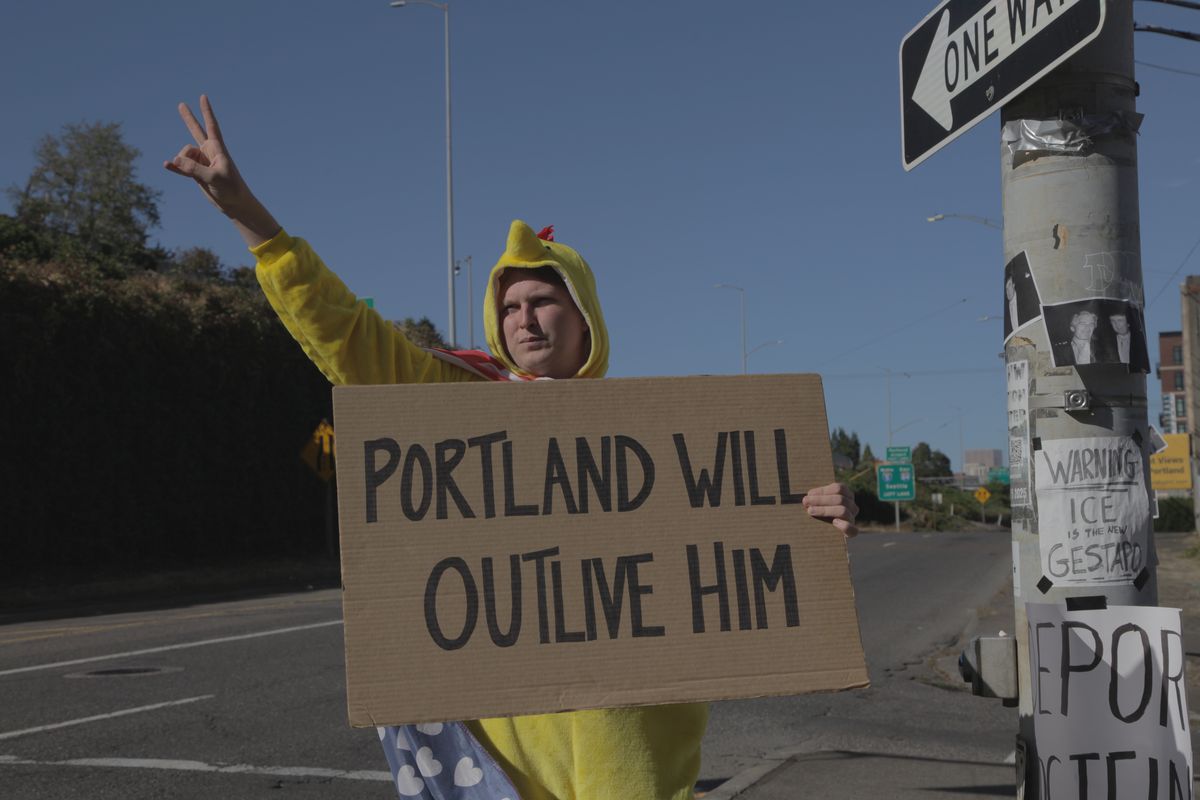
This is Jack Dickinson, who has been either protesting or doing advocacy work since March. He said he has helped immigrants with peer-support and know-your-rights information.
11:51 JST, September 29, 2025
PORTLAND, Ore. – “War-ravaged” Portland was having an unseasonably sunny September day. By lunchtime, hours after President Donald Trump said he would send troops to the city, it seemed everyone had a picture to post on social media – a long line at the homemade bread stand, cherry trees still blooming, a cat on a leash.
Trump has previously described living here, in the nation’s 26th-most-populous city, as being like “living in hell.” On Saturday, he authorized the military to use “Full Force, if necessary,” in Portland and at immigration facilities around the country.
Residents mostly met the news with confusion.
Hell? Here?
For many Portlanders, the city is something closer to heaven. The trees stay green all year long. The coffee is good at every shop. You can get to a mountain or the Pacific Ocean in an hour, and if you don’t feel like traveling, there are bookstores and parks in every neighborhood, not to mention some of the best restaurants in the country.
“It’s abundantly clear that Portland is very peaceful,” resident Ben Johnson said as he jogged past the Immigration and Customs Enforcement facility that has been the focus of protests for months but was nearly deserted Saturday morning. Johnson paused to talk to a cyclist who’d biked over to show his daughter in Montreal by text that the city was calm. She had been calling all morning, worried for his safety. The men laughed and took in the quiet street. It was the kind of day the men said called for rosé, not federal forces.
“Trump is just stoking hatred and rage,” Johnson said. “Any violence coming will be instigated by federal troops.”
Protesters have congregated outside the ICE facility as far back as 2018, when Trump’s family separation policy inspired ongoing demonstrations and an encampment. People have been arrested there, and this month, a charter school that rented space next door to the facility moved, citing the use of “chemical agents and crowd-control projectiles” as potential health risks for students.
On Sunday, Defense Secretary Pete Hegseth sent a memo to Oregon Gov. Tina Kotek (D) federalizing 200 members of the state’s National Guard. In response to questions about the deployment, the White House had earlier sent a list of recent incidents outside Portland’s ICE field office, including federal charges of arson, assaulting a police officer and resisting arrest.
“Despite the crime and neighborhood pushback caused by the months-long protest, Oregon Democrats still refuse to do anything about it,” the White House said in a statement.
Hardly anyone was at the ICE facility in the hours after Trump said he was sending troops to mitigate conflict outside the administrative building. Two homeless men slept on the sidewalk. The only person protesting at the time was a man wearing a chicken suit and an American flag that featured hearts instead of stars. Jack Dickinson, who wore the chicken suit, said he had protested ICE activity and helped immigrants with peer support and know-your-rights information since at least March.
“A lot of us on the ground have been waiting for something like this, wondering when the crackdown would come,” Dickinson said. “They have been laying the groundwork on Portland since 2020. Most of us knew this day was inevitable.”
In June, the Portland Police Bureau declared a riot after demonstrators blocked the driveway and threw objects including rocks and bricks at the facility and federal agents, according to local news media accounts and social media video. Multiple federal officers were injured, and Portland police arrested more than 20 people connected to the protests.
Dickinson acknowledged that some protesters have occasionally turned rowdy in the past six months and said others have lost sight of the reason they are there, but he maintained that most demonstrators were peaceful and there to protect people seeking asylum or legal immigration.
Violent crime and homicide rates in Portland have been declining over the past few years. According to FBI data from 2014 to 2024, the violent crime rate peaked in 2021, while the homicide rate topped out in 2022. The number of violent crimes has been lower in the first seven months of this year, compared with the same period in 2024, according to data from the Portland police.
For many hours Saturday morning, Dickinson remained the sole protester. Across town, life carried on as usual. In Rose City Park, men practiced their putts and parents watched their little boys kick a soccer ball everywhere but the goal. Closer to the center of town, hipster types spilled out of the new matcha place. The cramped organic grocery store parking lots were bumper-to-bumper. And the air smelled, as it usually does here, like weed.
But those are just the neighborhoods. When Trump talks about Portland, he tends to mean downtown. That area did see a downturn in the early days of the pandemic as the rates of homelessness increased, and the office-clothes staple Banana Republic closed. This weekend, however, only a handful of people slept in tents near the Burnside Bridge, and the new Shake Shack was overflowing. Even the regular protest spots – Pioneer Courthouse Square, the justice building – were quiet, save for a few shorts-wearing, Starbucks-sipping middle-agers.
The ICE office is not downtown. It’s five miles and a whole interstate away from Portland’s city center. It’s barely even bikeable, unless, however, you’re one of those “crazy people” Trump has described. And when it comes to cycling, plenty of Portlanders do qualify. They bike in the rain and up great hills. A sunny dip down to the ICE building is no big deal.
By 3 p.m., at least a half-dozen people had cycled over to join Dickinson. Others walked by with labradoodles young and old, and two older women drove past, flashed a thumbs-up, then explained they were too weak to leave the car but wanted to show their support. A Dominican radio journalist, Santiago Espinosa, drove up from Salem to join the mostly Anglo crowd and explained that many Latinos are too afraid to join the protests.
“They are scared this will become an excuse to profile,” said Espinosa, who is a U.S. citizen. “So I come out here to tell my Latino community in Oregon what is going on because they want to be informed.”
Espinosa said his broadcasts, which he streams under the name “Digalo Sin Miedo,” regularly receive 100,000 views. While he was streaming live Saturday, a dozen vehicles sped up to the ICE facility, then pulled into the garage. Some protesters screamed expletives, and at least one official heading into the facility held a middle finger out his car window.
Though Portland officials have said protesters have incited violence, Portland Police Bureau Assistant Chief Craig Dobson said in court last month that federal personnel have been “actually instigating and causing some of the ruckus that’s occurring down there.”
For Espinosa, the competing narratives made it all the more important to show the residents of Portland, and especially its Latino communities, what is actually happening in the city. Portland is not war-ravaged, he said, but for some groups, it may remain dangerous.
“The Latino community is very on edge,” Espinosa said. “They don’t know whether to send their children to school or go to church or even go to work.”





Most Read
Popular articles in the past 24 hours
-

Japanese Students Use Traditional Pickle to Create Novel Wagashi ...
-

‘Dry Bonsai’ Gives New Life to Withered Trees, Allows Free Artist...
-

McDonald's Japan Raises Prices; Big Mac to Cost ¥500, Double Chee...
-

Nepal Bus Crash Kills 19 People, Injures 25 Including One Japanes...
-

Astellas Collaborates with Vir to Develop Its Experimental Prosta...
-

Japan’s Nikkei Stock Average Rises as AI-Related Stocks Shine; Co...
-

Early-Blooming Kawazu Cherry Blossoms Create Sea of Pink at Park ...
-

Dodgers' Shohei Ohtani (Probably) Won't Pitch for Japan in WBC
Popular articles in the past week
-

Producer Behind Pop Group XG Arrested for Cocaine Possession
-

Japan PM Takaichi’s Cabinet Resigns en Masse
-

Sanae Takaichi Elected Prime Minister of Japan; Keeps All Cabinet...
-

Japan's Govt to Submit Road Map for Growth Strategy in March, PM ...
-
Bus Carrying 40 Passengers Catches Fire on Chuo Expressway; All E...
-
U.S. Firm to Build Training Hub in Fukushima N-plant for Debris R...
-
Japan, U.S. Name 3 Inaugural Investment Projects; Reached Agreeme...
-

Riku-Ryu Pair Wins Gold Medal: Their Strong Bond Leads to Major C...
Popular articles in the past month
-
Producer Behind Pop Group XG Arrested for Cocaine Possession
-
Japan PM Takaichi’s Cabinet Resigns en Masse
-

Japan Institute to Use Domestic Commercial Optical Lattice Clock ...
-

Man Infected with Measles Reportedly Dined at Restaurant in Tokyo...
-

Israeli Ambassador to Japan Speaks about Japan’s Role in the Reco...
-

Videos Plagiarized, Reposted with False Subtitles Claiming ‘Ryuky...
-

Man Infected with Measles May Have Come in Contact with Many Peop...
-

Prudential Life Insurance Plans to Fully Compensate for Damages C...
Top Articles in News Services
-
Survey Shows False Election Info Perceived as True
-
Hong Kong Ex-Publisher Jimmy Lai’s Sentence Raises International Outcry as China Defends It
-
Japan’s Nikkei Stock Average Touches 58,000 as Yen, Jgbs Rally on Election Fallout (UPDATE 1)
-
Japan’s Nikkei Stock Average Falls as US-Iran Tensions Unsettle Investors (UPDATE 1)
-
Trump Names Former Federal Reserve Governor Warsh as the Next Fed Chair, Replacing Powell
JN ACCESS RANKING
-
Producer Behind Pop Group XG Arrested for Cocaine Possession
-
Japan PM Takaichi’s Cabinet Resigns en Masse
-
Japan Institute to Use Domestic Commercial Optical Lattice Clock to Set Japan Standard Time
-
Man Infected with Measles Reportedly Dined at Restaurant in Tokyo Station
-
Israeli Ambassador to Japan Speaks about Japan’s Role in the Reconstruction of Gaza