
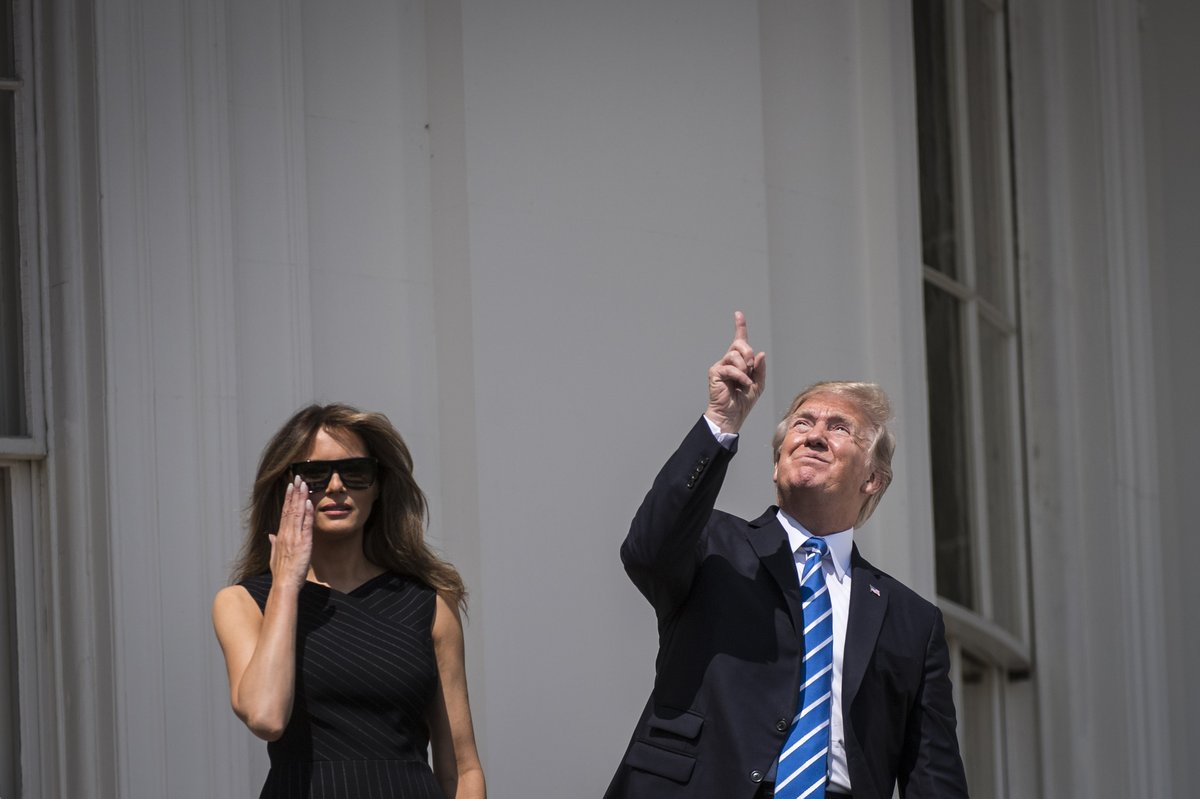
President Donald Trump looks up toward a solar eclipse without protective glasses, with first lady Melania Trump by his side, from a White House balcony on Aug. 21, 2017.
12:08 JST, September 26, 2025
The Trump administration has a dim view of the sun.
Solar panels provided most of the electricity capacity added to the U.S. power grid last year, and they will account for most new power built in America for the rest of President Donald Trump’s term, according to Energy Department data. But Trump and his Cabinet secretaries have argued this form of energy is so unreliable and expensive that it’s unlikely to play an important role in powering the world.
Energy Secretary Chris Wright has said solar panels are “just a parasite” on the grid that couldn’t power the planet even if they blanketed the entire surface of the Earth. The Energy Department’s X account – which once cheered solar projects during the Biden administration – now says solar panels are “essentially worthless when it is dark outside.”
In a speech to the U.N. on Tuesday, Trump told world leaders “the high cost of so-called green renewable energy is destroying a large part of the free world and a large part of our planet.”
The administration has used these arguments to justify policies that slow solar development while promoting fossil fuels – particularly natural gas, the industry where Wright made his fortune before becoming energy secretary. In an interview with The Washington Post, Wright stood by his criticism of solar power and his prediction that it would always play a minor role in global energy.
“If solar continued to grow at its current [rate] it could theoretically catch up to gas, but I don’t think that’s likely,” Wright said.
Bolstering Wright’s argument is the fact that – despite its recent growth spurt – solar power generates less than 3 percent of global energy, according to Energy Department data. The vast majority of the global economy runs on oil, gas and coal.
Switching to solar isn’t as simple as replacing fossil fuel power plants with solar farms, either: Roughly 80 percent of global energy consumption comes from cars, trucks, planes, ships, factories and furnaces that directly burn fossil fuels. They aren’t designed to run on electricity, so they’d have to be replaced with electric versions or burn expensive fuels made using electricity.
“One of the big problems with solar and wind is they only produce electricity,” Wright said. “We’ve been talking about ‘electrify everything’ for a while. Today, 15 percent of energy in manufacturing comes from electricity, same as it was 25 years ago.”
Despite the long-term challenges of powering the world with renewable electricity, many countries are investing in generating more electricity from solar and wind, which don’t cause as much planet-warming pollution and are often cheaper than fossil fuels. In the meantime, electric vehicle sales have surged in China and Europe, and electric heat pumps have started to replace fuel-burning furnaces. Both trends have gradually raised the share of global energy that comes from electricity.
“One hundred fifty years ago, zero percent of our energy consumption was coming from electricity, roughly,” said Josiah Neeley, a senior fellow at the R Street Institute, a center-right think tank. “A lot of [energy] consumption that isn’t electricity-based right now could move over to being electricity-based.”
The Trump administration’s solar policy makes the United States “an outlier” among world governments, according to Robert Stavins, a professor of energy and economic development at Harvard University.
“The European Union is going forward. China is going forward. India has not changed its position. Brazil is moving forward. So, the U.S. is really an exception,” Stavins said.
The Trump administration’s solar stance also puts it at odds with some right-leaning think tanks and political figures within the U.S., including Elon Musk, the former head of the U.S. DOGE Service, who posted on X, “Solar power is so obviously the future for anyone who can do elementary math.”
In a chippy exchange with the libertarian-leaning venture capitalists who host the “All-In” podcast, Wright said Musk “has a wildly exaggerated view of where solar and batteries will go.”
“If we could make a bet 50 years out, I’ll make a bet solar never gets to 10 percent of global energy,” Wright said.
Solar power could approach that milestone as soon as 2050, according to the Energy Department’s latest International Energy Outlook report.
When the report was released in 2023, the department estimated the world was on track to get about 8 percent of its energy from solar power by mid-century – potentially as high as 10 percent if costs keep falling or as low as 6 percent if the technology does not get cheaper. But the modelers wrote that big, unforeseen energy policy changes could “dramatically shift the course of energy system development.”
Two years later, Trump took office and wound down tax credits for solar power, restricted solar development on federal land and raised tariffs to block imports from China and other big solar manufacturers in Southeast Asia.
Solar installations in the U.S. may be 18 percent lower over the next five years in response to Trump administration policies, according to a September analysis from the energy research firm Wood Mackenzie.
Free-market conservatives have cheered Trump’s moves to roll back Biden-era subsidies for solar power.
“I agree with the Trump’s stance on solar, which is to repeal subsidies for solar so that energy sources can have a fair, level playing field,” said Austin Gae, a research associate at the Heritage Foundation’s Center for Energy, Climate, and Environment.
They’ve been less thrilled with his vow to block permits for solar projects.
“If Secretary Wright has confidence that fossil or thermal is the answer and that solar power is not going to succeed, then you don’t have to try and support fossil and place restrictions on solar,” said Neeley, the R Street Institute fellow. “Just let them compete and that’s what will happen.”
But Travis Fisher, director of energy and environmental policy studies at the libertarian Cato Institute, argued that the Trump administration’s meddling in the energy market is a mirror image of the Biden administration’s moves to block fossil fuel projects.
“The pearl clutching has been ironic to me because it’s like, ‘Hey guys, this has been the ballgame from the left for decades now,’” Fisher said. “So, the fact that it’s now the ballgame from the right – I’m not wild about it, but there’s a sense of irony that comes with it.”
Energy experts, meanwhile, say Trump’s policies are kneecapping the fastest-growing source of electricity in a country that is running out of power.
“What they’re doing right now is making it much, much, much harder than necessary to build economically competitive wind and solar resources across the U.S., while going out and saying all kinds of things in public that just aren’t true about them,” said Jesse Jenkins, an energy systems engineer at Princeton University.
Even without government support, most experts think solar will continue to grow.
“I think it’ll find its place, and it’s probably going to be less than the solar maximalist bros are talking about, and it’s probably going to be more than Trump is talking about,” Fisher said. “But the only way to know for sure is to see where it lands in the market.”








Most Read
Popular articles in the past 24 hours
-

Japanese Students Use Traditional Pickle to Create Novel Wagashi ...
-

‘Dry Bonsai’ Gives New Life to Withered Trees, Allows Free Artist...
-

McDonald's Japan Raises Prices; Big Mac to Cost ¥500, Double Chee...
-

Nepal Bus Crash Kills 19 People, Injures 25 Including One Japanes...
-

Astellas Collaborates with Vir to Develop Its Experimental Prosta...
-

Japan’s Nikkei Stock Average Rises as AI-Related Stocks Shine; Co...
-

Early-Blooming Kawazu Cherry Blossoms Create Sea of Pink at Park ...
-

Dodgers' Shohei Ohtani (Probably) Won't Pitch for Japan in WBC
Popular articles in the past week
-

Producer Behind Pop Group XG Arrested for Cocaine Possession
-

Japan PM Takaichi’s Cabinet Resigns en Masse
-

Sanae Takaichi Elected Prime Minister of Japan; Keeps All Cabinet...
-

Japan's Govt to Submit Road Map for Growth Strategy in March, PM ...
-

Bus Carrying 40 Passengers Catches Fire on Chuo Expressway; All E...
-

U.S. Firm to Build Training Hub in Fukushima N-plant for Debris R...
-

Japan, U.S. Name 3 Inaugural Investment Projects; Reached Agreeme...
-

Riku-Ryu Pair Wins Gold Medal: Their Strong Bond Leads to Major C...
Popular articles in the past month
-
Producer Behind Pop Group XG Arrested for Cocaine Possession
-
Japan PM Takaichi’s Cabinet Resigns en Masse
-

Japan Institute to Use Domestic Commercial Optical Lattice Clock ...
-

Man Infected with Measles Reportedly Dined at Restaurant in Tokyo...
-

Israeli Ambassador to Japan Speaks about Japan’s Role in the Reco...
-

Videos Plagiarized, Reposted with False Subtitles Claiming ‘Ryuky...
-

Man Infected with Measles May Have Come in Contact with Many Peop...
-

Prudential Life Insurance Plans to Fully Compensate for Damages C...
Top Articles in News Services
-

Survey Shows False Election Info Perceived as True
-

Hong Kong Ex-Publisher Jimmy Lai’s Sentence Raises International Outcry as China Defends It
-
Japan’s Nikkei Stock Average Touches 58,000 as Yen, Jgbs Rally on Election Fallout (UPDATE 1)
-
Japan’s Nikkei Stock Average Falls as US-Iran Tensions Unsettle Investors (UPDATE 1)
-
Trump Names Former Federal Reserve Governor Warsh as the Next Fed Chair, Replacing Powell
JN ACCESS RANKING
-
Producer Behind Pop Group XG Arrested for Cocaine Possession
-
Japan PM Takaichi’s Cabinet Resigns en Masse
-
Japan Institute to Use Domestic Commercial Optical Lattice Clock to Set Japan Standard Time
-
Man Infected with Measles Reportedly Dined at Restaurant in Tokyo Station
-
Israeli Ambassador to Japan Speaks about Japan’s Role in the Reconstruction of Gaza