
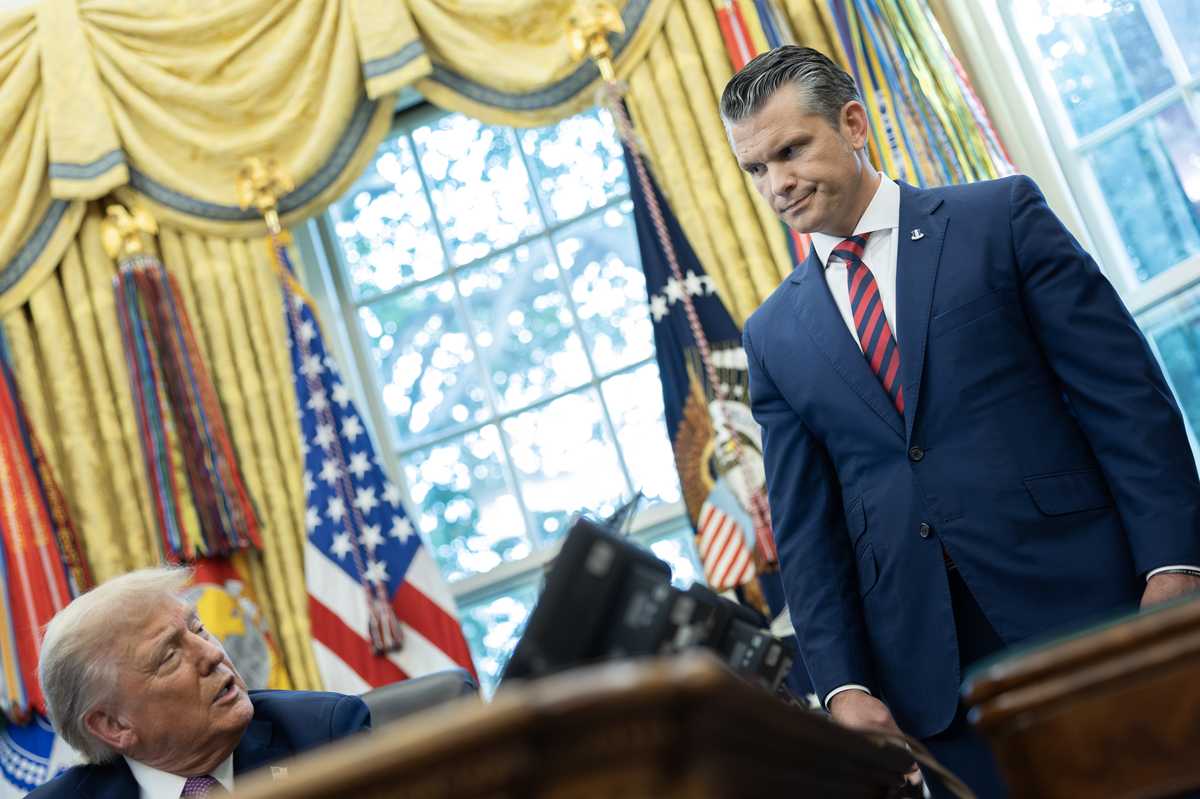
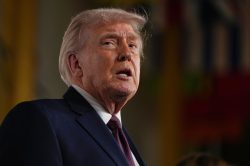
President Donald Trump and Defense Secretary Pete Hegseth in the Oval Office on Sept. 5.
15:05 JST, September 16, 2025
The U.S. military on Monday conducted a new attack on alleged drug smugglers from Venezuela, killing three people, President Donald Trump said on social media.
“This morning, on my orders, U.S. military forces conducted a SECOND kinetic strike against positively identified, extraordinarily violent drug trafficking cartels and narcoterrorists,” Trump wrote in a post on Truth Social that included video of a small boat suddenly erupting in flames. “The strike occurred while these confirmed narcoterrorists from Venezuela were in international waters transporting illegal narcotics … headed to the U.S.”
In remarks delivered later to reporters at the White House, the president suggested his administration was preparing to take military action against Latin American cartels that move illicit drugs over land, too, presumably via Mexico. Trump did not identify any specific groups, saying only, “We’re going to be stopping them the same way we stopped the boats.”
The Pentagon referred questions to a social media post from Defense Secretary Pete Hegseth, who said that the Trump administration would “stop at nothing” to defend the U.S. homeland and its people from drug traffickers. “We will track them, kill them, and dismantle their networks throughout our hemisphere – at the times and places of our choosing,” he added.
Monday’s strike follows another deadly operation, on Sept. 2, in which U.S. forces targeted an alleged drug boat from Venezuela that carried 11 people in the Caribbean Sea. All on board were killed, Trump has said.
The action marked a dramatic escalation in how the United States counters drug trafficking that originates in Latin America, prompting lawmakers and legal analysts to question its legality.
Upon entering office in January, Trump signed an executive order designating drug cartels and other Latin American criminal groups as foreign terrorist organizations. Legal experts viewed this as an attempt to justify any future decision by the president to authorize military action, and the president’s critics in Congress have said that the Trump administration itself acknowledged in past congressional testimony that such a designation alone does not permit the use of lethal force.
The White House – which has disclosed little about how either operation came together, the legal authorities under which they were carried out, or how officials assembled information leading to the strikes – has insisted its actions are “fully consistent with the law of armed conflict.”
In both cases, the use of lethal force appears to have occurred in international waters outside of an armed conflict. Traditionally, the U.S. government has relied on the Coast Guard, which has law enforcement authorities, to intercept boats suspected of hauling illegal drugs and take their crews into custody.
While administration officials have discussed for months how to better counter drug trafficking, it has pivoted sharply on the issue in recent weeks. Last month, the Pentagon assembled an armada of at least eight warships and dispatched them to the region, describing the move as part of an “enhanced counternarcotics operation.”
The Trump administration also has made moves to use Puerto Rico as a launchpad and logistics hub. Last week, Hegseth and Joint Chiefs Chairman Gen. Dan Caine made an unannounced visit to the island territory, and F-35 fighter jets were spotted arriving there Saturday.
Before Trump announced Monday’s strike, Venezuelan President Nicolás Maduro was still questioning the veracity of the video of the first attack. During a news conference in Caracas, Venezuela’s capital, he called for the U.S. to investigate the matter. The Maduro government has not commented on the latest strike.
“It is a diplomatic aggression and is on its way to becoming a military aggression,” Maduro said.
The boat targeted in the first military strike, on Sept. 2, appeared to be turning around to head back to shore before the U.S. launched its attack, according to two people familiar with the matter, who spoke on the condition of anonymity to discuss a sensitive matter. The crew, these people said, realized their vessel had been detected by the U.S. aircraft. Those details were reported earlier by the New York Times.
In the days after the first U.S. strike, authorities in Trinidad and Tobago recovered two bodies that washed ashore, police commissioner Allister Guevarro told The Washington Post. Preliminary observations “suggest signs of trauma” but both cases remain under investigation.
“We are aware of public speculation linking these discoveries to the recent U.S. maritime strike,” Guevarro said, adding no Venezuelan relatives have not come forward to claim the bodies.
The country’s prime minister, Kamla Persad-Bissessar, has ruled out using its coast guard resources to search the sea for other remains, saying in statement last week, “I prefer seeing drug and gun traffickers blown to pieces than seeing our citizens murdered each year because of drug-fueled violence.” The U.S. military, she said, “should kill them all violently.”
The Trump administration has not identified what military assets were used in either strike and, to date, has not made public evidence verifying who was on the boats – and what they were transporting – when U.S. forces blew them up.
Trump has claimed that the U.S. government has “tapes” of the suspects speaking before they were killed in the first strike. He told reporters in his remarks at the White House on Monday that “we have proof” those targeted in the second strike were drug traffickers, saying cocaine and fentanyl “spattered all over the ocean.”
The U.S. government considers Maduro an illegitimate leader. Since taking office, the Trump administration has sought to portray him as orchestrating violent gang activity in the U.S., an assertion that has faced scrutiny. In August, Attorney General Pam Bondi doubled to $50 million an existing reward for information leading to the arrest of Maduro, who has been indicted in the U.S. on drug trafficking charges.
During his news conference in Caracas, Maduro said Venezuela has a right to prepare to defend itself, and he has called up tens of thousands of reservists to be prepared for what he said was a potential invasion by the United States.
Over the weekend, the Maduro government accused the U.S. of stopping a boat carrying tuna fishermen in Venezuela’s exclusive economic zone and detaining the crew for eight hours before releasing them. The Pentagon has not commented publicly on the incident, though Trump appeared to acknowledge it in his remarks at the White House.
“If I were a fisherman,” the president said, “I wouldn’t want to go fishing. … I think the fishing business [has] probably been hurt.”
Democrats have expressed outrage at the use of deadly force, indicating they are likely to stage a formal challenge through the War Powers Act. At least one Republican, Sen. Rand Paul (Kentucky), has also publicly registered opposition.
“If the new policy is that we will blow you up if we think you might be a drug dealer,” Paul said last week, “that’s kind of a worrisome policy.”





Most Read
Popular articles in the past 24 hours
-

‘Dry Bonsai’ Gives New Life to Withered Trees, Allows Free Artist...
-

Japanese Students Use Traditional Pickle to Create Novel Wagashi ...
-

McDonald's Japan Raises Prices; Big Mac to Cost ¥500, Double Chee...
-
Nepal Bus Crash Kills 19 People, Injures 25 Including One Japanes...
-

Japan’s Nikkei Stock Average Rises as AI-Related Stocks Shine; Co...
-

Astellas Collaborates with Vir to Develop Its Experimental Prosta...
-

Early-Blooming Kawazu Cherry Blossoms Create Sea of Pink at Park ...
-

Joruri Bunraku Narrative Performed in Honor of Donald Keene by La...
Popular articles in the past week
-

Producer Behind Pop Group XG Arrested for Cocaine Possession
-

Japan PM Takaichi’s Cabinet Resigns en Masse
-

Sanae Takaichi Elected Prime Minister of Japan; Keeps All Cabinet...
-

Japan's Govt to Submit Road Map for Growth Strategy in March, PM ...
-

Bus Carrying 40 Passengers Catches Fire on Chuo Expressway; All E...
-
U.S. Firm to Build Training Hub in Fukushima N-plant for Debris R...
-

Japan, U.S. Name 3 Inaugural Investment Projects; Reached Agreeme...
-

Riku-Ryu Pair Wins Gold Medal: Their Strong Bond Leads to Major C...
Popular articles in the past month
-
Producer Behind Pop Group XG Arrested for Cocaine Possession
-
Japan PM Takaichi’s Cabinet Resigns en Masse
-

Japan Institute to Use Domestic Commercial Optical Lattice Clock ...
-

Man Infected with Measles Reportedly Dined at Restaurant in Tokyo...
-

Israeli Ambassador to Japan Speaks about Japan’s Role in the Reco...
-

Videos Plagiarized, Reposted with False Subtitles Claiming ‘Ryuky...
-

Man Infected with Measles May Have Come in Contact with Many Peop...
-

Prudential Life Insurance Plans to Fully Compensate for Damages C...
Top Articles in News Services
-
Survey Shows False Election Info Perceived as True
-
Hong Kong Ex-Publisher Jimmy Lai’s Sentence Raises International Outcry as China Defends It
-
Japan’s Nikkei Stock Average Touches 58,000 as Yen, Jgbs Rally on Election Fallout (UPDATE 1)
-
Japan’s Nikkei Stock Average Falls as US-Iran Tensions Unsettle Investors (UPDATE 1)
-
Trump Names Former Federal Reserve Governor Warsh as the Next Fed Chair, Replacing Powell
JN ACCESS RANKING
-
Producer Behind Pop Group XG Arrested for Cocaine Possession
-
Japan PM Takaichi’s Cabinet Resigns en Masse
-
Japan Institute to Use Domestic Commercial Optical Lattice Clock to Set Japan Standard Time
-
Man Infected with Measles Reportedly Dined at Restaurant in Tokyo Station
-
Israeli Ambassador to Japan Speaks about Japan’s Role in the Reconstruction of Gaza