
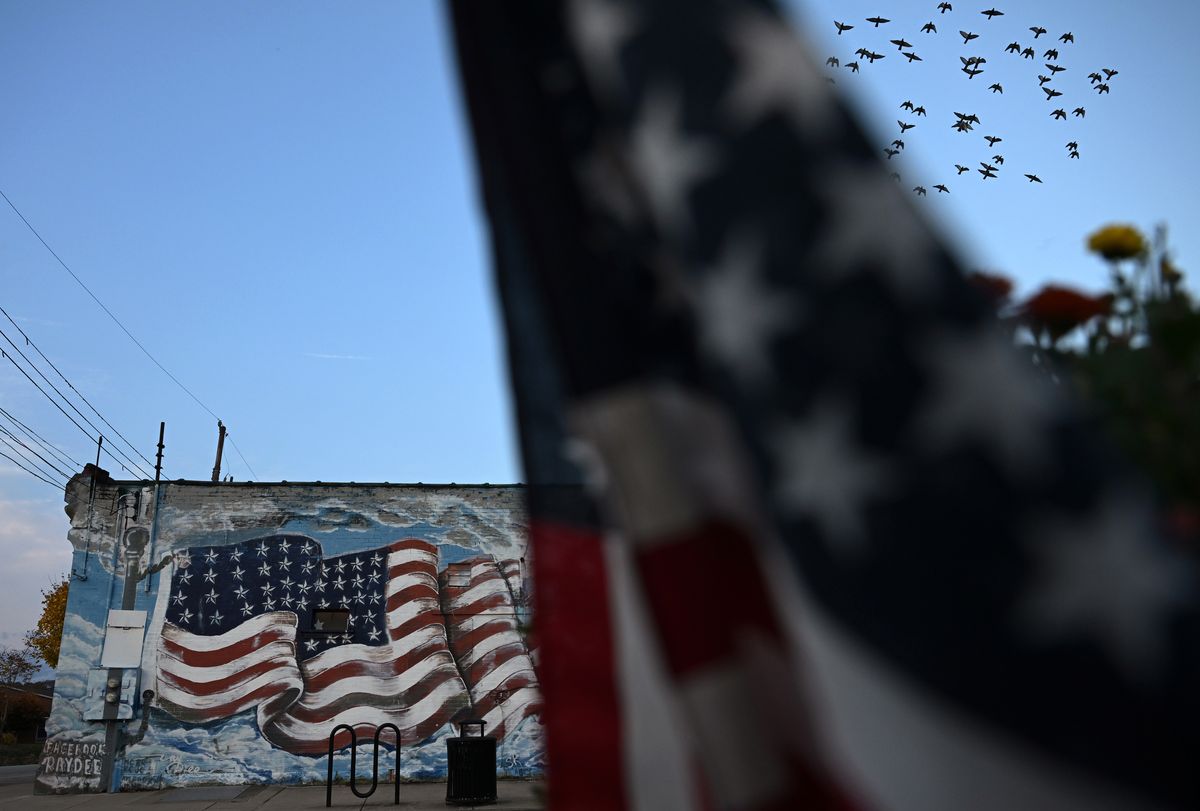
A mural of the American flag in Verona, Pennsylvania, in October 2024.
12:20 JST, September 15, 2025
At no time in living memory has this country’s democratic system appeared more fragile. A question now is whether the values upon which that system was built are capable of repairing it.
The murder on Wednesday of conservative influencer Charlie Kirk on a Utah college campus, videos of which played endlessly on social media, was the latest episode in a rising tide of violence aimed at figures across ideological and partisan lines. It is happening with an intensity and frequency unlike any seen in more than half a century.
At the same time, shared norms and institutions are giving way to zero-sum politics, led by a president who is stretching executive authority in unprecedented ways while turning an already polarized country into even more of a red-versus-blue battleground.
Family members of Tyler James Robinson, the 22-year-old suspect in Kirk’s killing, described someone steeped in online culture who had become “more political” in the run-up to the shooting. Unfired bullet casings discovered by investigators were said to have been engraved with messages, including one that read “hey fascist! catch!”
Utah’s Republican governor, Spencer Cox, called what happened “much bigger than an attack on an individual. It is an attack on all of us. It is an attack on the American experiment.”
“This is our moment. Do we escalate or do we find an off-ramp?” Cox added during a news conference on Friday. “It’s a choice, and every one of us gets to make that choice.”
One place where the country has traditionally made such choices has been at the ballot box, which is why the stakes of next year’s midterm elections loom so large.
The party that holds the White House is at a historical disadvantage; it almost always loses seats in Congress. And the Republicans’ current majority in the House is a slim one.
So Donald Trump is squeezing out what marginal gains he can, encouraging gerrymandering efforts in Republican-led states, starting with one that could pick up five seats in Texas, a move that could be met in kind by California and potentially other Democratic strongholds.
What Democrats discovered in 2024 is that framing an election as a clash between the abstractions of democracy and autocracy had limited appeal at a time when many in the electorate were more concerned with grappling with the financial stresses of day-to-day living.
As Democratic political strategist David Axelrod put it then: “If you are talking about democracy over the dinner table, it is probably because you don’t have to worry about the cost of food on your dinner table.” Axelrod continues to view the democracy argument as one that appeals primarily to economically comfortable elites.
But elevating the state of democracy as an issue could have more resonance now, other Democrats contend, with Trump back in office and pushing bounds in ways that might have seemed unimaginable before.
“The road to authoritarianism is littered with people telling you, you’re overreacting,” Minnesota Gov. Tim Walz, the 2024 Democratic vice-presidential nominee, said Friday in an interview.
“Well, when their neighbors are getting picked up [by immigration authorities], when they’re seeing this now, now it’s in action,” Walz added. “It’s no longer like, look, Trump is going to do whatever he wants. He’s going to step over the rule of law. He’s going to go around Congress. He’s going to defund things that he has no authority to do. All of those things are happening.”
“Do I think his hardcore supporters are going to move? No,” Walz said. “It’s the 70 million [voters] who stayed home who are seeing it now. It’s becoming much more personal to them.”
That is also the premise being put forward by political strategist Stacey Abrams, the former minority leader of the Georgia House who vaulted to national prominence when she ran two failed races for governor in which she drew attention to concerns about voter suppression.
On Monday, Abrams plans to announce a national campaign with a seven-figure budget centered on a 10-point framework she has put together to make the case that democracy’s guardrails are already crumbling.
Authoritarianism does not arrive suddenly, Abrams said Tuesday at the Cap Times Idea Fest in Madison, Wisconsin. “It settles in, and it becomes an inevitable force. And you cannot uproot it, unless you start fighting it soon.”
“This is an existential fight about the nature of democracy in the United States of America, and if we think of it as anything less, we are misreading the moment,” she added.
A connection must also be drawn between the fraying of democratic norms and the rise in horrifying political attacks, Abrams told me in a subsequent interview after Kirk’s murder. While political violence should always be deplored, she said, it should not be a muzzle on those like herself who are pointing out that link. “We cannot eschew these conversations because they are uncomfortable,” she added.
Matthew Dallek, a George Washington University professor of political management who has written extensively about violent political movements, said that when each side views the other as an existential threat – or in Trump’s words, as “the enemy from within” – it provides a rationale for people who are unbalanced to take violent action.
Particularly with the accelerant of social media, “individuals who are mentally ill absorb ideas that are swimming in the culture,” Dallek said.
Trump contended that Kirk’s murder follows a pattern by the “radical left.” In an address on Wednesday from the Oval Office, he also cited the assassination attempt against him during a rally in Butler, Pennsylvania; attacks on Immigration and Customs Enforcement agents; the killing of a health care executive in New York; and the 2017 shooting that wounded Rep. Steve Scalise (R-Louisiana), now the House majority leader, and three others.
Absent from that list were incidents against prominent Democrats, including the 2022 bludgeoning in his home of Paul Pelosi, the husband of Rep. Nancy Pelosi (D-California), who was then the speaker of the House; a 2020 plot by members of a right-wing paramilitary militia group to kidnap Michigan Gov. Gretchen Whitmer; the arson in April of the Pennsylvania governor’s mansion where Josh Shapiro and his family were celebrating Passover; or the far-right zealot masquerading as a police officer who in June allegedly killed Democratic State Rep. Melissa Hortman and her husband, Mark, and wounded state Sen. John Hoffman and his wife, Yvette.
The president vowed that his administration would avenge Kirk’s death by wreaking retribution against “each and every one of those who contributed to this atrocity, and to other political violence, including the organizations that fund it and support it.”
Largely missing these days have been the kind of political leaders who have in the past summoned the country to rise above such impulses.
After a truck bomb planted by a political extremist leveled a federal building in Oklahoma City in 1995, killing 168 people, President Bill Clinton traveled to that deeply conservative part of the country and delivered what is widely regarded as the most powerful speech he ever made. In the wake of the deadliest act of homegrown terrorism in U.S. history, the president marginalized radical fringe actors who commit such acts and offered a strong defense of the government workers who had been the target of the bombing committed by Timothy McVeigh.
“To all my fellow Americans beyond this hall, I say, one thing we owe those who have sacrificed is the duty to purge ourselves of the dark forces which gave rise to this evil,” Clinton said. “They are forces that threaten our common peace, our freedom, our way of life.”
In the words of Utah’s governor on Friday, there was a stirring of that kind of leadership.
“Political violence is different than any other type of violence for lots of different reasons,” Cox said. “We will never be able to solve all the other problems – including the violence – problems that people are worried about, if we can’t have a clash of ideas safely and securely.”
“Especially,” he added, “those ideas with which you disagree.”





Most Read
Popular articles in the past 24 hours
-

‘Dry Bonsai’ Gives New Life to Withered Trees, Allows Free Artist...
-

Japanese Students Use Traditional Pickle to Create Novel Wagashi ...
-

McDonald's Japan Raises Prices; Big Mac to Cost ¥500, Double Chee...
-

Nepal Bus Crash Kills 19 People, Injures 25 Including One Japanes...
-

Japan’s Nikkei Stock Average Rises as AI-Related Stocks Shine; Co...
-

Astellas Collaborates with Vir to Develop Its Experimental Prosta...
-

Early-Blooming Kawazu Cherry Blossoms Create Sea of Pink at Park ...
-

Joruri Bunraku Narrative Performed in Honor of Donald Keene by La...
Popular articles in the past week
-

Producer Behind Pop Group XG Arrested for Cocaine Possession
-

Japan PM Takaichi’s Cabinet Resigns en Masse
-

Sanae Takaichi Elected Prime Minister of Japan; Keeps All Cabinet...
-
Japan's Govt to Submit Road Map for Growth Strategy in March, PM ...
-

Bus Carrying 40 Passengers Catches Fire on Chuo Expressway; All E...
-

U.S. Firm to Build Training Hub in Fukushima N-plant for Debris R...
-

Japan, U.S. Name 3 Inaugural Investment Projects; Reached Agreeme...
-

Riku-Ryu Pair Wins Gold Medal: Their Strong Bond Leads to Major C...
Popular articles in the past month
-
Producer Behind Pop Group XG Arrested for Cocaine Possession
-
Japan PM Takaichi’s Cabinet Resigns en Masse
-

Japan Institute to Use Domestic Commercial Optical Lattice Clock ...
-

Man Infected with Measles Reportedly Dined at Restaurant in Tokyo...
-

Israeli Ambassador to Japan Speaks about Japan’s Role in the Reco...
-

Videos Plagiarized, Reposted with False Subtitles Claiming ‘Ryuky...
-

Man Infected with Measles May Have Come in Contact with Many Peop...
-

Prudential Life Insurance Plans to Fully Compensate for Damages C...
Top Articles in News Services
-
Survey Shows False Election Info Perceived as True
-
Hong Kong Ex-Publisher Jimmy Lai’s Sentence Raises International Outcry as China Defends It
-
Japan’s Nikkei Stock Average Touches 58,000 as Yen, Jgbs Rally on Election Fallout (UPDATE 1)
-
Japan’s Nikkei Stock Average Falls as US-Iran Tensions Unsettle Investors (UPDATE 1)
-
Trump Names Former Federal Reserve Governor Warsh as the Next Fed Chair, Replacing Powell
JN ACCESS RANKING
-
Producer Behind Pop Group XG Arrested for Cocaine Possession
-
Japan PM Takaichi’s Cabinet Resigns en Masse
-
Japan Institute to Use Domestic Commercial Optical Lattice Clock to Set Japan Standard Time
-
Man Infected with Measles Reportedly Dined at Restaurant in Tokyo Station
-
Israeli Ambassador to Japan Speaks about Japan’s Role in the Reconstruction of Gaza