
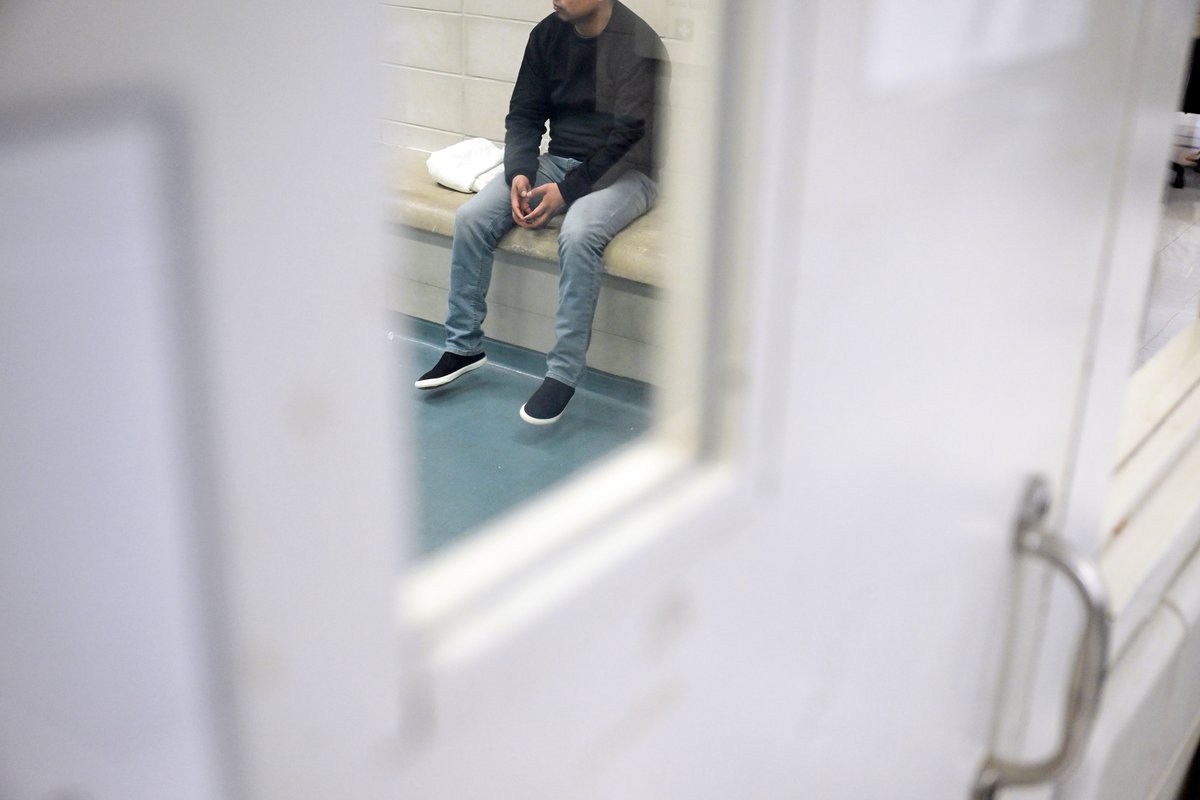
A person sits in a holding cell after he was detained during ICE-led operations to apprehend illegal immigrants on Jan. 28 in New York.
12:30 JST, September 8, 2025
The Trump administration plans to reopen several former prisons and detention centers that were closed by the federal government years ago over concerns about violence, medical neglect and systemic understaffing, as part of the president’s plan to carry out the largest deportation campaign in U.S. history.
Three of the facilities, in Texas, Kansas and Georgia, are on a government list of detention centers that U.S. Immigration and Customs Enforcement plans to reopen or expand by the end of this year, according to an internal planning document obtained by The Washington Post. All three would be operated by the companies that ran them previously.
Congress has approved $45 billion to expand immigrant detention over the next four years. Meanwhile, the Trump administration has stripped away oversight measures and provided limited details on how it plans to address chronic issues that led to past problems at these facilities, including understaffing in remote areas.
The troubled facilities were closed during the Biden administration after serious incidents, and in some cases, years of recurring problems.
At the sprawling Reeves County prison in West Texas, which could hold more than 4,000 people, inmates rioted to protest poor medical care, food and the use of solitary confinement, causing $20 million in damage.
A Senate investigation found that a physician affiliated with the 1,000-bed Irwin County Detention Center in rural Georgia appeared to have performed “excessive, invasive and often unnecessary gynecological procedures” on dozens of women detained between 2017 and 2020.
And at a prison in Leavenworth, Kansas, with capacity for about 1,000 inmates, understaffing led to such a level of violence and chaos that one federal judge characterized the facility as “an absolute hell hole.”
“The facilities that have been closed in prior administrations were closed for good reason, generally after a lot of thought and negotiation and consideration,” said Deborah Fleischaker, former acting ICE chief of staff under President Joe Biden. “And to reopen those without really, really clear mitigation plans and oversight and staffing models is just a recipe for more harm to detainees.”
Reeves was overseen by the Federal Bureau of Prisons, Irwin by ICE and Leavenworth by the U.S. Marshals Service. Representatives for the private companies that operate the Reeves and Irwin detention facilities – Geo Group and LaSalle Corrections, respectively – did not respond to requests for comment.
Steve Owen, a spokesman for CoreCivic, the owner of the Leavenworth facility, said in an email that the company meets or exceeds government standards at all its 42 correctional and detention facilities across the country. He said that the Kansas prison faced security challenges related to understaffing during a short period of its 30 years in operation, and that the company has seen a positive response from job seekers as it lays plans to reopen the facility.
“As with any difficult situation, we sought to learn from it,” he said. “Staffing was the main contributor to the challenges, and the COVID-19 pandemic compounded the labor issues.”
Tricia McLaughlin, a Department of Homeland Security spokeswoman, said in an emailed statement that ICE detention centers abide by higher standards than most prisons. She also said that the internal planning document is still subject to changes, and the agency may ultimately decide against issuing certain contracts. DHS noted that funds for staff who would be responsible for medical and detention standards compliance were included in Congress’s spending bill.
The Trump administration said in March that it was closing two watchdog agencies that oversaw detention centers and investigated detainee complaints. DHS later reversed course, but lawyers for immigrants and nonprofit advocacy groups assert that deteriorating conditions at some locations are festering unchecked. A federal judge in New York ruled last month that ICE needed to improve conditions at a Lower Manhattan immigration holding facility, where detainees claimed they were held without beds, showers or medical support and received only two small meals a day.
Unlike criminal detention, immigration detention is not meant to be punitive. A Supreme Court ruling and ICE’s website state that those facing civil violations should not be held as a form of punishment; rather, detention for immigration offenses is meant to ensure people show up for proceedings.
Detainees at some facilities are housed in dormitory-style rooms with bunk beds and limited access to a recreational area at certain times during the day. But Eunice Cho, senior counsel at the American Civil Liberties Union’s National Prison Project, says detainees are increasingly being locked in cells with little access to bare necessities.
“Punitive conditions can take place in a number of ways,” Cho said, including “deprivation of medical care, deprivation of access to counsel; abuse of force; severe overcrowding.”
Remote locations, isolated detainees
Many of the facilities that ICE plans to reopen are in remote, rural areas where, historically, few people have been willing to work a difficult job that requires frequent overtime shifts. Many state and local prisons are already experiencing a staffing crisis, said Lauren-Brooke Eisen, who researches private prisons as a senior director of the Brennan Center’s Justice Program, a nonpartisan law and policy organization affiliated with New York University’s law school.
Nearly 90 percent of ICE detainees are held in facilities run by contract companies in the private sector. These firms shifted away from holding people in federal prisons over the past decade after Presidents Barack Obama and Joe Biden ordered the Bureau of Prisons to phase out contracts with privately run prisons, citing federal research showing such facilities were more likely to have security problems and do not substantially save taxpayers money.
President Donald Trump has reversed these policies, but federal prison contracts have continued to wind down and private prison companies now own many empty facilities. This year, ICE started working with contractors to convert a few of those prisons into immigrant detention centers, including in Michigan and Tennessee, and plans to issue many more contracts in the coming months.
The Reeves County Detention Center, located in the remote Trans-Pecos region of West Texas, was so hard to staff when it received a contract in 2007 to house migrant men that officials eliminated the minimum required staffing levels determined by the federal government, according to a 2015 audit by the Justice Department’s Office of the Inspector General. The unusual concession meant Reeves was rarely – if ever – fully staffed.
Reeves’s remoteness contributed to a sense that guards “can act with impunity,” said Lisa Graybill, former legal director for the ACLU of Texas, who sued the federal government and the administrators of the prison over the death of an undocumented immigrant who was denied medical care at the facility. Graybill, who litigated the case on behalf of his survivors, said that he was epileptic and put in solitary confinement merely because he was demanding medication.
Geo Group claimed legal immunity and said it had acted in “good faith” in court filings. The case was resolved in a monetary settlement awarded to the detainee’s family.
“The understaffing was astounding even in a system that flourishes and profits on what I would call planned understaffing,” Graybill said.
These factors contributed to a series of riots in 2008 and 2009 in which inmates set a mattress on fire and destroyed property, demanding better food, medical care and living conditions. Three inmates were hospitalized, according to a CNN report at the time. Graybill described the events as an act of “desperation.”
Two of the three units at Reeves closed in 2017, after the government did not renew its contract. The third unit closed in 2022 after the Biden administration issued its executive order phasing out Justice Department contracts with private prisons, saying they provide “incarceration that is less humane and less safe.”
ICE plans to award Geo a new contract to reopen Reeves by October, and eventually to house up to 5,700 immigrant detainees there, according to the internal planning document obtained by The Post. That includes 2,000 beds for unauthorized migrant parents and children, which would make it one of the largest family detention centers in the country.
‘Gynecological abuse’
The Irwin County Detention Center is in the tiny town of Ocilla, Georgia, which is more than 100 miles from the nearest major city and has a population smaller than some high schools. In 2020, former Irwin detainees complained that they’d undergone nonconsensual and unnecessary gynecological procedures by an outside doctor whom Irwin’s medical staff had referred them to.
Sarah Owings, a Georgia-based immigration attorney who represented some of the women alleging mistreatment, said the facility’s location “in the middle of nowhere” likely constrained its ability to hire qualified medical staff, as well as the failure of authorities to see what was happening to the women there.
“There’s no oversight,” she said. “When you combine that with the absolute powerlessness of the people you are talking about detaining, that makes it possible for bad things to happen in the dark.”
Studies have shown numerous deficiencies in the health care that ICE and its contractors typically provide detainees, from ineffective mental health screenings to improper surgical procedures. One report last year by the ACLU and Physicians for Human Rights found that over 95 percent of the deaths that occurred in ICE custody between 2017 and 2021 could have been prevented.
A bipartisan Senate report in 2022 found that ICE failed to end a years-long pattern of what medical experts described as “aggressive and unethical” treatment by a single doctor working with Irwin’s detainees.
Sen. Jon Ossoff (D-Georgia), then-chair of the Senate subcommittee that led the investigation, blamed ICE for not properly vetting the doctor and noted that he had previously been sued by the Justice Department and the state of Georgia for allegedly “performing excessive and unnecessary procedures.” He also had been dropped by a major insurer for “excessive malpractice cases” and was not board-certified, the report said.
At the time, an ICE health care official testified that the agency did not find evidence of such procedures but immediately stopped sending patients to the doctor “out of an abundance of caution.” A representative from LaSalle Corrections, the Irwin operator, testified that ICE “was solely authorized and responsible for vetting and credentialing all off-site medical providers.” The doctor has denied any wrongdoing.
Elora Mukherjee, a law professor at Columbia University who filed a class action complaint against the facility, said that “the gynecological abuse was one piece in a horrifying scene of myriad problems.” The case was settled last year.
The Biden administration ended ICE’s contract with Irwin in 2021. Irwin is on the list of facilities for which ICE plans to issue a new contract in the coming months, according to the agency planning document.
Trump’s border czar, Tom Homan, has repeatedly said that expanding ICE’s detention capacity is necessary to arrest and deport more people.
“The more beds we have, the more success we’re going to see,” he told reporters at a press briefing in Washington last month.
Communities on edge
With the reopening of these facilities, some people who live near them see the problems of the past as reason to worry about what happens next.
A group of residents in Leavenworth has come together to oppose the planned reopening of the local prison as an ICE facility, writing newspaper editorials, putting up yard signs and staging protests. They contend that the facility’s owner, CoreCivic, presided over an era in which the prison failed to keep its guards and inmates safe.
A judge in Kansas issued a temporary injunction this summer blocking CoreCivic from reopening the facility without a local permit or sign-off from a court. CoreCivic is appealing that decision.
CoreCivic operated the former maximum-security prison before closing it in 2021, after the ACLU wrote a letter to the White House claiming that understaffing and rampant drug use by prisoners created an unruly atmosphere where beatings and bloodshed were the norm. At the time, a CoreCivic representative described the allegations in the letter as “false and defamatory” and designed “to exert political pressure.”
William Rogers, a former guard at the Leavenworth facility, said in an interview that he was assaulted seven times during the five years he worked there, from 2016 to 2020, including once when he was stabbed.
CoreCivic’s Owen said the company has hired about 130 of the 300 staff it expects to need at the facility, and plans to pay them a starting wage of $28.25 an hour – slightly higher than the median wage for correctional officers last year, according to the Bureau of Labor Statistics. The facility is about 30 miles from Kansas City – closer to a major city than many other detention centers.
Owen said the facilities are “regularly subject to independent audits without any prior notice” and that the company sees it as its responsibility to “care for each person respectfully and humanely while they receive the legal due process that they are entitled to.”
Rogers, a member of the local community who has participated in recent protests against CoreCivic, said he nonetheless fears that conditions could be worse than they were before, in part because the Trump administration’s aggressive approach to arresting and deporting people might foster an atmosphere of carelessness toward migrants.
“There’s going to be a whole different level of how these people are treated,” Rogers said.








Most Read
Popular articles in the past 24 hours
-

‘Dry Bonsai’ Gives New Life to Withered Trees, Allows Free Artist...
-

Japanese Students Use Traditional Pickle to Create Novel Wagashi ...
-

McDonald's Japan Raises Prices; Big Mac to Cost ¥500, Double Chee...
-

Nepal Bus Crash Kills 19 People, Injures 25 Including One Japanes...
-

Japan’s Nikkei Stock Average Rises as AI-Related Stocks Shine; Co...
-

Astellas Collaborates with Vir to Develop Its Experimental Prosta...
-

Early-Blooming Kawazu Cherry Blossoms Create Sea of Pink at Park ...
-

Joruri Bunraku Narrative Performed in Honor of Donald Keene by La...
Popular articles in the past week
-

Producer Behind Pop Group XG Arrested for Cocaine Possession
-

Japan PM Takaichi’s Cabinet Resigns en Masse
-

Sanae Takaichi Elected Prime Minister of Japan; Keeps All Cabinet...
-

Japan's Govt to Submit Road Map for Growth Strategy in March, PM ...
-

Bus Carrying 40 Passengers Catches Fire on Chuo Expressway; All E...
-

U.S. Firm to Build Training Hub in Fukushima N-plant for Debris R...
-

Japan, U.S. Name 3 Inaugural Investment Projects; Reached Agreeme...
-

Riku-Ryu Pair Wins Gold Medal: Their Strong Bond Leads to Major C...
Popular articles in the past month
-
Producer Behind Pop Group XG Arrested for Cocaine Possession
-
Japan PM Takaichi’s Cabinet Resigns en Masse
-

Japan Institute to Use Domestic Commercial Optical Lattice Clock ...
-

Man Infected with Measles Reportedly Dined at Restaurant in Tokyo...
-

Israeli Ambassador to Japan Speaks about Japan’s Role in the Reco...
-

Videos Plagiarized, Reposted with False Subtitles Claiming ‘Ryuky...
-

Man Infected with Measles May Have Come in Contact with Many Peop...
-

Prudential Life Insurance Plans to Fully Compensate for Damages C...
Top Articles in News Services
-

Survey Shows False Election Info Perceived as True
-
Hong Kong Ex-Publisher Jimmy Lai’s Sentence Raises International Outcry as China Defends It
-
Japan’s Nikkei Stock Average Touches 58,000 as Yen, Jgbs Rally on Election Fallout (UPDATE 1)
-
Japan’s Nikkei Stock Average Falls as US-Iran Tensions Unsettle Investors (UPDATE 1)
-

Trump Names Former Federal Reserve Governor Warsh as the Next Fed Chair, Replacing Powell
JN ACCESS RANKING
-
Producer Behind Pop Group XG Arrested for Cocaine Possession
-
Japan PM Takaichi’s Cabinet Resigns en Masse
-
Japan Institute to Use Domestic Commercial Optical Lattice Clock to Set Japan Standard Time
-
Man Infected with Measles Reportedly Dined at Restaurant in Tokyo Station
-
Israeli Ambassador to Japan Speaks about Japan’s Role in the Reconstruction of Gaza