
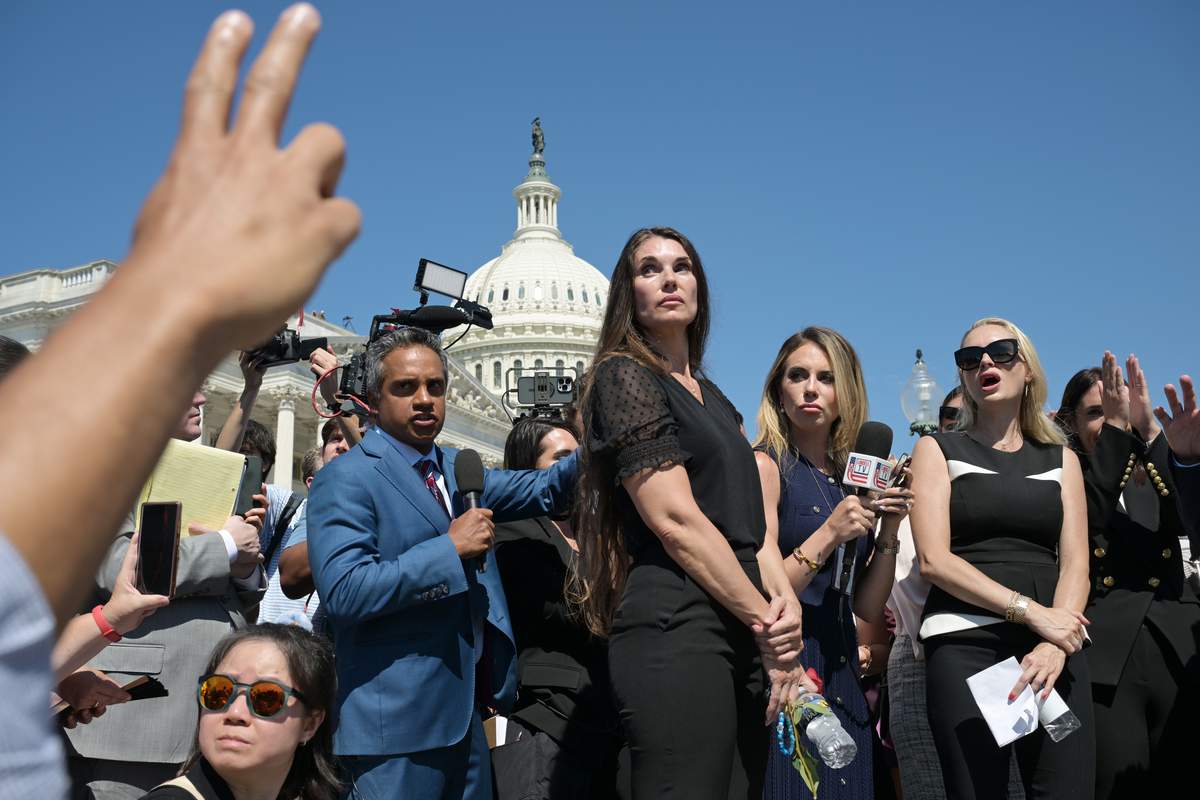
Anouska De Georgiou, right, gathers with other Jeffrey Epstein accusers at a news conference calling for the release of government files outside the U.S. Capitol on Sept. 3.
12:15 JST, September 8, 2025
Though celebrity real estate developer Donald Trump was not yet running for president when he took the stage at the Conservative Political Action Conference in February 2015, he was already planting the seeds of groundless supposition that have since come back to haunt him.
Asked for his opinion of Bill Clinton, Trump replied, “Nice guy.” Then he added what sounded almost like a non sequitur: “Got a lot of problems coming up in my opinion with the famous island. With Jeffrey Epstein.”
Clinton has acknowledged he traveled on Epstein’s plane, but there is no evidence he knew of the financier’s alleged sex trafficking. The former Democratic president also denies he ever set foot on Epstein’s infamous Caribbean island.
But conspiracy theories, once stoked, are not easy to control or extinguish – as Trump, who once described Epstein as “a lot of fun to be with,” is discovering.
American history is replete with fringe thinking, going as far back as 18th-century theories that the country was being run by supposed secret societies, including the Freemasons and the Illuminati. What distinguishes Trump is the degree to which he built his political movement around conspiracy theories.
With his administration under bipartisan pressure to release everything it has on Epstein, who died by suicide in his prison cell in 2019, Trump claimed last Wednesday that the files in question are “a Democrat hoax that never ends.” That ignored the role he and his own allies had played in fostering the idea that the records hold something secret and damning about powerful men.
Meanwhile, Epstein’s accusers were telling their harrowing stories on Capitol Hill – some of them in public for the first time – and demanding more accountability.
A day later, Trump Health and Human Services Secretary Robert F. Kennedy Jr., a leading evangelist for theories that have fueled vaccine skepticism, came under blistering criticism from both Democrats and Republicans on the Senate Finance Committee. Trump administration actions have included firing the director of the Centers for Disease Control and Prevention after she refused to resign amid pressure to change vaccine policy; dismantling the expert panel that makes vaccine recommendations, and canceling nearly $500 million in grants and contracts for mRNA vaccines, including for flu and the coronavirus.
“Effectively, we’re denying people vaccine,” said Sen. Bill Cassidy (R-Louisiana), a physician who had been a key vote in Kennedy’s confirmation as health secretary.
While Trump has in the past flirted with the discredited idea that there is a link between vaccines and autism, the paradox is that Operation Warp Speed – the accelerated development of an effective shot in the throes of the covid-19 pandemic – stands as arguably the greatest achievement of his first term, estimated to have prevented millions of deaths. Yet the man who now serves as his health secretary once called the vaccine “a crime against humanity.”
Among Senate Republicans, there are clear signs that support for and patience with Kennedy are evaporating, marking a rare fissure between the president and his party in Congress. But at least for the time being, Trump is standing by Kennedy. “I like the fact that he’s different,” he said.
Joseph Uscinski, a political scientist at the University of Miami and co-author of the book “American Conspiracy Theories,” said that before running for president, Trump “was not a conservative, did not have a ready-made coalition already supporting him, did not have any governing experience. And those are the things that primaries are usually fought on. So he changed the game.”
“Donald Trump’s message was, everything is corrupt. Washington, D.C., is a swamp that needs to be drained, and anyone who’s been a part of it is more corrupt than me,” Uscinski added. “It’s not just rhetoric. He pulled in people who already viewed the world that way.”
Indeed, five years before Trump jumped into the large and highly credentialed 2016 GOP primary field, he had already won a following on the conspiratorial right by pushing the outlandish “birtherism” theory that then-president Barack Obama, who was born in Hawaii and whose father was Kenyan, had been born in Africa and was therefore not constitutionally qualified to hold the office.
The falsehood about Obama gained striking currency. At one point in 2011, polling suggested that about a quarter of Americans believed it to be true, and among Republicans, 45 percent said they thought Obama was not born in the United States. Trump claimed to have dispatched investigators to Hawaii to uncover “one of the greatest cons in the history of politics and beyond.” That team was never heard from in the end.
As president, Trump employed the machinery of government in the service of conspiracy theories and wildly inaccurate assertions. In July, my colleague Naftali Bendavid catalogued a number of them, including that Social Security funds are going to millions of dead people and that South Africa’s government is massacring White farmers.
Trump has also commissioned a lengthy Justice Department investigation to squelch speculation that the department was concealing an explosive list of Epstein’s clients and that the convicted sex trafficker had been secretly murdered. On his Truth Social platform, the president implored his followers not to “waste Time and Energy on Jeffrey Epstein, somebody that nobody cares about.”
A problem now, however, is that Trump sits atop the very power structure that his followers have been so conditioned to mistrust.
“This is the danger of Trump’s strategy. He didn’t put together a coalition of people with policy preferences. He put together a coalition of people who are conspiracy-minded, who believe tons of conspiracy theories. And when you boil all those theories down, it comes down to people in power are doing terrible things to us in secret. And he’s the person in power,” Uscinski said.
So what now? Trump is doing his best to change the subject. As Uscinski put it: “What he did in his first term, and what he’s doing even more so now, is try and shoot conspiracy theories at every other thing.”





Most Read
Popular articles in the past 24 hours
-

‘Dry Bonsai’ Gives New Life to Withered Trees, Allows Free Artist...
-

Japanese Students Use Traditional Pickle to Create Novel Wagashi ...
-
McDonald's Japan Raises Prices; Big Mac to Cost ¥500, Double Chee...
-

Nepal Bus Crash Kills 19 People, Injures 25 Including One Japanes...
-

Japan’s Nikkei Stock Average Rises as AI-Related Stocks Shine; Co...
-

Astellas Collaborates with Vir to Develop Its Experimental Prosta...
-

Early-Blooming Kawazu Cherry Blossoms Create Sea of Pink at Park ...
-

Joruri Bunraku Narrative Performed in Honor of Donald Keene by La...
Popular articles in the past week
-

Producer Behind Pop Group XG Arrested for Cocaine Possession
-

Japan PM Takaichi’s Cabinet Resigns en Masse
-

Sanae Takaichi Elected Prime Minister of Japan; Keeps All Cabinet...
-

Japan's Govt to Submit Road Map for Growth Strategy in March, PM ...
-

Bus Carrying 40 Passengers Catches Fire on Chuo Expressway; All E...
-
U.S. Firm to Build Training Hub in Fukushima N-plant for Debris R...
-

Japan, U.S. Name 3 Inaugural Investment Projects; Reached Agreeme...
-

Riku-Ryu Pair Wins Gold Medal: Their Strong Bond Leads to Major C...
Popular articles in the past month
-
Producer Behind Pop Group XG Arrested for Cocaine Possession
-
Japan PM Takaichi’s Cabinet Resigns en Masse
-

Japan Institute to Use Domestic Commercial Optical Lattice Clock ...
-

Man Infected with Measles Reportedly Dined at Restaurant in Tokyo...
-

Israeli Ambassador to Japan Speaks about Japan’s Role in the Reco...
-

Videos Plagiarized, Reposted with False Subtitles Claiming ‘Ryuky...
-

Man Infected with Measles May Have Come in Contact with Many Peop...
-

Prudential Life Insurance Plans to Fully Compensate for Damages C...
Top Articles in News Services
-
Survey Shows False Election Info Perceived as True
-
Hong Kong Ex-Publisher Jimmy Lai’s Sentence Raises International Outcry as China Defends It
-
Japan’s Nikkei Stock Average Touches 58,000 as Yen, Jgbs Rally on Election Fallout (UPDATE 1)
-
Japan’s Nikkei Stock Average Falls as US-Iran Tensions Unsettle Investors (UPDATE 1)
-
Trump Names Former Federal Reserve Governor Warsh as the Next Fed Chair, Replacing Powell
JN ACCESS RANKING
-
Producer Behind Pop Group XG Arrested for Cocaine Possession
-
Japan PM Takaichi’s Cabinet Resigns en Masse
-
Japan Institute to Use Domestic Commercial Optical Lattice Clock to Set Japan Standard Time
-
Man Infected with Measles Reportedly Dined at Restaurant in Tokyo Station
-
Israeli Ambassador to Japan Speaks about Japan’s Role in the Reconstruction of Gaza