
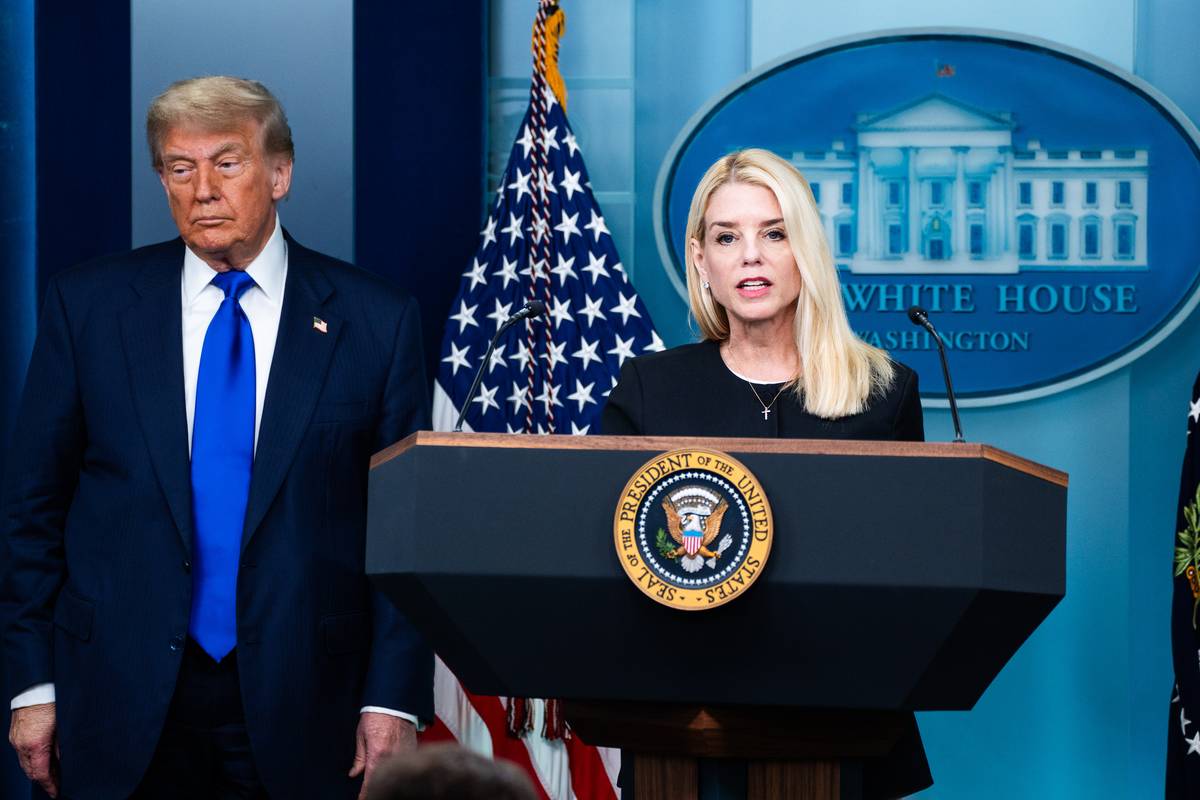
President Donald Trump with Attorney General Pam Bondi during a press briefing at the White House on June 27.
16:40 JST, September 4, 2025
Attorney General Pam Bondi has issued a pair of immigration rulings aimed at making it more difficult for immigrant families fleeing persecution and victims of domestic abuse to qualify for asylum in the United States.
The rulings late Tuesday marked the first time that Bondi has used her authority to review immigration appeals court decisions and set precedents for judges nationwide. Bondi’s interpretations could affect a significant share of pending asylum claims in immigration courts, which make up the majority of the 3.7 million cases nationwide.
The Board of Immigration Appeals is the highest authority in the administrative immigration courts operated by the Justice Department; the attorney general has the power to review its decisions and issue precedent-setting rulings. Former attorneys general in Republican and Democratic administrations have exercised that authority to shape or fine-tune immigration decisions.
Bondi’s rulings essentially reinstated previous decisions from then-Attorneys General Jeff Sessions and William P. Barr and then-acting attorney general Jeffrey Rosen during the first Trump administration. They had determined that victims of domestic abuse and families targeted by gangs or other threats generally would not qualify for asylum under U.S. law. The Biden administration vacated those decisions in 2021 to give immigrants more latitude to seek protection.
The flip-flopping on humanitarian protections reflects how the Justice Department’s immigration courts are vulnerable to the political whims of a sitting president and the nation’s highly polarized political debate over asylum. Republicans contend that being a victim of a crime perpetrated by a private citizen – as opposed to governmental persecution – is not usually grounds for asylum; immigrant rights advocates say such cases are often legally valid under asylum laws and merit a full hearing in immigration court.
In a statement, Justice Department spokesman Chad Gilmartin said: “Attorney General Bondi’s decision closes loopholes opened by the previous Administration and reduces the ability of illegal aliens to remain in the U.S. for long periods of time on the basis of invalid asylum claims. This decision restores fidelity to the law and helps secure our border and make America safe again.”
Bondi said she ordered the Board of Immigration Appeals to reconsider two asylum cases – one involving a domestic violence victim who feared returning to Honduras and another filed by a mother and her child from El Salvador who sought refuge in the U.S. a decade ago because their family had been targeted by gangs. Both parties had appealed their cases to U.S. circuit courts and hoped for a fresh hearing based on the Biden administration’s asylum decisions.
Bondi ruled that the criteria for deciding such cases should be narrowed.
“Although there may be circumstances when a government’s failure to control private conduct itself amounts to persecution,” those circumstances are “few and far between,” she wrote in the Honduran woman’s case. Family members will need to provide more evidence than biological ties to demonstrate that they are a member of a distinct group targeted by gangs, for instance, Bondi said.
Asylum is a humanitarian protection in federal law that allows people with a well-founded fears of persecution to apply for permanent refuge – and legal residency – in the United States. Federal law stipulates that people may seek asylum if they fear persecution based on race, religion, nationality, political opinion or “membership in a particular social group,” which in legal terms means a specific group that is a target for violence, such as victims of gang violence.
The Honduran woman, for instance, had sought asylum alleging she would be persecuted in her native country because of her political opinions and because she is a member of various groups that face persecution, including women who are domestic violence victims in Honduras, Bondi’s decision said.
Bondi’s decisions come as immigration courts under her watch have prompted concerns from civil rights advocates that they are growing less impartial and becoming politicized to help boost the Trump administration’s mass-deportation campaign. Court officials have in recent months encouraged judges to consider dismissing asylum cases without a hearing, fired immigration judges for unspecified reasons despite the asylum claims backlog and sought to replenish their ranks with military judges instead.
“This time around I think the dangers are much more profound than the first time,” Victoria Neilson, supervising attorney at the National Immigration Project, said of Bondi’s asylum rulings. “They could be an easy tool for someone that’s predisposed to dismiss cases.”
Immigration attorneys say Bondi’s rulings are likely to face legal challenges as migrants appeal immigration court denials in their asylum cases to the federal circuit courts.
In 2020, for instance, the U.S. Court of Appeals for the First Circuit ruled in favor of a woman from the Dominican Republic who argued that she deserved asylum protection because of that nation’s government had failed to stop her domestic abuser. The woman had lost her case in immigration court and at the Board of Immigration Appeals, but the federal circuit court found that the appeals board had failed to properly consider her arguments.
But many immigrants lack legal representation and advocates voiced concerns that Bondi’s decisions will empower immigration judges to dismiss their asylum cases without a hearing.
Immigration judges have denied nearly 59,000 asylum claims in fiscal 2025, which ends Sept. 30 – the highest yearly figure in at least a decade.
Blaine Bookey, an asylum law expert at the University of California College of the Law in San Francisco, said Bondi appeared to be aiming to deny asylum to as many people as possible.
“People will be denied protection,” she said, adding that courts will be flooded with cases on appeal.





Most Read
Popular articles in the past 24 hours
-

‘Dry Bonsai’ Gives New Life to Withered Trees, Allows Free Artist...
-

Japanese Students Use Traditional Pickle to Create Novel Wagashi ...
-

McDonald's Japan Raises Prices; Big Mac to Cost ¥500, Double Chee...
-

Nepal Bus Crash Kills 19 People, Injures 25 Including One Japanes...
-

Japan’s Nikkei Stock Average Rises as AI-Related Stocks Shine; Co...
-

Astellas Collaborates with Vir to Develop Its Experimental Prosta...
-

Early-Blooming Kawazu Cherry Blossoms Create Sea of Pink at Park ...
-

Joruri Bunraku Narrative Performed in Honor of Donald Keene by La...
Popular articles in the past week
-

Producer Behind Pop Group XG Arrested for Cocaine Possession
-

Japan PM Takaichi’s Cabinet Resigns en Masse
-

Sanae Takaichi Elected Prime Minister of Japan; Keeps All Cabinet...
-

Japan's Govt to Submit Road Map for Growth Strategy in March, PM ...
-

Bus Carrying 40 Passengers Catches Fire on Chuo Expressway; All E...
-

U.S. Firm to Build Training Hub in Fukushima N-plant for Debris R...
-

Japan, U.S. Name 3 Inaugural Investment Projects; Reached Agreeme...
-

Riku-Ryu Pair Wins Gold Medal: Their Strong Bond Leads to Major C...
Popular articles in the past month
-
Producer Behind Pop Group XG Arrested for Cocaine Possession
-
Japan PM Takaichi’s Cabinet Resigns en Masse
-

Japan Institute to Use Domestic Commercial Optical Lattice Clock ...
-

Man Infected with Measles Reportedly Dined at Restaurant in Tokyo...
-

Israeli Ambassador to Japan Speaks about Japan’s Role in the Reco...
-

Videos Plagiarized, Reposted with False Subtitles Claiming ‘Ryuky...
-

Man Infected with Measles May Have Come in Contact with Many Peop...
-

Prudential Life Insurance Plans to Fully Compensate for Damages C...
Top Articles in News Services
-
Survey Shows False Election Info Perceived as True
-
Hong Kong Ex-Publisher Jimmy Lai’s Sentence Raises International Outcry as China Defends It
-
Japan’s Nikkei Stock Average Touches 58,000 as Yen, Jgbs Rally on Election Fallout (UPDATE 1)
-
Japan’s Nikkei Stock Average Falls as US-Iran Tensions Unsettle Investors (UPDATE 1)
-
Trump Names Former Federal Reserve Governor Warsh as the Next Fed Chair, Replacing Powell
JN ACCESS RANKING
-
Producer Behind Pop Group XG Arrested for Cocaine Possession
-
Japan PM Takaichi’s Cabinet Resigns en Masse
-
Japan Institute to Use Domestic Commercial Optical Lattice Clock to Set Japan Standard Time
-
Man Infected with Measles Reportedly Dined at Restaurant in Tokyo Station
-
Israeli Ambassador to Japan Speaks about Japan’s Role in the Reconstruction of Gaza