
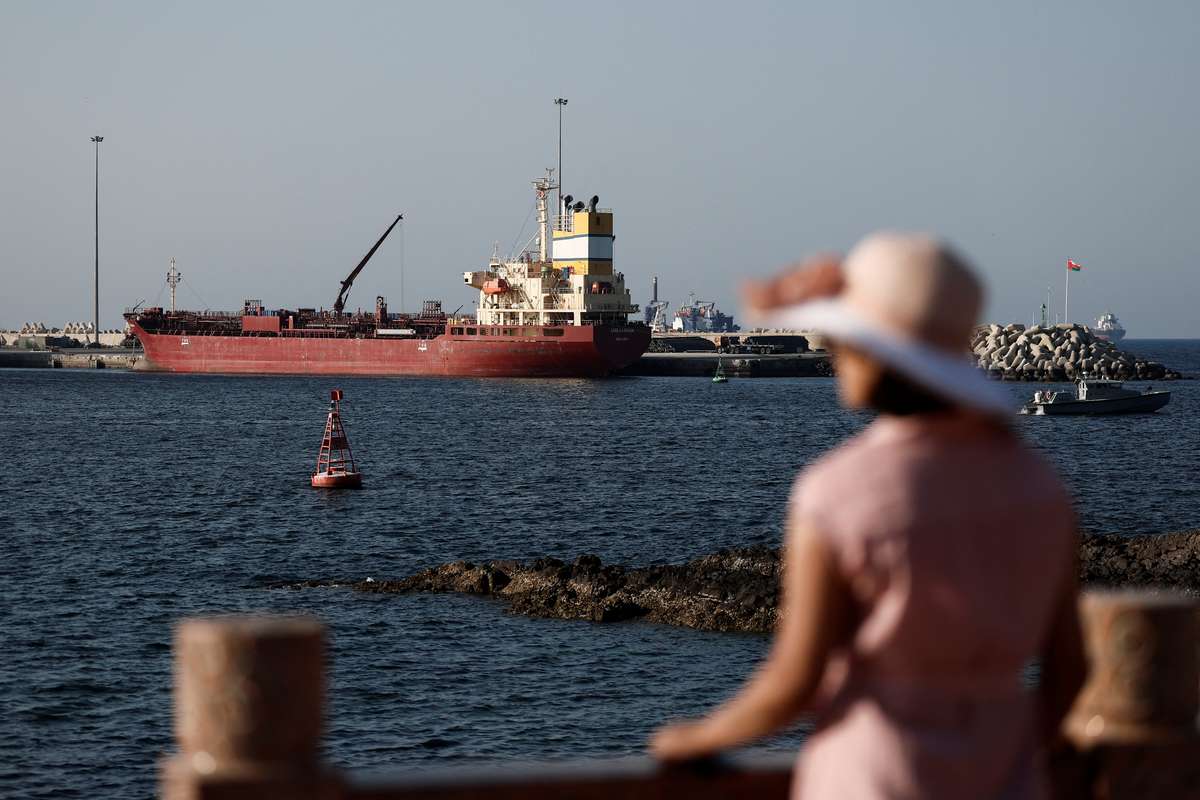
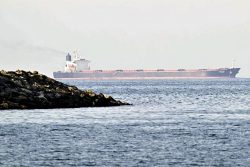
Luojiashan tanker sits anchored in Muscat, as Iran vows to close the Strait of Hormuz, amid the U.S.-Israeli conflict with Iran, in Muscat, Oman, March 7, 2026.
12:04 JST, March 10, 2026
March 10 (Reuters) – Oil prices fell on Tuesday after hitting their highest level in more than three years in the prior session as U.S. President Donald Trump predicted the war in the Middle East could end soon, easing concerns about prolonged disruptions to global oil supplies.
Brent futures LCOc1 fell $6.51, or 6.6%, to $92.45 a barrel at 0018 GMT, while U.S. West Texas Intermediate (WTI) crude CLc1 was down $6.12, or 6.5%, to $88.65.
Oil prices surged past $100 a barrel on Monday, hitting session highs of $119.50 for Brent and $119.48 for WTI, their highest since mid-2022, as supply cuts by Saudi Arabia and other producers during the expanding U.S.-Israeli war with Iran stoked fears of major disruptions to global supplies.
Prices later retreated after Russian President Vladimir Putin held a call with Trump and shared proposals aimed at a quick settlement to the Iran war, according to a Kremlin aide, easing concerns about a prolonged supply disruption.
Trump said on Monday in a CBS News interview that he thinks the war against Iran “is very complete” and that Washington was “very far ahead” of his initial four- to five-week estimated timeframe.
In response to Trump, Iran’s Revolutionary Guards (IRGC) said they would “determine the end of the war” and that Tehran would not allow “one liter of oil” to be exported from the region if U.S. and Israeli attacks continued, state media reported on Tuesday citing IRGC’s spokesperson.
But those comments did not lift prices, which were also under pressure because Trump is considering easing oil sanctions on Russia and releasing emergency crude stockpiles as part of a package of options aimed at curbing spiking global oil prices amid the Iran conflict, according to multiple sources.
“Taking the events of the past 24 hours into account, I expect crude oil to remain highly volatile, trading within a wide range between $75ish and $105ish in the sessions ahead,” Tony Sycamore, IG market analyst, said in a note.
Gulf oil producers have begun cutting output as the U.S.-Israeli war on Iran disrupted shipping in the region. Over the weekend, Iraq slashed production at its main southern oilfields by 70% to 1.3 million barrels per day while Kuwait Petroleum Corporation also began reducing output and declared force majeure.
Adding to the cuts, Saudi Arabia has now begun trimming production, sources said on Monday.
G7 nations said on Monday they were prepared to implement “necessary measures” in response to surging global oil prices but stopped short of committing to release emergency reserves.




Most Read
Popular articles in the past 24 hours
-

Foreign Influence Operations: This Issue Is No Longer Someone Els...
-

World's Oldest Bio-Business Is Japan's Seed Koji Retailing, Mold ...
-

Tokyo’s Classic ‘Pointed Hat’ Intake Tower Cameos in Films, Anime...
-

Man Attacked by Bear in Iwate Pref.; Injuries Not Life-Threatenin...
-
Flower Power; Tokyo Metropolitan Government Building Illuminated ...
-
208 Japanese Nationals Who Evacuated Qatar Arrive in Saudi Arabia
-

Councils under Cabinet Secretariat: Abolish Task Forces Whose Nec...
-
Trump Threatens to Escalate Iran War, but Says It Could End Soon
Popular articles in the past week
-

Ibaraki Pref.'s 1st Foreign Bus Driver Hired in Tsukuba
-
Amid Strait of Hormuz Blockade, Shipping Companies Scramble to Ge...
-
Strait of Hormuz Closure Shakes Markets; Prolonged Closure Could ...
-
2 Unpublished Early Novellas by Japan's Kenzaburo Oe Discovered, ...
-

Japan's 2nd Round of U.S. Investments May Be Worth Over $100 Bill...
-
Japan Govt Survey Finds Just 10% of Workers Want Working Hours to...
-

Imperial Family Watches World Baseball Classic Game Against Austr...
-
Govt to Utilize ODA for Ensuring Economic Security; Securing Ener...
Popular articles in the past month
-

Producer Behind Pop Group XG Arrested for Cocaine Possession
-

Japan PM Takaichi’s Cabinet Resigns en Masse
-

Man Infected with Measles Reportedly Dined at Restaurant in Tokyo...
-

Videos Plagiarized, Reposted with False Subtitles Claiming ‘Ryuky...
-

iPS Treatments Pass Key Milestone, but Broader Applications Far f...
-

Sanae Takaichi Elected Prime Minister of Japan; Keeps All Cabinet...
-

Nepal Bus Crash Kills 19 People, Injures 25 Including One Japanes...
-

Japan's Govt to Submit Road Map for Growth Strategy in March, PM ...
Top Articles in News Services
-
Survey Shows False Election Info Perceived as True
-

Japan’s Nikkei Stock Average Falls as US-Iran Tensions Unsettle Investors (UPDATE 1)
-
Japan’s Nikkei Stock Average Touches 58,000 as Yen, Jgbs Rally on Election Fallout (UPDATE 1)
-
Japan’s Nikkei Stock Average Rises on Tech Rally and Takaichi’s Spending Hopes (UPDATE 1)
-

Japan to Ban Use of Power Banks on Airplanes
JN ACCESS RANKING
-
Producer Behind Pop Group XG Arrested for Cocaine Possession
-
Japan PM Takaichi’s Cabinet Resigns en Masse
-
Man Infected with Measles Reportedly Dined at Restaurant in Tokyo Station
-
Videos Plagiarized, Reposted with False Subtitles Claiming ‘Ryukyu Belongs to China’; Anti-China False Information Also Posted in Japan
-
iPS Treatments Pass Key Milestone, but Broader Applications Far from Guaranteed