
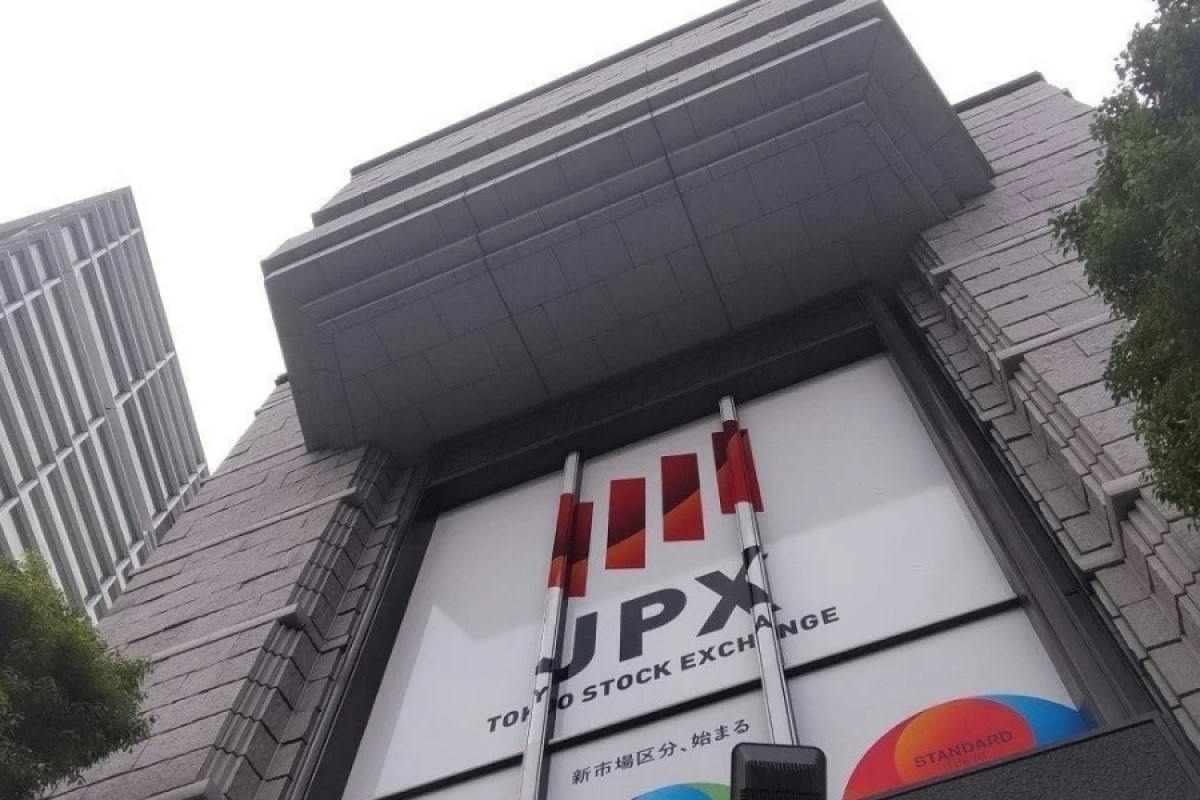
The Tokyo Stock Exchange
11:23 JST, September 19, 2025 (updated at 14:50 JST, Sep. 19)
TOKYO (Reuters) – Japan’s Nikkei share average turned negative on Friday, while the yen firmed, after the Bank of Japan (BOJ) kept interest rates steady as expected, butin a split decision, with two of the nine board members voting in favor of a hike.
The central bank also announced it will begin selling its holdings of exchange-traded funds (ETFs) and Japanese real-estate investment trusts (J-REITS), amassed over a decade of massive stimulus.
Japanese government bond yields jumped to 17-year peaks.
It came as a surprise, Hirofumi Suzuki, chief currency strategist at SMBC, said about the BOJ’s decision.
With the start of ETF sales and two dissenting votes against leaving policy unchanged, i.e., in favor of tightening, the outcome was hawkish despite expectations for a straightforward hold.
Investor focus now shifts to BOJ Governor Kazuo Ueda’s news conference at 0630 GMT.
The Nikkei tumbled as much as 1.8% in the immediate aftermath of the policy announcement, and was down 0.5% at 45,099.98, as of 0508 GMT, about 80 minutes after the central bank’s announcement.
In early trading, the index had risen as much as 1.2% to a record high of 45,852.75, driven by a surge in chip-sector stocks following anovernight rally inU.S. peers.
The timing of the ETF sale came as something of a surprise, occurring just as Japanese equity markets were hitting fresh highs and investor caution was rising, said Shinichiro Kobayashi, principal economist at Mitsubishi UFJ Research and Consulting.
While it is a negative factor [for stock prices], unwinding ETF holdings is the right step, as a central bank taking on private-sector credit risk is itself an unusual situation.
The yen strengthened as much as 0.5% to 147.20 per dollar, reversing about half of the 1% decline in the previous two sessions and eroding some of the support for Japan’s exporter-heavy stock market.
Traders now lay 60% odds on a quarter-point rate hike over the two remaining BOJ meetings this year, up from about 50% odds a week ago, according to LSEG data.
The two-year JGB yield, which is extremely sensitive to monetary policy expectations, jumped 2.5 basis points (bps) to 0.905%, the highest since June 2008.
The five-year yield leapt 4.5 bps to 1.2%, a level not seen since October 2008.
The 10-year yield added four bps to 1.635%, just short of this month’s peak of 1.64%, which was the highest since July 2008.
The 20-year yield, though, nudged down 0.5 bp to 2.62%. Benchmark 30-year JGBs had yet to trade following the BOJ’s announcement.
Initial market reactions suggest that short- and medium-term yields may now be more susceptible to upward pressure, as investors translate the reduction of risk-asset purchases into heightened expectations of future rate increases, said Shoki Omori, chief desk strategist at Mizuho Securities.
By contrast, yields at the long and super-long end of the curve should remain more insulated, their behavior being driven primarily by changes in the term premium.







Most Read
Popular articles in the past 24 hours
-

Yokohama to Test Out Renewable-Powered Offshore Floating Data Cen...
-

Ishinomaki Man Plush Toy Offers Hope to Children in Times of Disa...
-

Microsoft Japan Raided by Antitrust Watchdog for Allegedly Blocki...
-
Japan Eyes Introducing Prescreening System for Foreign Travelers,...
-

Nikkei Tops 59,000 for First Time
-

Pokémon Celebrates 30 Years with Japanese Pro Baseball Collab
-

Party Representatives’ Questions in Diet: Takaichi Says Consumpti...
-

Milano Cortina 2026: News in Pictures / Feats of Japanese Athlete...
Popular articles in the past week
-

Producer Behind Pop Group XG Arrested for Cocaine Possession
-

iPS Treatments Pass Key Milestone, but Broader Applications Far f...
-

Japan, U.S. Name 3 Inaugural Investment Projects; Reached Agreeme...
-

Tokyo Skytree's Elevator Stops, Trapping 20 People; All Rescued (...
-
Milano Cortina 2026: Japanese Gold Medalist Figure Skater Miura S...
-

Japan’s Major Real Estate Firms Expanding Overseas Businesses to ...
-

Nepal Bus Crash Kills 19 People, Injures 25 Including One Japanes...
-

Baby Monkey Punch Captures Hearts at Chiba Pref. Zoo, on Social M...
Popular articles in the past month
-
Producer Behind Pop Group XG Arrested for Cocaine Possession
-

Japan PM Takaichi’s Cabinet Resigns en Masse
-

Japan Institute to Use Domestic Commercial Optical Lattice Clock ...
-

Man Infected with Measles Reportedly Dined at Restaurant in Tokyo...
-

Israeli Ambassador to Japan Speaks about Japan’s Role in the Reco...
-

Videos Plagiarized, Reposted with False Subtitles Claiming ‘Ryuky...
-

Man Infected with Measles May Have Come in Contact with Many Peop...
-

Prudential Life Insurance Plans to Fully Compensate for Damages C...
Top Articles in News Services
-
Survey Shows False Election Info Perceived as True
-
Hong Kong Ex-Publisher Jimmy Lai’s Sentence Raises International Outcry as China Defends It
-
Japan’s Nikkei Stock Average Touches 58,000 as Yen, Jgbs Rally on Election Fallout (UPDATE 1)
-
Japan’s Nikkei Stock Average Falls as US-Iran Tensions Unsettle Investors (UPDATE 1)
-

Trump Names Former Federal Reserve Governor Warsh as the Next Fed Chair, Replacing Powell
JN ACCESS RANKING
-
Producer Behind Pop Group XG Arrested for Cocaine Possession
-
Japan PM Takaichi’s Cabinet Resigns en Masse
-
Man Infected with Measles Reportedly Dined at Restaurant in Tokyo Station
-
Israeli Ambassador to Japan Speaks about Japan’s Role in the Reconstruction of Gaza
-
Videos Plagiarized, Reposted with False Subtitles Claiming ‘Ryukyu Belongs to China’; Anti-China False Information Also Posted in Japan