
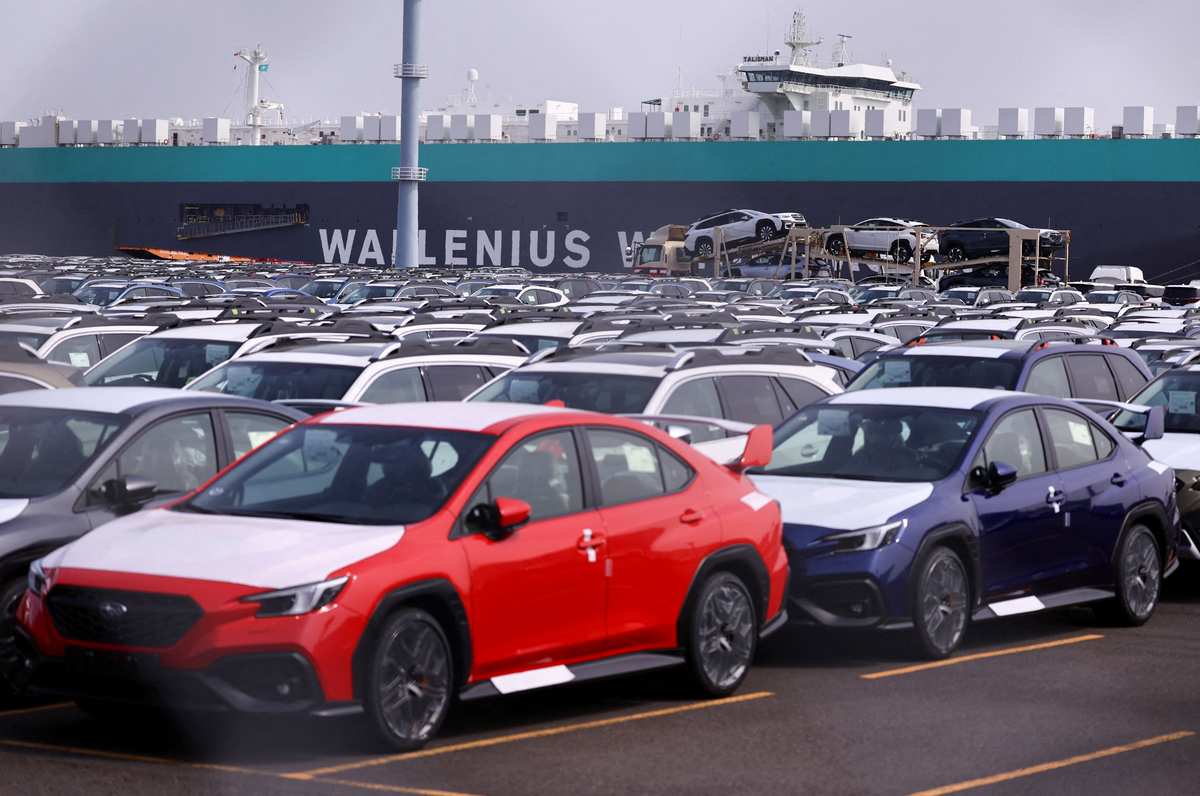
Newly manufactured cars of the automobile maker Subaru awaiting export are parked at a port in Yokohama, south of Tokyo, Japan March 27, 2025.
12:17 JST, September 17, 2025
TOKYO, Sept 17 (Reuters) – Japan’s exports fell for a fourth straight month in August, government data showed on Wednesday, as elevated U.S. tariffs took a deeper toll on the country’s automotive and other manufacturing sectors.
“Japanese automakers are still mostly absorbing the tariff costs by cutting export prices to maintain U.S. sales volumes,” said Saisuke Sakai, chief Japan economist at Mizuho Research.
“But some of them, unable to withstand rising costs, have begun increasing prices to pass them on to consumers,” he said.
“Coupled with growing uncertainties over the U.S. economy, the tariff impact on Japan’s exports and output is set to intensify towards the year-end.”
Total exports by value dropped 0.1% year-on-year in August, the data showed, less than a median market forecast for a 1.9% decrease and following a 2.6% fall in July.
Exports to the United States plunged 13.8% in August from a year earlier, representing the largest drop since February 2021, dragged down by a 28.4% fall in automobiles and 38.9% plunge in chipmaking equipment.
The volume of U.S.-bound shipments fell 12.0%, extending the 2.3% decline seen in July.
The export plunge helped halve the trade surplus with the U.S. to 324 billion yen ($2.21 billion), the smallest since January 2023.
Exports to China were down 0.5%, while those to Asia and the European Union rose, partially offseting the plunge in U.S.-bound exports.
Total imports dropped 5.2% in August from a year earlier, compared with market forecasts for a 4.2% increase, reflecting lower oil prices.
As a result, Japan ran a trade deficit of 242.5 billion yen ($1.66 billion) in August, compared with the forecast of a deficit of 513.6 billion yen.
Washington agreed on a baseline 15% tariff rate on nearly all Japanese imports in late July, down from the initial 27.5% on autos and a 25% duty threatened for most other goods, offering some relief to Japanese exporters.
But the impact remains significant, particularly for Japanese automakers and auto parts suppliers, as the levy is still multiple times higher than their previous 2.5% rate.
According to a poll by Japan Center for Economic Research, 37 economists surveyed predict the economy will shrink by an annualized 1.1% in the current quarter, reflecting weak overseas demand.
Bank of Japan Governor Kazuo Ueda has vowed to go slow in hiking rates due to uncertainty over the impact of U.S. tariffs on Japan’s economy.
Economists are focused on how falling exports will affect corporate spending and wages. Japanese corporate spending on plant and equipment has so far shown no signs of abating, rising 7.6% in the April-June quarter from a year earlier, according to government data released this month.
Surprisingly, the biggest increase came from the automotive sector, which posted a 43.4% jump, driven by brisk investment in electric vehicle production – despite a 30.7% plunge in operating profit during the same period.






Most Read
Popular articles in the past 24 hours
-

Ishinomaki Man Plush Toy Offers Hope to Children in Times of Disa...
-

Microsoft Japan Raided by Antitrust Watchdog for Allegedly Blocki...
-

Party Representatives’ Questions in Diet: Takaichi Says Consumpti...
-
Japan Eyes Introducing Prescreening System for Foreign Travelers,...
-

Milano Cortina 2026: News in Pictures / Feats of Japanese Athlete...
-

Pokémon Celebrates 30 Years with Japanese Pro Baseball Collab
-

Nikkei Tops 59,000 for First Time
-
New U.S. Tariff Unlikely to Significantly Impact Japan, BOJ Gov. ...
Popular articles in the past week
-

Producer Behind Pop Group XG Arrested for Cocaine Possession
-

iPS Treatments Pass Key Milestone, but Broader Applications Far f...
-

Tokyo Skytree's Elevator Stops, Trapping 20 People; All Rescued (...
-

Milano Cortina 2026: Japanese Gold Medalist Figure Skater Miura S...
-

Japan’s Major Real Estate Firms Expanding Overseas Businesses to ...
-

Nepal Bus Crash Kills 19 People, Injures 25 Including One Japanes...
-

Baby Monkey Punch Captures Hearts at Chiba Pref. Zoo, on Social M...
-

Milano Cortina 2026: Japanese Figure Skater Kaori Sakamoto’...
Popular articles in the past month
-
Producer Behind Pop Group XG Arrested for Cocaine Possession
-

Japan PM Takaichi’s Cabinet Resigns en Masse
-

Japan Institute to Use Domestic Commercial Optical Lattice Clock ...
-

Man Infected with Measles Reportedly Dined at Restaurant in Tokyo...
-

Israeli Ambassador to Japan Speaks about Japan’s Role in the Reco...
-

Videos Plagiarized, Reposted with False Subtitles Claiming ‘Ryuky...
-

Man Infected with Measles May Have Come in Contact with Many Peop...
-

Prudential Life Insurance Plans to Fully Compensate for Damages C...
Top Articles in News Services
-
Survey Shows False Election Info Perceived as True
-
Hong Kong Ex-Publisher Jimmy Lai’s Sentence Raises International Outcry as China Defends It
-
Japan’s Nikkei Stock Average Touches 58,000 as Yen, Jgbs Rally on Election Fallout (UPDATE 1)
-
Japan’s Nikkei Stock Average Falls as US-Iran Tensions Unsettle Investors (UPDATE 1)
-
Trump Names Former Federal Reserve Governor Warsh as the Next Fed Chair, Replacing Powell
JN ACCESS RANKING
-
Producer Behind Pop Group XG Arrested for Cocaine Possession
-
Japan PM Takaichi’s Cabinet Resigns en Masse
-
Man Infected with Measles Reportedly Dined at Restaurant in Tokyo Station
-
Israeli Ambassador to Japan Speaks about Japan’s Role in the Reconstruction of Gaza
-
Videos Plagiarized, Reposted with False Subtitles Claiming ‘Ryukyu Belongs to China’; Anti-China False Information Also Posted in Japan