
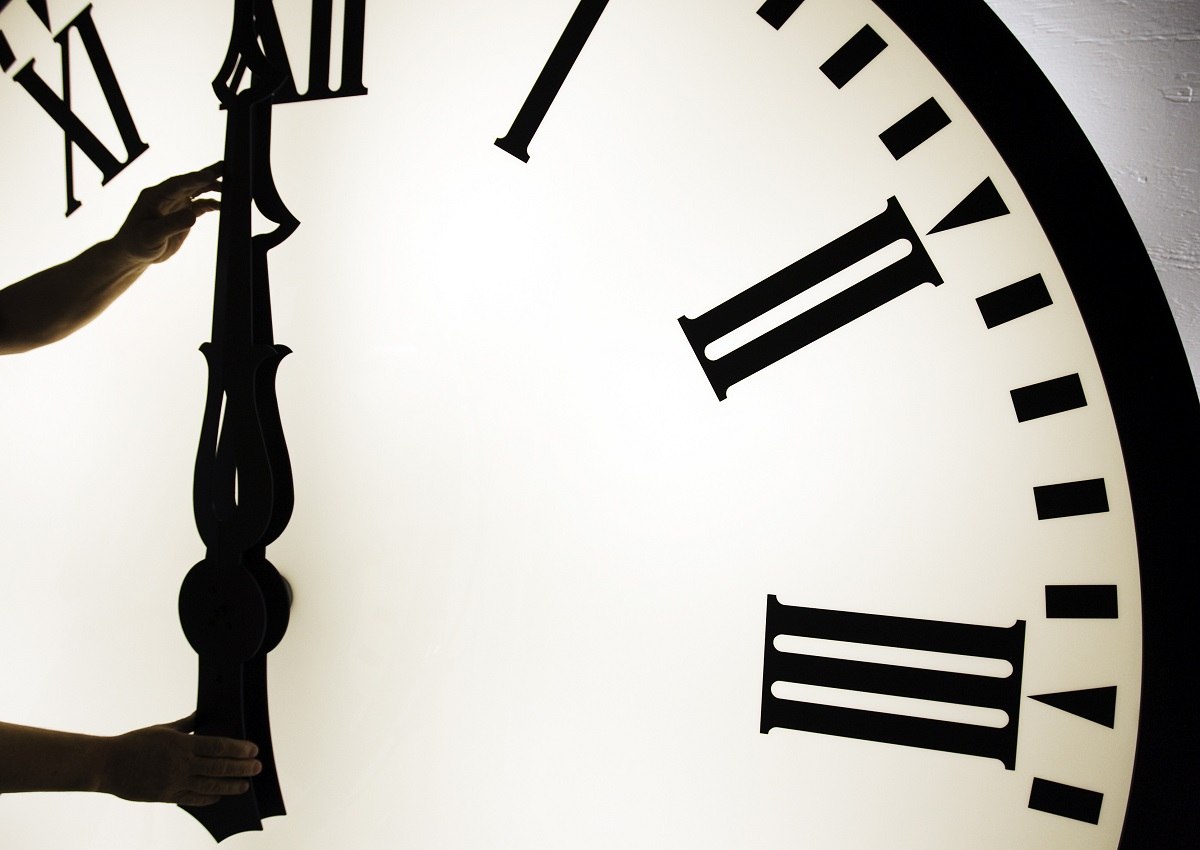
Scott Gow adjusts a tower clock on test at the Electric Time Company in Medfield, Massachusetts March 6, 2009.
17:34 JST, March 10, 2024
WASHINGTON (Reuters) – A group of 12 bipartisan senators said on Friday they are making a new legislative effort to make daylight saving time permanent and end the twice-annual changing of clocks.
In March 2022, the U.S. Senate passed legislation that would have made daylight saving time permanent starting in 2023.
But Congress could not come to agreement and the bill was never voted on in the House of Representatives.
Since then, there has been little movement. However, on Friday, senators led by Democrat Ed Markey and Republican Marco Rubio reintroduced legislation, just ahead of the resumption of daylight saving time at 2 a.m. on Sunday. A companion measure was again introduced in the House by Representative Vern Buchanan.
“The antiquated biannual ritual of toggling between times isn’t just an inconvenience – it also has very real impacts on our economy, our energy consumption, and our health,” Markey said.
Rubio said: “We’re ‘springing forward’ but should have never ‘fallen back.'”
Not putting back the clocks in autumn would enable children to play outdoors later and reduce seasonal depression, according to supporters. But critics say it would force many children to go to school in the dark.
President Joe Biden has never taken a position on the issue. Some lawmakers say they support ending clock-switching but are unsure whether to stick with daylight or standard time.
Since 2015, about 30 states have introduced legislation to end the twice-yearly changing of clocks, with some states proposing to do it only if neighboring states do the same.
Daylight saving time has been in place in nearly all of the United States since the 1960s after being first tried in 1918.
Year-round daylight savings time was used during World War Two and adopted again in 1973 in a bid to reduce fuel use because of an energy crisis. But it was repealed a year later amid public complaints.
The bill would allow Arizona and Hawaii, which do not observe daylight saving time, to remain on standard time, as well as American Samoa, Guam, the Northern Mariana Islands, Puerto Rico and the U.S. Virgin Islands.








Most Read
Popular articles in the past 24 hours
-

Hawaii Museum on Tsunami Including Japan's 2011 Disaster at Risk ...
-

Japan Train Company to Increase Fares, Including in Tokyo Metropo...
-

Tail of ANA Plane Struck Runway During Landing in Houston; No Inj...
-

Samurai Japan Holds First Practice in Miami; Team Will Play again...
-

Iran Targets Busiest International Airport as Top UN Body Demands...
-

Japan to Face Venezuela in World Baseball Classic Quarterfinals
-
Japan Govt to Tighten Requirements to Receive Permanent Residency...
-

North Korean Leader Kim and His Daughter Try out New Pistols at S...
Popular articles in the past week
-

Japan Figure Skating Legend Yuzuru Hanyu Is Proud Disaster Surviv...
-

Nippon Life Insurance's U.S. Arm Sues OpenAI Over Legal Assistanc...
-

Ibaraki Pref.'s 1st Foreign Bus Driver Hired in Tsukuba
-
Govt to Utilize ODA for Ensuring Economic Security; Securing Ener...
-
Massive Sewer Pipe Found Jutting Out of Highway in Osaka
-

Amid Strait of Hormuz Blockade, Shipping Companies Scramble to Ge...
-

Beckoning Cats Get Makeover to Fit Modern Lifestyles with Sleek D...
-
Japan Govt Survey Finds Just 10% of Workers Want Working Hours to...
Popular articles in the past month
-

Producer Behind Pop Group XG Arrested for Cocaine Possession
-

Japan PM Takaichi’s Cabinet Resigns en Masse
-

Man Infected with Measles Reportedly Dined at Restaurant in Tokyo...
-

Videos Plagiarized, Reposted with False Subtitles Claiming ‘Ryuky...
-

iPS Treatments Pass Key Milestone, but Broader Applications Far f...
-

Sanae Takaichi Elected Prime Minister of Japan; Keeps All Cabinet...
-

Nepal Bus Crash Kills 19 People, Injures 25 Including One Japanes...
-
South Korea Tightens Rules on Foreigners Buying Homes in Seoul Me...
Top Articles in News Services
-
Survey Shows False Election Info Perceived as True
-

Japan’s Nikkei Stock Average Falls as US-Iran Tensions Unsettle Investors (UPDATE 1)
-
Japan’s Nikkei Stock Average Rises on Tech Rally and Takaichi’s Spending Hopes (UPDATE 1)
-

Japan to Ban Use of Power Banks on Airplanes
-

North Korea Unveils Image of Kim Jong Un’s Teenage Daughter Firing Rifle
JN ACCESS RANKING
-
Producer Behind Pop Group XG Arrested for Cocaine Possession
-
Japan PM Takaichi’s Cabinet Resigns en Masse
-
Man Infected with Measles Reportedly Dined at Restaurant in Tokyo Station
-
Videos Plagiarized, Reposted with False Subtitles Claiming ‘Ryukyu Belongs to China’; Anti-China False Information Also Posted in Japan
-
iPS Treatments Pass Key Milestone, but Broader Applications Far from Guaranteed