
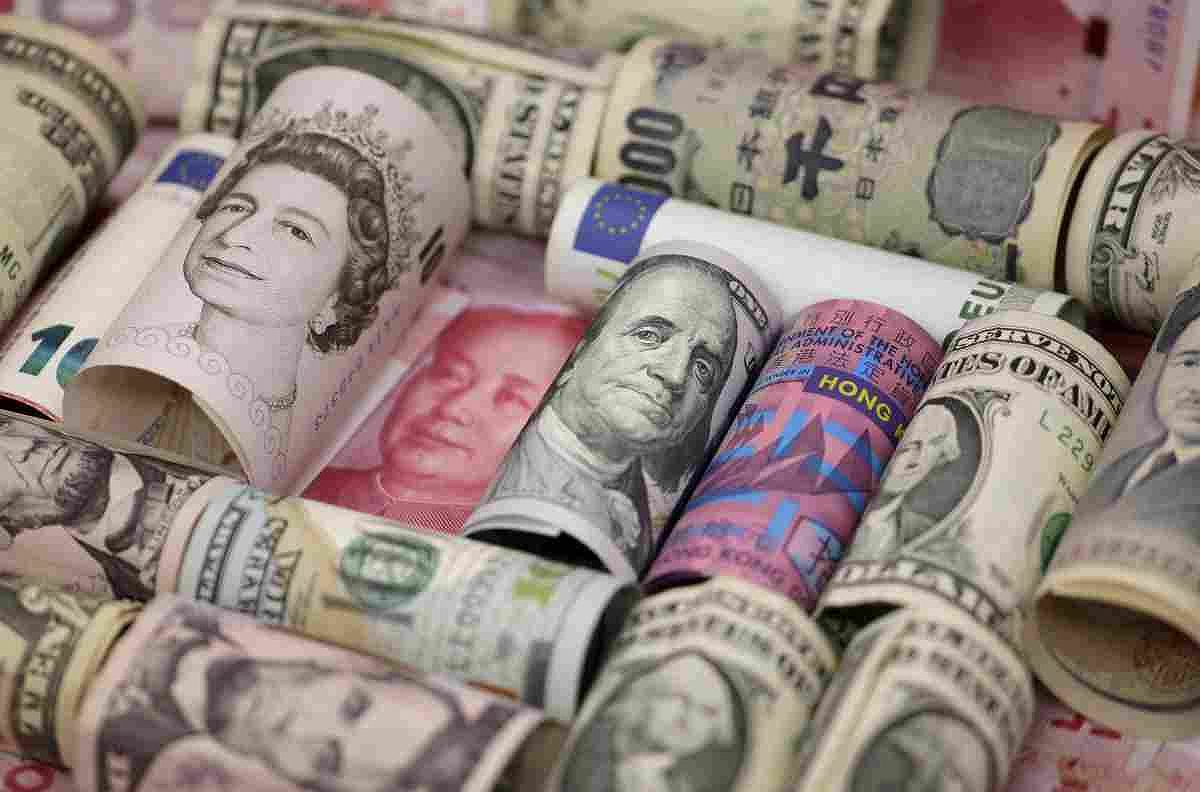
Euro, Hong Kong dollar, U.S. dollar, Japanese yen, British pound and Chinese 100-yuan banknotes are seen in a picture illustration.
17:00 JST, February 20, 2024
SINGAPORE (Reuters) – The yen was pinned near a three-month low against the dollar on Tuesday as sticky U.S. inflation bolstered the case for higher-for-longer interest rates, contrasting with a recession in Japan and market doubts about a near-term exit from its easy policy.
In Asia, China’s loan prime rate (LPR) decision takes center stage, where it is widely expected to trim its benchmark mortgage reference rate to shore up the country’s faltering economic growth.
Ahead of the outcome, the offshore yuan edged marginally lower to 7.2143 per dollar.
The greenback last bought 150.25 yen, having already surpassed the psychological 150 per dollar level for six straight sessions and prompting warnings from Japanese officials in a bid to stabilize the currency.
Higher-than-expected U.S. producer prices and consumer prices data last week further scaled back market expectations of how soon, and by how much, the Federal Reserve could ease interest rates this year, with futures pointing to just about 90 basis points worth of cuts in 2024, down from about 160 bps at the end of last year.
On the other hand, Japan’s economy, which unexpectedly slipped into a recession in the final quarter of last year on sluggish consumption and capital expenditure, has prompted investors to rethink the chances of a near-term exit by the Bank of Japan (BOJ) from its ultra-loose monetary policy.
“At the moment, the data coming in from Japan is telling us that it’s not as rosy as what the BOJ would like to see in order to begin moving away from negative interest rates,” said Rodrigo Catril, senior currency strategist at National Australia Bank (NAB).
In the broader market, the dollar edged higher, though moves were largely subdued due to Monday’s holiday in the United States for Presidents’ Day.
Against the greenback, the euro fell 0.09% to $1.0770, while sterling GBP=D3 dipped 0.06% to $1.2588.
The New Zealand dollar eased 0.11% to $0.6143.
“We’re still stuck in these ranges to some extent, and waiting for more meaningful or material data to swing us one way or the other,” said NAB’s Catril. “So for that, data coming from the U.S. remains paramount.”
In the bond market, U.S. Treasury yields ticked higher in response to last week’s inflation data and the repricing of Fed expectations. US/
The benchmark 10-year yield rose about 2 bps to 4.3166%, while the two-year yield US2YT=RR steadied at 4.6565%.
The dollar index, a measure of the greenback against major peers, rose 0.03% to 104.33.
Down Under, the Australian dollar fell 0.14% to $0.6531.
Minutes of the Reserve Bank of Australia’s February meeting out on Tuesday showed policymakers considered hiking rates by another quarter-point, but decided to hold steady given progress had been made on inflation and the labor market was loosening faster than expected.







Most Read
Popular articles in the past 24 hours
-

Japan Figure Skating Legend Yuzuru Hanyu Is Proud Disaster Surviv...
-

Massive Sewer Pipe Found Jutting Out of Highway in Osaka
-

Japan-U.S. Summit Likely to Focus on Middle East; Takaichi to Fac...
-

Hawaii Museum on Tsunami Including Japan's 2011 Disaster at Risk ...
-

15 Years since Great East Japan Earthquake: How Can Affected Area...
-

Japan Holds Memorial Events to Mark 15th Anniversary of 2011 Eart...
-

Japan Train Company to Increase Fares, Including in Tokyo Metropo...
-

Parents in Japan to Get Instagram Notifications When Teens Repeat...
Popular articles in the past week
-

Ibaraki Pref.'s 1st Foreign Bus Driver Hired in Tsukuba
-

Nippon Life Insurance's U.S. Arm Sues OpenAI Over Legal Assistanc...
-
Japan Figure Skating Legend Yuzuru Hanyu Is Proud Disaster Surviv...
-

Govt to Utilize ODA for Ensuring Economic Security; Securing Ener...
-
Massive Sewer Pipe Found Jutting Out of Highway in Osaka
-

Amid Strait of Hormuz Blockade, Shipping Companies Scramble to Ge...
-

Beckoning Cats Get Makeover to Fit Modern Lifestyles with Sleek D...
-
Japan Govt Survey Finds Just 10% of Workers Want Working Hours to...
Popular articles in the past month
-

Producer Behind Pop Group XG Arrested for Cocaine Possession
-

Japan PM Takaichi’s Cabinet Resigns en Masse
-

Man Infected with Measles Reportedly Dined at Restaurant in Tokyo...
-

Videos Plagiarized, Reposted with False Subtitles Claiming ‘Ryuky...
-

iPS Treatments Pass Key Milestone, but Broader Applications Far f...
-

Sanae Takaichi Elected Prime Minister of Japan; Keeps All Cabinet...
-

Nepal Bus Crash Kills 19 People, Injures 25 Including One Japanes...
-

South Korea Tightens Rules on Foreigners Buying Homes in Seoul Me...
Top Articles in News Services
-
Survey Shows False Election Info Perceived as True
-

Japan’s Nikkei Stock Average Falls as US-Iran Tensions Unsettle Investors (UPDATE 1)
-
Japan’s Nikkei Stock Average Rises on Tech Rally and Takaichi’s Spending Hopes (UPDATE 1)
-

Japan to Ban Use of Power Banks on Airplanes
-

North Korea Unveils Image of Kim Jong Un’s Teenage Daughter Firing Rifle
JN ACCESS RANKING
-
Producer Behind Pop Group XG Arrested for Cocaine Possession
-
Japan PM Takaichi’s Cabinet Resigns en Masse
-
Man Infected with Measles Reportedly Dined at Restaurant in Tokyo Station
-
Videos Plagiarized, Reposted with False Subtitles Claiming ‘Ryukyu Belongs to China’; Anti-China False Information Also Posted in Japan
-
iPS Treatments Pass Key Milestone, but Broader Applications Far from Guaranteed