
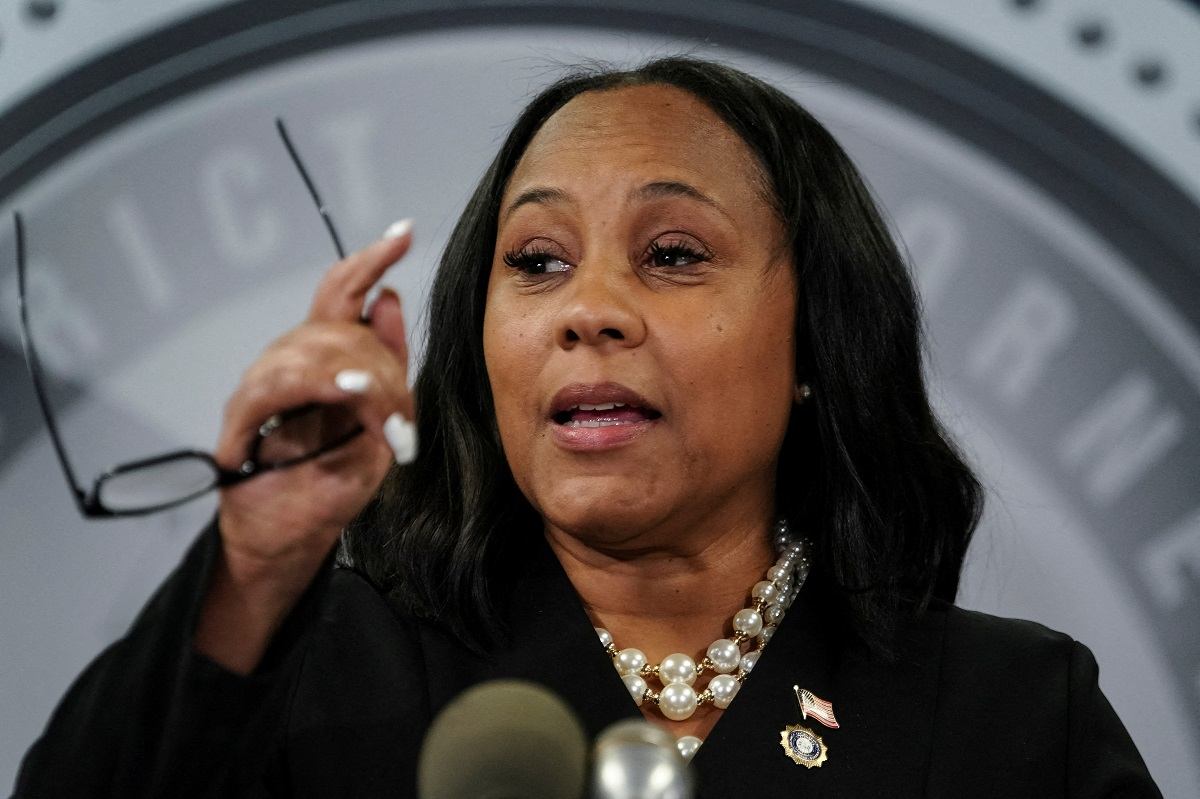
Fulton County District Attorney Fani Willis speaks to the media after a Grand Jury brought back indictments against former President Donald Trump and 18 of his allies in their attempt to overturn the state’s 2020 election results, in Atlanta, Georgia, U.S. August 14, 2023.
12:14 JST, August 16, 2023
Criminal charges filed against former U.S. President Donald Trump in Georgia state court include allegations that he violated an anti-organized crime law known as RICO that is more expansive than its federal counterpart.
WHAT IS RICO?
U.S. lawmakers passed the federal Racketeering Influenced and Corrupt Organizations Act in 1970 to battle organized crime, notably the mafia. Most states enacted similar laws with various twists.
The main requirements under the federal RICO law are at least two underlying crimes and participation in a criminal enterprise over a long period of time.
Georgia’s RICO law does not require criminal enterprises to be long running and lists nearly 50 underlying crimes that qualify as racketeering, compared with 35 under its federal counterpart.
Defendants who are found guilty of Georgia RICO charges face between five and 20 years in prison, and while federal law has the same maximum, it does not have a minimum.
HOW IS RICO TYPICALLY USED?
The mafia in the U.S. has largely been dismantled, and RICO’s application has been broadened to many other types of organized criminal activity.
Prosecutors have applied the law to all sorts of groups that they characterize as criminal “enterprises,” including Wall Street banks and traders engaged in market manipulation.
Fulton County District Attorney Fani Willis, an elected Democrat who brought the charges against Trump, once used the law to prosecute more than two dozen Atlanta educators for allegedly scheming to cheat on standardized test scores in 2014.
Attorneys for the teachers said Willis overreached by deeming Atlanta’s public school system a “criminal enterprise,” but the convictions held up on appeal.
WHY ARE PROSECUTORS USING RICO?
RICO was originally conceived as a tool to go after mafia kingpins who kept their hands clean by parking ill-gotten gains in shell corporations and leaving the dirty work to underlings.
The law does not require prosecutors to prove that defendants directly engaged in criminal activity, just that they were part of a larger organization that did.
That means prosecutors would not necessarily have to prove Trump personally broke the law but knowingly coordinated with others who did.
WHAT ARE THE RISKS OF USING RICO?
RICO cases are inherently more complex because prosecutors must first prove the existence of a criminal enterprise.
The Trump indictment names an additional 18 co-defendants, including Trump’s onetime lawyer Rudy Giuliani, his former chief of staff Mark Meadows and lawyer John Eastman.
Prosecutors will need to prove that Trump and his co-defendants worked together towards a common criminal purpose, which is not always as straightforward as proving an underlying RICO crime.
But each additional co-defendant is another that prosecutors could coax into testifying against the others.





Most Read
Popular articles in the past 24 hours
-

Ishinomaki Man Plush Toy Offers Hope to Children in Times of Disa...
-

Party Representatives’ Questions in Diet: Takaichi Says Consumpti...
-

Milano Cortina 2026: News in Pictures / Feats of Japanese Athlete...
-

Microsoft Japan Raided by Antitrust Watchdog for Allegedly Blocki...
-

Pokémon Celebrates 30 Years with Japanese Pro Baseball Collab
-
Japan Eyes Introducing Prescreening System for Foreign Travelers,...
-

Nikkei Tops 59,000 for First Time
-

Bernini, Barberini Celebrated as Vatican Marks 400 Years of St. P...
Popular articles in the past week
-

Producer Behind Pop Group XG Arrested for Cocaine Possession
-

iPS Treatments Pass Key Milestone, but Broader Applications Far f...
-

Tokyo Skytree's Elevator Stops, Trapping 20 People; All Rescued (...
-
Milano Cortina 2026: Japanese Gold Medalist Figure Skater Miura S...
-

Japan’s Major Real Estate Firms Expanding Overseas Businesses to ...
-

Nepal Bus Crash Kills 19 People, Injures 25 Including One Japanes...
-

Baby Monkey Punch Captures Hearts at Chiba Pref. Zoo, on Social M...
-

Milano Cortina 2026: Japanese Figure Skater Kaori Sakamoto’...
Popular articles in the past month
-
Producer Behind Pop Group XG Arrested for Cocaine Possession
-

Japan PM Takaichi’s Cabinet Resigns en Masse
-

Japan Institute to Use Domestic Commercial Optical Lattice Clock ...
-

Man Infected with Measles Reportedly Dined at Restaurant in Tokyo...
-

Israeli Ambassador to Japan Speaks about Japan’s Role in the Reco...
-

Videos Plagiarized, Reposted with False Subtitles Claiming ‘Ryuky...
-

Man Infected with Measles May Have Come in Contact with Many Peop...
-

Prudential Life Insurance Plans to Fully Compensate for Damages C...
Top Articles in News Services
-
Survey Shows False Election Info Perceived as True
-
Hong Kong Ex-Publisher Jimmy Lai’s Sentence Raises International Outcry as China Defends It
-
Japan’s Nikkei Stock Average Touches 58,000 as Yen, Jgbs Rally on Election Fallout (UPDATE 1)
-
Japan’s Nikkei Stock Average Falls as US-Iran Tensions Unsettle Investors (UPDATE 1)
-
Trump Names Former Federal Reserve Governor Warsh as the Next Fed Chair, Replacing Powell
JN ACCESS RANKING
-
Producer Behind Pop Group XG Arrested for Cocaine Possession
-
Japan PM Takaichi’s Cabinet Resigns en Masse
-
Man Infected with Measles Reportedly Dined at Restaurant in Tokyo Station
-
Israeli Ambassador to Japan Speaks about Japan’s Role in the Reconstruction of Gaza
-
Videos Plagiarized, Reposted with False Subtitles Claiming ‘Ryukyu Belongs to China’; Anti-China False Information Also Posted in Japan