
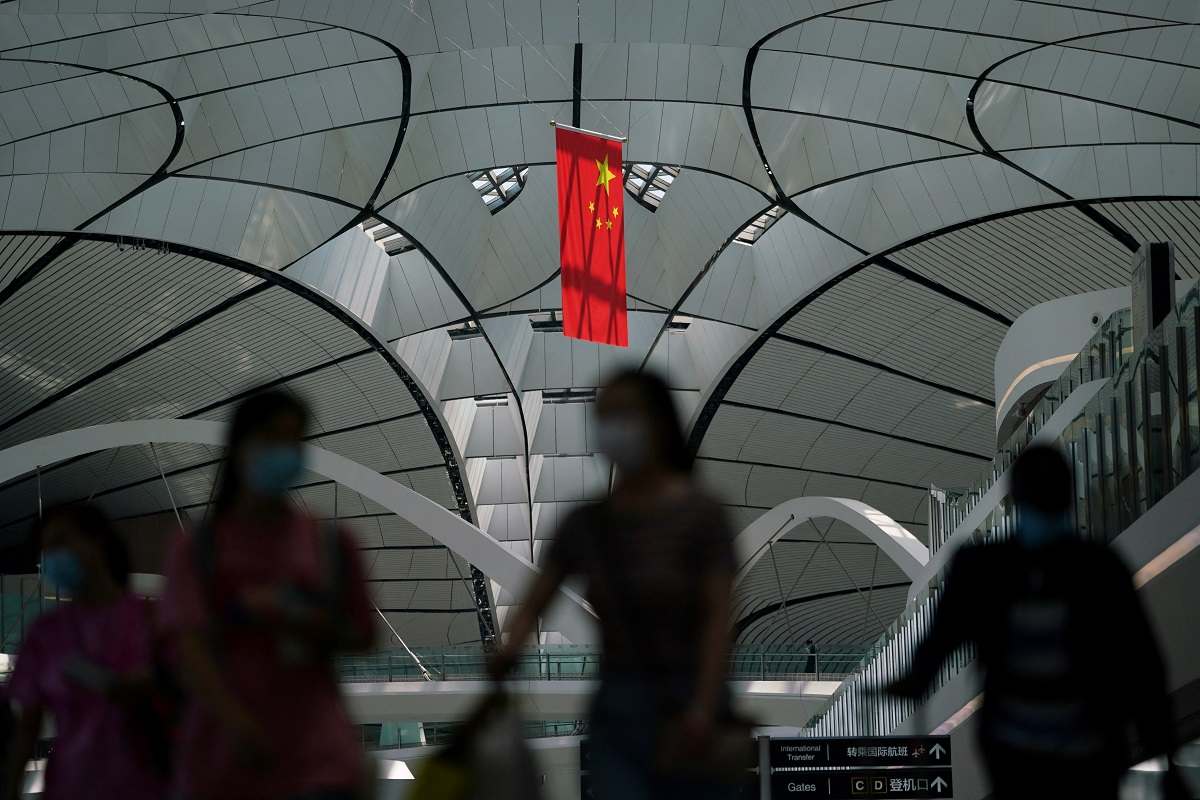
People wearing face masks following the coronavirus disease (COVID-19) outbreak walk under a Chinese flag at Beijing Daxing International Airport in Beijing, China July 24, 2020.
13:07 JST, March 28, 2023
JOHANNESBURG (Reuters) – China spent $240 billion bailing out 22 developing countries between 2008 and 2021, with the amount soaring in recent years as more have struggled to repay loans spent building “Belt & Road” infrastructure, according to a study published Tuesday.
Almost 80% of the rescue lending was made between 2016 and 2021, mainly to middle-income countries including Argentina, Mongolia and Pakistan, according to the report by researchers from the World Bank, Harvard Kennedy School, AidData and the Kiel Institute for the World Economy.
China has lent hundreds of billions of dollars to build infrastructure in developing countries, but lending has tailed off since 2016 as many projects have failed to pay the expected financial dividends.
“Beijing is ultimately trying to rescue its own banks. That’s why it has gotten into the risky business of international bailout lending,” said Carmen Reinhart, a former World Bank chief economist and one of the study’s authors.
Chinese loans to countries in debt distress soared from less than 5% of its overseas lending portfolio in 2010 to 60% in 2022, the study found.
Argentina received the most, with $111.8 billion, followed Pakistan on $48.5 billion and Egypt with $15.6 billion. Nine countries received less than $1 billion.
People’s Bank of China (PBOC) swap lines accounted for $170 billion of the rescue financing, including in Suriname, Sri Lanka and Egypt. Bridge loans or balance of payments support by Chinese state-owned banks was $70 billion. Rollovers of both kinds of loan were $140 billion.
The study was critical of some central banks potentially using the PBOC swap lines to artifically pump up their foreign exchange reserve figures.
China’s rescue lending is “opaque and uncoordinated,” said Brad Parks, one of the report’s authors, and director of AidData, a research lab at William & Mary College in the United States.
The bailout loans are mainly concentrated in the middle income countries that make up four-fifths of its lending, due to the risk they pose to Chinese banks’ balance sheets, whereas low income countries are offered grace periods and maturity extensions, the report said.
China is negotiating debt restructurings with countries including Zambia, Ghana and Sri Lanka and has been criticized for holding up the processes. In response, it has called on the World Bank and International Monetary Fund to also offer debt relief.







Most Read
Popular articles in the past 24 hours
-
Japan Seeks to Counter China's Expanding Influence in Pacific by ...
-

Exhibition Featuring Yoshiharu Tsuge’s Manga World Underway in Ch...
-

Tokyo Skytree Observation Deck Remains Closed for Inspection afte...
-

Japanese Watermelon Shipments Starts in Leading Production Distri...
-

Impact on Japanese Economy Unclear with Trump’s New Tariffs, Shif...
-

Takeshima Day: Persistently Demanding Resolution from South Korea...
-

Hanzomon Line Service Suspended between Kudanshita, Oshiage Stati...
-
CARTOON OF THE DAY (February 25)
Popular articles in the past week
-

Producer Behind Pop Group XG Arrested for Cocaine Possession
-

iPS Treatments Pass Key Milestone, but Broader Applications Far f...
-

Japan, U.S. Name 3 Inaugural Investment Projects; Reached Agreeme...
-

Tokyo Skytree's Elevator Stops, Trapping 20 People; All Rescued (...
-

Director Naomi Kawase's New Film Explores Heart Transplants in Ja...
-

Japan’s Major Real Estate Firms Expanding Overseas Businesses to ...
-

Milano Cortina 2026: Japanese Figure Skater Kaori Sakamoto’...
-

Baby Monkey Punch Captures Hearts at Chiba Pref. Zoo, on Social M...
Popular articles in the past month
-
Producer Behind Pop Group XG Arrested for Cocaine Possession
-

Japan PM Takaichi’s Cabinet Resigns en Masse
-

Japan Institute to Use Domestic Commercial Optical Lattice Clock ...
-

Man Infected with Measles Reportedly Dined at Restaurant in Tokyo...
-

Israeli Ambassador to Japan Speaks about Japan’s Role in the Reco...
-

Videos Plagiarized, Reposted with False Subtitles Claiming ‘Ryuky...
-

Man Infected with Measles May Have Come in Contact with Many Peop...
-

Prudential Life Insurance Plans to Fully Compensate for Damages C...
Top Articles in News Services
-
Survey Shows False Election Info Perceived as True
-
Hong Kong Ex-Publisher Jimmy Lai’s Sentence Raises International Outcry as China Defends It
-

Japan’s Nikkei Stock Average Touches 58,000 as Yen, Jgbs Rally on Election Fallout (UPDATE 1)
-
Japan’s Nikkei Stock Average Falls as US-Iran Tensions Unsettle Investors (UPDATE 1)
-

Trump Names Former Federal Reserve Governor Warsh as the Next Fed Chair, Replacing Powell
JN ACCESS RANKING
-
Producer Behind Pop Group XG Arrested for Cocaine Possession
-
Japan PM Takaichi’s Cabinet Resigns en Masse
-
Man Infected with Measles Reportedly Dined at Restaurant in Tokyo Station
-
Israeli Ambassador to Japan Speaks about Japan’s Role in the Reconstruction of Gaza
-
Videos Plagiarized, Reposted with False Subtitles Claiming ‘Ryukyu Belongs to China’; Anti-China False Information Also Posted in Japan