
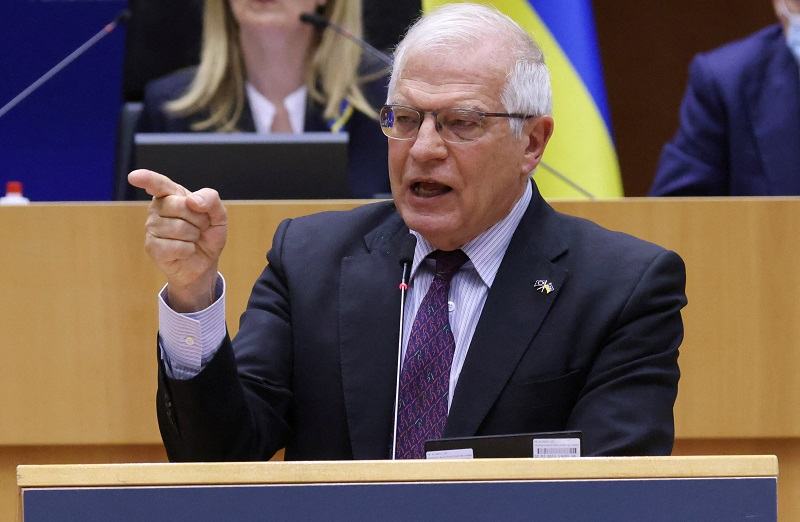
European Union foreign policy chief Josep Borell addresses the special session to debate its response to the Russian invasion of Ukraine, in Brussels on March 1.
14:59 JST, August 29, 2022
PRAGUE (Reuters) — European Union defense and foreign ministers, meeting in Prague this week, will discuss options for setting up an EU military training mission for Ukrainian forces and also look into calls by some members to ban Russian tourists from entering the bloc.
Several EU countries have been training Ukrainian troops for a while, mainly enabling them to operate weapons Western nations are delivering to Ukraine to help its fight against Russia’s invasion.
It is not clear yet where an EU training program could be based and what mandate it might have, EU diplomats told Reuters ahead of the defense ministers’ meeting on Monday and Tuesday.
The bloc’s foreign policy and security chief, Josep Borrell, has given few details of his plans so far, merely stating such a program would not be based in Ukraine but in neighboring countries.
At a joint session with U.N. and NATO representatives, defense ministers will also discuss the future of the EU’s suspended training mission in Mali and the U.N peacekeeping force MINUSMA, as concerns are growing over an increasing Russian presence in the West African country.
The six-month-old war in Ukraine remains a foreign policy priority for the European Union and when the bloc’s foreign ministers take over the meetings in Prague on Tuesday, a proposed visa ban for Russians will be at the top of their agenda.
The Czechs, who currently hold the EU’s rotating presidency, are pushing for an EU-wide ban on visas for Russian tourists, an idea supported mainly by the Baltic countries.
However, Germany, some other member states and Borrell reject such a move, arguing it might breach EU rules and cut off escape routes for Russian dissidents.
Lithuanian Foreign Minister Gabrielius Landsbergis has said Estonia, Latvia, Lithuania, Poland and Finland, which all share a border with Russia, may act on their own to block tourists if the EU does not agree on a union-wide ban.
Russians mostly enter the EU via the land borders of the five countries since direct flights between Russia and the bloc were suspended following Moscow’s invasion of Ukraine, according to Landsbergis.
In mid-August, Estonia closed its border to more than 50,000 Russians with previously issued visas, the first country in the EU to do so.
Ukrainian President Volodymyr Zelenskyy called on the West earlier this month to impose a blanket travel ban on Russians, drawing an angry rebuke from Moscow.





Most Read
Popular articles in the past 24 hours
-

My Spendthrift Mother Constantly Asks Me for Money
-

Japanese Students Use Traditional Pickle to Create Novel Wagashi ...
-

‘Dry Bonsai’ Gives New Life to Withered Trees, Allows Free Artist...
-

McDonald's Japan Raises Prices; Big Mac to Cost ¥500, Double Chee...
-

Nepal Bus Crash Kills 19 People, Injures 25 Including One Japanes...
-

Astellas Collaborates with Vir to Develop Its Experimental Prosta...
-

Japan’s Nikkei Stock Average Rises as AI-Related Stocks Shine; Co...
-

Early-Blooming Kawazu Cherry Blossoms Create Sea of Pink at Park ...
Popular articles in the past week
-

Producer Behind Pop Group XG Arrested for Cocaine Possession
-

Japan PM Takaichi’s Cabinet Resigns en Masse
-

Sanae Takaichi Elected Prime Minister of Japan; Keeps All Cabinet...
-

Japan's Govt to Submit Road Map for Growth Strategy in March, PM ...
-

Bus Carrying 40 Passengers Catches Fire on Chuo Expressway; All E...
-

U.S. Firm to Build Training Hub in Fukushima N-plant for Debris R...
-

Japan, U.S. Name 3 Inaugural Investment Projects; Reached Agreeme...
-

Riku-Ryu Pair Wins Gold Medal: Their Strong Bond Leads to Major C...
Popular articles in the past month
-
Producer Behind Pop Group XG Arrested for Cocaine Possession
-
Japan PM Takaichi’s Cabinet Resigns en Masse
-

Japan Institute to Use Domestic Commercial Optical Lattice Clock ...
-

Man Infected with Measles Reportedly Dined at Restaurant in Tokyo...
-

Israeli Ambassador to Japan Speaks about Japan’s Role in the Reco...
-

Videos Plagiarized, Reposted with False Subtitles Claiming ‘Ryuky...
-

Man Infected with Measles May Have Come in Contact with Many Peop...
-

Prudential Life Insurance Plans to Fully Compensate for Damages C...
Top Articles in News Services
-
Survey Shows False Election Info Perceived as True
-
Hong Kong Ex-Publisher Jimmy Lai’s Sentence Raises International Outcry as China Defends It
-
Japan’s Nikkei Stock Average Touches 58,000 as Yen, Jgbs Rally on Election Fallout (UPDATE 1)
-
Japan’s Nikkei Stock Average Falls as US-Iran Tensions Unsettle Investors (UPDATE 1)
-
Trump Names Former Federal Reserve Governor Warsh as the Next Fed Chair, Replacing Powell
JN ACCESS RANKING
-
Producer Behind Pop Group XG Arrested for Cocaine Possession
-
Japan PM Takaichi’s Cabinet Resigns en Masse
-
Japan Institute to Use Domestic Commercial Optical Lattice Clock to Set Japan Standard Time
-
Man Infected with Measles Reportedly Dined at Restaurant in Tokyo Station
-
Israeli Ambassador to Japan Speaks about Japan’s Role in the Reconstruction of Gaza