
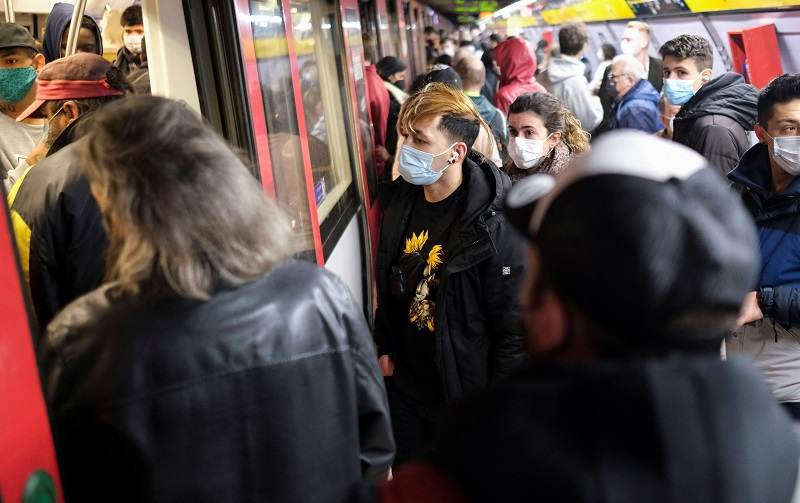
Commuters wait for the train at the subway station, amid the outbreak of the coronavirus disease (COVID-19) and after Omicron has become the dominant coronavirus variant in Europe, in Barcelona, Spain January 12, 2022.
17:14 JST, April 28, 2022
BRUSSELS (Reuters) – The European Commission said that between 60% and 80% of the EU population was estimated to have been infected with COVID-19, as the bloc enters a post-emergency phase in which mass reporting of cases was no longer necessary.
In preparing for this less acute phase, European Union governments should ramp up COVID-19 immunisations of children, the bloc’s executive body said, signallingit was considering plans to develop antivirals.
“It is estimated that between 60% to 80% of the EU population has by now had COVID,” EU health commissioner Stella Kyriakides told a news conference.
The EU public health agency said reported cases had covered about 30% of the European population so far, but if unreported infections were added, cases could be as high as 350 million, about 77% of the European population.
With a recent drop in infections and deaths linked to COVID-19, the EU is now shifting away from mass testing and reporting of cases, Kyriakides said, confirming what Reuters reported on Tuesday. Read full story
But fresh COVID-19 surges are likely as the virus is expected to continue mutating, and therefore countries should have in place plans to shift back into emergency mode, and should ramp up vaccinations, the commission said.
In a document outlining the strategy for the post-emergency phase of the pandemic, Brussels urged governments to continue pushing for the immunization of the unvaccinated, especially children before the start of the new school term in the autumn.
Immunization rates are below 15% among children aged between 5 and 9, the youngest age group for which COVID-19 vaccines have been authorized in Europe. That compares to over 70% of teens aged 15 to 17, the document says.
The Commission also said it could back the development of new drugs against COVID-19, especially antivirals that are easier to store and administer.
The EU “will explore possibilities to support projects targeting the development of antivirals,” it said.
Antiviral pills against COVID-19 developed by Pfizer PFE.N and Merck & Co MRK.N have been approved for use in the EU. But their uptake has so far been limited, due to a range of reasons including the slowing of the pandemic, high prices and complicated national procedures to prescribe them.
The EU executive also said it would work to support the development of the next generation of COVID-19 vaccines which it expects will offer more robust and longer-lasting protection against infection or transmission.






Most Read
Popular articles in the past 24 hours
-

Record Snowfall in Japan Causes Serious Agricultural Damage in To...
-

Japan Traditional Puppet Performance Held at Onsen Resort in Shiz...
-

Strait of Hormuz Closure Shakes Markets; Prolonged Closure Could ...
-

U.S. Urges Citizens to Immediately Depart over A Dozen Middle Eas...
-

2 of Japan's Opposition Parties Submit Bill to Revise Political F...
-

Iran Situation: Japan Must Exert Diplomatic Efforts without Merel...
-

Chiba Police to Arrest Japanese National in Midair; Man Accused o...
-

Japanese Firms Ban Business Trips, Cancel Vacation Tours Amid Mid...
Popular articles in the past week
-

Milano Cortina 2026: Japanese Gold Medalist Figure Skater Miura S...
-

Tokyo Spends Big on Children, Wins Over Parents
-

Japan’s Miura, Kihara Announce Withdrawal from Figure Skating Wor...
-

Exhibition Featuring Yoshiharu Tsuge’s Manga World Underway in Ch...
-

Yokohama to Test Out Renewable-Powered Offshore Floating Data Cen...
-

BOJ Keeping Eye on Economy and Takaichi's ‘Proactive Fiscal Polic...
-

Tokyo Measles Patient Traveled to Fukuoka Aboard JAL Planes; Susp...
-

Japan Seeks to Counter China's Expanding Influence in Pacific by ...
Popular articles in the past month
-

Producer Behind Pop Group XG Arrested for Cocaine Possession
-

Japan PM Takaichi’s Cabinet Resigns en Masse
-

Man Infected with Measles Reportedly Dined at Restaurant in Tokyo...
-

Israeli Ambassador to Japan Speaks about Japan’s Role in the Reco...
-

Videos Plagiarized, Reposted with False Subtitles Claiming ‘Ryuky...
-

Prudential Life Insurance Plans to Fully Compensate for Damages C...
-

Woman with Measles Visited Hospital in Tokyo Multiple Times Befor...
-

iPS Treatments Pass Key Milestone, but Broader Applications Far f...
Top Articles in News Services
-

Survey Shows False Election Info Perceived as True
-
Hong Kong Ex-Publisher Jimmy Lai’s Sentence Raises International Outcry as China Defends It
-

Japan’s Nikkei Stock Average Falls as US-Iran Tensions Unsettle Investors (UPDATE 1)
-
Japan’s Nikkei Stock Average Touches 58,000 as Yen, Jgbs Rally on Election Fallout (UPDATE 1)
-
Japan’s Nikkei Stock Average Rises on Tech Rally and Takaichi’s Spending Hopes (UPDATE 1)
JN ACCESS RANKING
-
Producer Behind Pop Group XG Arrested for Cocaine Possession
-
Japan PM Takaichi’s Cabinet Resigns en Masse
-
Man Infected with Measles Reportedly Dined at Restaurant in Tokyo Station
-
Israeli Ambassador to Japan Speaks about Japan’s Role in the Reconstruction of Gaza
-
Videos Plagiarized, Reposted with False Subtitles Claiming ‘Ryukyu Belongs to China’; Anti-China False Information Also Posted in Japan