
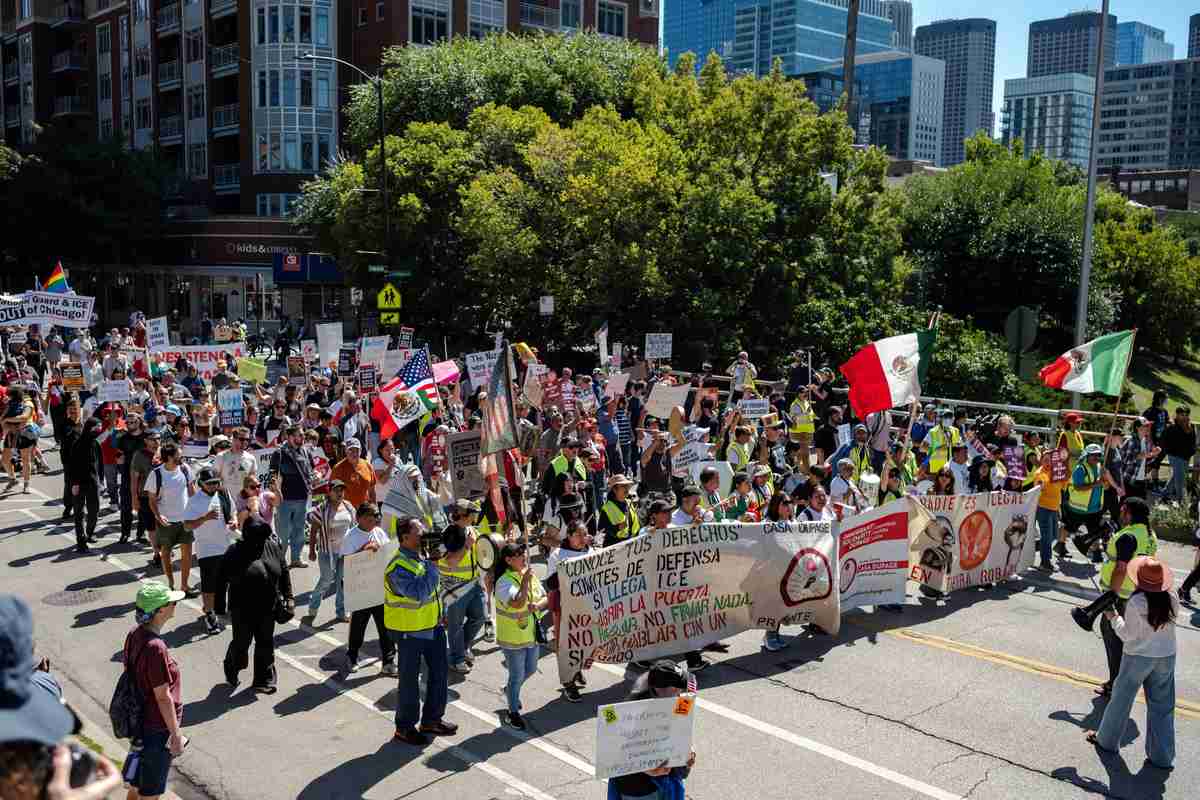
People participate in a Labor Day protest in Chicago, Illinois, U.S., September 1, 2025.
11:39 JST, September 2, 2025
CHICAGO, Sept 1 (Reuters) – Thousands of protesters packed the streets near downtown Chicago on Monday, singing, chanting and waving signs protesting U.S. President Donald Trump’s threats to flood the city with National Guard troops and federal immigration agents.
The march was one of roughly 1,000 “Workers over Billionaires” protests across the country on the U.S. Labor Day holiday. But Chicago’s demonstration had a decidedly more pointed tone as residents bristled against Trump’s promise to target Chicago next in a deployment similar to those under way in Los Angeles and Washington D.C., two other Democrat-run cities.
Mayor Brandon Johnson, speaking to the crowd, vowed that Chicago would resist federal encroachment.
“This is the city that will defend the country,” he said, receiving loud cheers from protesters waving blue-striped Chicago flags.
As the crowd wove through the city, some walking dogs and carrying children on their shoulders, diners sitting outside at local restaurants and cafes pumped their fists and cars honked in support. Organizers estimated 5,000 to 10,000 people were in attendance, though Reuters was not immediately able to verify the size with city officials.
Protesters said they were concerned by Trump’s threat to send out the National Guard and additional ICE agents.
Filiberto Ramirez, 72, feared violence if additional ICE agents come to the city. “Do we feel there’s gonna be trouble? Yes,” Ramirez said. “I hope nobody gets hurt.”
Trump has singled out Chicago in recent weeks over violent crime, calling the city “a mess,” “a hellhole” and a “killing field.” But on Monday, Chicagoans at the protest said they did not feel the National Guard was a solution to crime in the city.
“There is a crime problem,” said Yvonne Spears, 67, “but the National Guard is supposed to fight for us, not against us.”
Homicide rates in the nation’s third-largest city have plunged in recent years, according to city crime data. And though a 2025 University of Chicago survey reported roughly half of Chicagoans feel unsafe in their neighborhoods at night, many protesters said on Monday that they felt largely safe in the city.
City and state leaders have already readied measures to shield Chicago from federal troops and would likely launch a slew of lawsuits challenging a deployment, which legal experts said would violate the U.S. Constitution and a 19th-century law prohibiting the military from enforcing domestic laws.
Mayor Johnson signed an executive order on Saturday saying that Chicago police will not collaborate with federal agents or National Guard troops and directing all police officers to wear official uniforms and not to wear masks. Meanwhile, immigrant rights groups have worked to fortify their defenses amid threats of stepped-up immigration enforcement by working to hire more attorneys, staffing immigration hotlines and launching more “know your rights” training.
“The people here are proud that we’re a sanctuary city,” said Andrea Reyes, 42, referencing city policies prohibiting its government from involvement with federal immigration enforcement.
“I don’t think it’ll go well if the National Guard comes here.”




Most Read
Popular articles in the past 24 hours
-

My Spendthrift Mother Constantly Asks Me for Money
-

Japanese Students Use Traditional Pickle to Create Novel Wagashi ...
-

‘Dry Bonsai’ Gives New Life to Withered Trees, Allows Free Artist...
-

McDonald's Japan Raises Prices; Big Mac to Cost ¥500, Double Chee...
-

Nepal Bus Crash Kills 19 People, Injures 25 Including One Japanes...
-

Astellas Collaborates with Vir to Develop Its Experimental Prosta...
-

Japan’s Nikkei Stock Average Rises as AI-Related Stocks Shine; Co...
-

Early-Blooming Kawazu Cherry Blossoms Create Sea of Pink at Park ...
Popular articles in the past week
-

Producer Behind Pop Group XG Arrested for Cocaine Possession
-

Japan PM Takaichi’s Cabinet Resigns en Masse
-

Sanae Takaichi Elected Prime Minister of Japan; Keeps All Cabinet...
-

Japan's Govt to Submit Road Map for Growth Strategy in March, PM ...
-

Bus Carrying 40 Passengers Catches Fire on Chuo Expressway; All E...
-

U.S. Firm to Build Training Hub in Fukushima N-plant for Debris R...
-

Japan, U.S. Name 3 Inaugural Investment Projects; Reached Agreeme...
-

Riku-Ryu Pair Wins Gold Medal: Their Strong Bond Leads to Major C...
Popular articles in the past month
-
Producer Behind Pop Group XG Arrested for Cocaine Possession
-
Japan PM Takaichi’s Cabinet Resigns en Masse
-

Japan Institute to Use Domestic Commercial Optical Lattice Clock ...
-

Man Infected with Measles Reportedly Dined at Restaurant in Tokyo...
-

Israeli Ambassador to Japan Speaks about Japan’s Role in the Reco...
-

Videos Plagiarized, Reposted with False Subtitles Claiming ‘Ryuky...
-

Man Infected with Measles May Have Come in Contact with Many Peop...
-

Prudential Life Insurance Plans to Fully Compensate for Damages C...
Top Articles in News Services
-
Survey Shows False Election Info Perceived as True
-
Hong Kong Ex-Publisher Jimmy Lai’s Sentence Raises International Outcry as China Defends It
-
Japan’s Nikkei Stock Average Touches 58,000 as Yen, Jgbs Rally on Election Fallout (UPDATE 1)
-
Japan’s Nikkei Stock Average Falls as US-Iran Tensions Unsettle Investors (UPDATE 1)
-
Trump Names Former Federal Reserve Governor Warsh as the Next Fed Chair, Replacing Powell
JN ACCESS RANKING
-
Producer Behind Pop Group XG Arrested for Cocaine Possession
-
Japan PM Takaichi’s Cabinet Resigns en Masse
-
Japan Institute to Use Domestic Commercial Optical Lattice Clock to Set Japan Standard Time
-
Man Infected with Measles Reportedly Dined at Restaurant in Tokyo Station
-
Israeli Ambassador to Japan Speaks about Japan’s Role in the Reconstruction of Gaza