
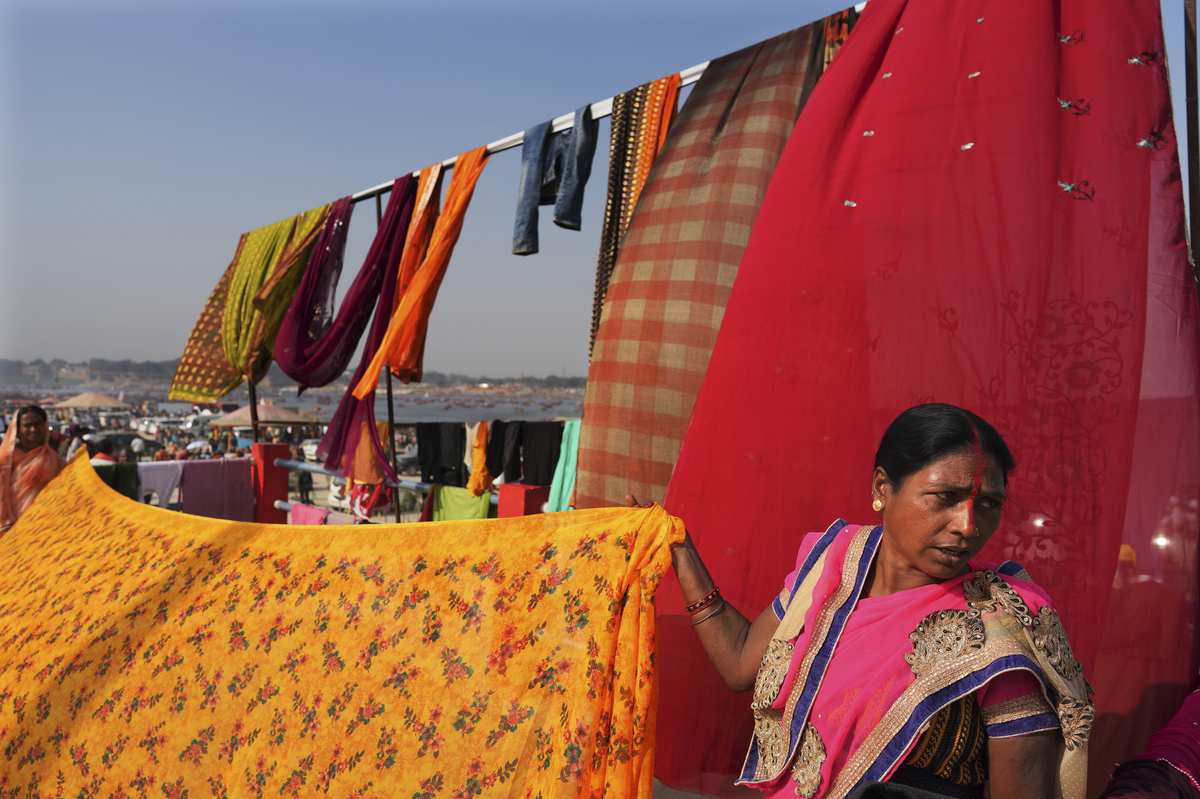
Pilgrims hold up their saris to dry after a holy dip at the confluence of the Ganges, the Yamuna and the mythical Saraswati rivers during Maha Kumbh festival in Prayagraj on Sunday.
15:11 JST, February 17, 2025
PRAYAGRAJ, India (AP) — The traditional colorful Indian fabric worn by women is ubiquitous to the world’s largest religious gathering in northern India’s Prayagraj city, where millions of Hindus are thronging to seek absolution from their sins and take dips in the holy waters.
This display of Indian women’s most idiosyncratic garment — known as the sari — is, however, seen mostly when it is sun-dried right on the sandy banks at the confluence of the Ganges, the Yamuna and the mythical Saraswati rivers after women bathe.
Pilgrims, particularly women, are seen sun-drying saris on bamboo rods and on the ground. Some hold the fabrics on both sides and shake it to remove any folds before letting it dry. Others just spread it on the river bank and the let the sun do its job, before it is packed in their bags and in some cases worn again.
The Maha Kumbh festival, which began on Jan. 13 and is held every 12 years, ends on Feb. 26. The authorities expect more than 400 million people to attend. Hindus believe that bathing at the confluence of the rivers will cleanse them of their sins and release them from the cycle of rebirth.
The festival also sees millions of Hindu women taking a dip in the waters, often draped in a sari.
Saris have remained traditional dresses for women in India and other South Asian countries including Pakistan, Bangladesh, and Nepal.
It is also one of the modest-dress customs of India’s both Hindu and Muslim communities, but at the Maha Kumbh festival, the textile is also symbolic of Hindu culture. Each sari color has a significance, with red and yellow believed to be most auspicious.
The festival has its roots in a Hindu tradition that says the god Vishnu wrested a golden pitcher containing the nectar of immortality from demons. Hindus believe that a few drops fell in the cities of Prayagraj, Nasik, Ujjain and Haridwar — the four places where the Kumbh festival has been held for centuries.





Most Read
Popular articles in the past 24 hours
-

My Spendthrift Mother Constantly Asks Me for Money
-
Japanese Students Use Traditional Pickle to Create Novel Wagashi ...
-
‘Dry Bonsai’ Gives New Life to Withered Trees, Allows Free Artist...
-

McDonald's Japan Raises Prices; Big Mac to Cost ¥500, Double Chee...
-

Nepal Bus Crash Kills 19 People, Injures 25 Including One Japanes...
-

Astellas Collaborates with Vir to Develop Its Experimental Prosta...
-

Japan’s Nikkei Stock Average Rises as AI-Related Stocks Shine; Co...
-
Early-Blooming Kawazu Cherry Blossoms Create Sea of Pink at Park ...
Popular articles in the past week
-

Producer Behind Pop Group XG Arrested for Cocaine Possession
-

Japan PM Takaichi’s Cabinet Resigns en Masse
-

Sanae Takaichi Elected Prime Minister of Japan; Keeps All Cabinet...
-

Japan's Govt to Submit Road Map for Growth Strategy in March, PM ...
-

Bus Carrying 40 Passengers Catches Fire on Chuo Expressway; All E...
-
U.S. Firm to Build Training Hub in Fukushima N-plant for Debris R...
-

Japan, U.S. Name 3 Inaugural Investment Projects; Reached Agreeme...
-

Riku-Ryu Pair Wins Gold Medal: Their Strong Bond Leads to Major C...
Popular articles in the past month
-
Producer Behind Pop Group XG Arrested for Cocaine Possession
-
Japan PM Takaichi’s Cabinet Resigns en Masse
-

Japan Institute to Use Domestic Commercial Optical Lattice Clock ...
-

Man Infected with Measles Reportedly Dined at Restaurant in Tokyo...
-

Israeli Ambassador to Japan Speaks about Japan’s Role in the Reco...
-

Videos Plagiarized, Reposted with False Subtitles Claiming ‘Ryuky...
-

Man Infected with Measles May Have Come in Contact with Many Peop...
-

Prudential Life Insurance Plans to Fully Compensate for Damages C...
Top Articles in News Services
-
Survey Shows False Election Info Perceived as True
-
Hong Kong Ex-Publisher Jimmy Lai’s Sentence Raises International Outcry as China Defends It
-
Japan’s Nikkei Stock Average Touches 58,000 as Yen, Jgbs Rally on Election Fallout (UPDATE 1)
-
Japan’s Nikkei Stock Average Falls as US-Iran Tensions Unsettle Investors (UPDATE 1)
-

Trump Names Former Federal Reserve Governor Warsh as the Next Fed Chair, Replacing Powell
JN ACCESS RANKING
-
Producer Behind Pop Group XG Arrested for Cocaine Possession
-
Japan PM Takaichi’s Cabinet Resigns en Masse
-
Japan Institute to Use Domestic Commercial Optical Lattice Clock to Set Japan Standard Time
-
Man Infected with Measles Reportedly Dined at Restaurant in Tokyo Station
-
Israeli Ambassador to Japan Speaks about Japan’s Role in the Reconstruction of Gaza