
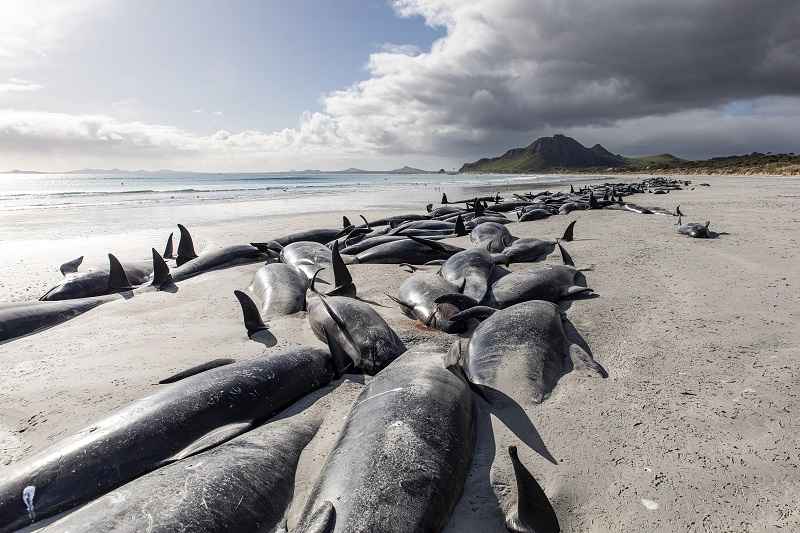
A string of dead pilot whales line the beach at Tupuangi Beach, Chatham Islands, in New Zealand’s Chatham Archipelago, Saturday, Oct. 8, 2022.
15:31 JST, October 12, 2022
WELLINGTON, New Zealand (AP) — Some 477 pilot whales have died after stranding themselves on two remote New Zealand beaches over recent days, officials say.
None of the stranded whales could be refloated and all either died naturally or were euthanized in a “heartbreaking” loss, said Daren Grover, the general manager of Project Jonah, a nonprofit group which helps rescue whales.
The whales beached themselves on the Chatham Islands, which are home to about 600 people and located about 800 kilometers (500 miles) east of New Zealand’s main islands.
The Department of Conservation said 232 whales stranded themselves Friday at Tupuangi Beach and another 245 at Waihere Bay on Monday.
The deaths come two weeks after about 200 pilot whales died in Australia after stranding themselves on a remote Tasmanian beach.
“These events are tough, challenging situations,” the Department of Conservation wrote in a Facebook post. “Although they are natural occurrences, they are still sad and difficult for those helping.”
Grover said the remote location and presence of sharks in the surrounding waters meant they couldn’t mobilize volunteers to try to refloat the whales as they have in past stranding events.
“We do not actively refloat whales on the Chatham Islands due to the risk of shark attack to humans and the whales themselves, so euthanasia was the kindest option,” said Dave Lundquist, a technical marine advisor for the conservation department.
Mass strandings of pilot whales are reasonably common in New Zealand, especially during the summer months. Scientists don’t know exactly what causes the whales to strand, although it appears their location systems can get confused by gently sloping sandy beaches.
Grover said there is a lot of food for the whales around the Chatham Islands, and as they swim closer to land, they would quickly find themselves going from very deep to shallow water.
“They rely on their echolocation and yet it doesn’t tell them that they are running out of water,” Grover said. “They come closer and closer to shore and become disoriented. The tide can then drop from below them and before they know it, they’re stranded on the beach.”
Because of the remote location of the beaches, the whale carcasses won’t be buried or towed out to sea, as is often the case, but instead will be left to decompose, Grover said.
“Nature is a great recycler and all the energy stored within the bodies of all the whales will be returned to nature quite quickly,” he said.









Most Read
Popular articles in the past 24 hours
-

Toronto Blue Jays’ Kazuma Okamoto Blasts 1st HR of Spring
-

20 Trapped in Tokyo Skytree Lift, Rescued 5½ Hours Later
-

Japan Seeks to Counter China's Expanding Influence in Pacific by ...
-

Aggression against Ukraine: Malignant Precedent Must Not Be Set t...
-

Japan's Diet Begins Debate on Takaichi's Budget Plans, ‘Proactive...
-

Japan Asks U.S. Not to Worsen Tariffs; Chief Cabinet Secretary Ki...
-

Milano Cortina 2026: Gold Medal Olympic Figure Skaters Riku Miura...
-

Exhibition Featuring Yoshiharu Tsuge’s Manga World Underway in Ch...
Popular articles in the past week
-

Producer Behind Pop Group XG Arrested for Cocaine Possession
-

Sanae Takaichi Elected Prime Minister of Japan; Keeps All Cabinet...
-

Japan's Govt to Submit Road Map for Growth Strategy in March, PM ...
-

Japan, U.S. Name 3 Inaugural Investment Projects; Reached Agreeme...
-

iPS Treatments Pass Key Milestone, but Broader Applications Far f...
-

Riku-Ryu Pair Wins Gold Medal: Their Strong Bond Leads to Major C...
-

Tokyo Skytree's Elevator Stops, Trapping 20 People; All Rescued (...
-

Director Naomi Kawase's New Film Explores Heart Transplants in Ja...
Popular articles in the past month
-
Producer Behind Pop Group XG Arrested for Cocaine Possession
-

Japan PM Takaichi’s Cabinet Resigns en Masse
-

Japan Institute to Use Domestic Commercial Optical Lattice Clock ...
-

Man Infected with Measles Reportedly Dined at Restaurant in Tokyo...
-

Israeli Ambassador to Japan Speaks about Japan’s Role in the Reco...
-

Videos Plagiarized, Reposted with False Subtitles Claiming ‘Ryuky...
-

Man Infected with Measles May Have Come in Contact with Many Peop...
-

Prudential Life Insurance Plans to Fully Compensate for Damages C...
Top Articles in News Services
-

Survey Shows False Election Info Perceived as True
-

Hong Kong Ex-Publisher Jimmy Lai’s Sentence Raises International Outcry as China Defends It
-

Japan’s Nikkei Stock Average Touches 58,000 as Yen, Jgbs Rally on Election Fallout (UPDATE 1)
-
Japan’s Nikkei Stock Average Falls as US-Iran Tensions Unsettle Investors (UPDATE 1)
-

Trump Names Former Federal Reserve Governor Warsh as the Next Fed Chair, Replacing Powell
JN ACCESS RANKING
-
Producer Behind Pop Group XG Arrested for Cocaine Possession
-
Japan PM Takaichi’s Cabinet Resigns en Masse
-
Man Infected with Measles Reportedly Dined at Restaurant in Tokyo Station
-
Israeli Ambassador to Japan Speaks about Japan’s Role in the Reconstruction of Gaza
-
Videos Plagiarized, Reposted with False Subtitles Claiming ‘Ryukyu Belongs to China’; Anti-China False Information Also Posted in Japan