
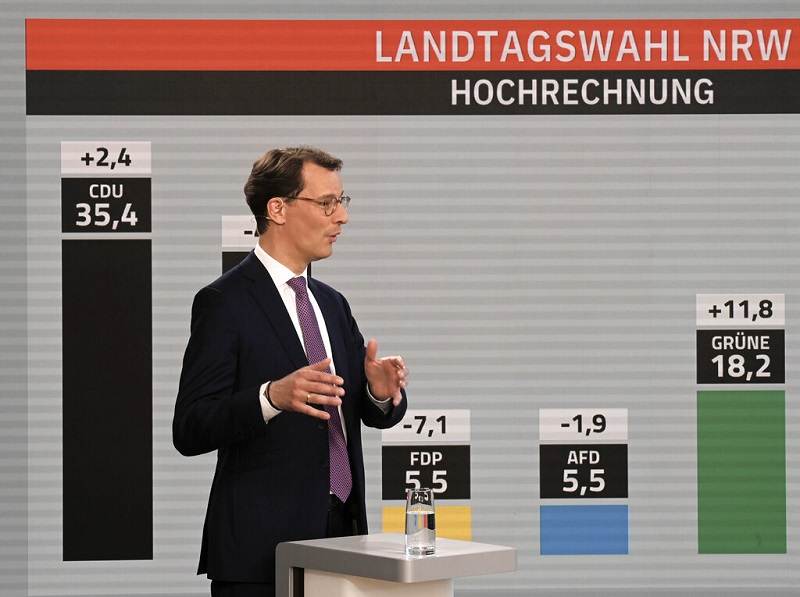
Hendrik Wuest, the former NRW Minister President and CDU top candidate for the state election in North Rhine-Westphalia, speaks in a TV studio in the state parliament on the evening of the state election in North Rhine-Westphalia, Germany, Sunday, May 15, 2022.
13:45 JST, May 16, 2022
BERLIN (AP) — Voters backed the incumbent conservative governor and dealt a blow to Chancellor Olaf Scholz’s Social Democrats on Sunday in Germany’s most populous state, projections based on partial counts showed.
Figures published by public broadcaster WDR forecast the Christian Democrats making small gains in the North Rhine-Westphalia state election to take 35.7% of the vote.
The Social Democrats slumped to 26.7%, while the environmentalist Greens more than doubled their share with 18.2% — a record for the party in the state.
The pro-business Free Democrats saw a big drop in support and were on course to get 5.6% of the vote. Its national leader, German Finance Minister Christian Lindner, called it a “disastrous defeat” for his party.
The far-right Alternative for Germany were also projected to take 5.6%.
The election in North Rhine-Westphalia was seen as an important test for Scholz. His government at the national level has faced a challenging start tackling the fallout from the coronavirus pandemic and Russia’s war in Ukraine.
The Christian Democrats have been governing together with the Free Democrats since 2017 in North Rhine-Westphalia, which is home to almost 18 million people and includes major cities such as Cologne and Duesseldorf.
Incumbent governor Hendrik Wuest could need to enter into a pact with the Social Democrats or the Greens. An alliance between the Social Democrats, Greens and the Free Democrats — mirroring the one governing at the national level — was also feasible.
But Wuest insisted that, as the party with the biggest number of votes, the Christian Democrats were first in line to form a new state government.
Alongside the rising cost of living, the war in Ukraine and education, the issue of tackling the causes and effects of climate change in the state — with its long history of heavy industry — was considered an important election issue.
North Rhine-Westphalia was among the regions hit by a devastating flash flood last year that fueled calls to end coal mining in the state. Experts say continued burning of fossil fuels increases the likelihood of such disasters in the future.
The Christian Democrats last week won a state vote in Schleswig-Holstein, but lost power to the Social Democrats in tiny Saarland in March.








Most Read
Popular articles in the past 24 hours
-

Japan to Strictly Control Exports of Lethal Defense Equipment Whi...
-

High-Hydration Bread on the Rise, Seeing Increase in Specialty Sh...
-

Japan's Prime Minister Sanae Takaichi Is ‘World's Most Powerful W...
-

White and Pink Plum Blossoms Begin to Bloom at Yuki Shrine in Jap...
-

Reform of Retrial System: Diet Must Thoroughly Discuss Remedies f...
-

17-Year-Old Fatally Stabbed in Osaka’s Dotonbori; Suspect at Larg...
-

Gold Smuggling into Japan Running Rampant
-

Bear Found in Warehouse in Fukushima Prefecture Culled
Popular articles in the past week
-

Prudential Life Insurance Plans to Fully Compensate for Damages C...
-

Woman with Measles Visited Hospital in Tokyo Multiple Times Befor...
-

Woman with No Overseas Travel History Infected with Measles in Na...
-

Measles Patient Flew Between Tokyo, Hokkaido in Late January; Lik...
-

Milano Cortina 2026: Kokomo Murase Comes Out on Top After Overcom...
-

CRA Leadership Election Will Center on Party Rebuilding; Lower Ho...
-

Videos Plagiarized, Reposted with False Subtitles Claiming ‘Ryuky...
-
Crime in Japan Ticks Up for 4th Straight Year
Popular articles in the past month
-

Japan Institute to Use Domestic Commercial Optical Lattice Clock ...
-

Israeli Ambassador to Japan Speaks about Japan’s Role in the Reco...
-

Man Infected with Measles May Have Come in Contact with Many Peop...
-
China Eyes Rare Earth Foothold in Malaysia to Maintain Dominance,...
-
Prudential Life Insurance Plans to Fully Compensate for Damages C...
-
Woman with Measles Visited Hospital in Tokyo Multiple Times Befor...
-
Australian Woman Dies After Mishap on Ski Lift in Nagano Prefectu...
-
Foreign Snowboarder in Serious Condition After Hanging in Midair ...
Top Articles in News Services
-

Prudential Life Expected to Face Inspection over Fraud
-
Hong Kong Ex-Publisher Jimmy Lai’s Sentence Raises International Outcry as China Defends It
-

Japan’s Nikkei Stock Average Touches 58,000 as Yen, Jgbs Rally on Election Fallout (UPDATE 1)
-

Trump Names Former Federal Reserve Governor Warsh as the Next Fed Chair, Replacing Powell
-

Suzuki Overtakes Nissan as Japan’s Third‑Largest Automaker in 2025
JN ACCESS RANKING
-
Japan Institute to Use Domestic Commercial Optical Lattice Clock to Set Japan Standard Time
-
Israeli Ambassador to Japan Speaks about Japan’s Role in the Reconstruction of Gaza
-
Man Infected with Measles May Have Come in Contact with Many People in Tokyo, Went to Store, Restaurant Around When Symptoms Emerged
-
China Eyes Rare Earth Foothold in Malaysia to Maintain Dominance, Counter Japan, U.S.
-
Prudential Life Insurance Plans to Fully Compensate for Damages Caused by Fraudulent Actions Without Waiting for Third-Party Committee Review