
Kochi: Statue of Sakamoto Ryoma, Almost 100 Years Old, Continues to Symbolize the Youth

The statue of Sakamoto Ryoma, which stands on Katsurahama Beach in Kochi
10:38 JST, January 3, 2026
KOCHI — A famous bronze statue stands as if gazing out over the Pacific Ocean at Cape Ryuzu on the eastern tip of bow-shaped Katsurahama Beach, a scenic spot in Kochi Prefecture on along the southern coast of Shikoku. The 5.3-meter-tall statue — 13.5 meters including its pedestal — is of Sakamoto Ryoma (1835–67), a historical figure who enjoys immense popularity among the Japanese people.
Born into a low-ranking samurai family in Kochi Prefecture, Ryoma was ambitious, wanting to usher in a new world. He played a significant role in mediating discussions between powerful domains aimed at overthrowing the Tokugawa shogunate.
You may also like to read
Kyoto: Retired Steam Locomotives Collected Show Off Rich Railway History as Part of Japanese CultureHyogo: Kobe Muslim Mosque in Japan Symbolizes Coexistence with People with Different Religious, Cultural BackgroundsThe statue, which was put up in 1928, will soon mark its 100th anniversary.
Looking up at the statue against the backdrop of pine trees, you see Ryoma wearing traditional Japanese formal attire paired with Western-style boots, which had been newly introduced from abroad when he was alive. His pose, with his right hand tucked into his kimono, is a familiar sight to many Japanese, who have seen it in their history textbooks.
Ryoma was assassinated at an early age and never got to witness the new world that emerged after the fall of the shogunate.
The statue is not only a place of pilgrimage for Ryoma’s fans but also a popular tourist attraction. A 69-year-old woman from Colorado, who stopped by while on a cruise, said that she understands well why the Japanese respect this revolutionary samurai.
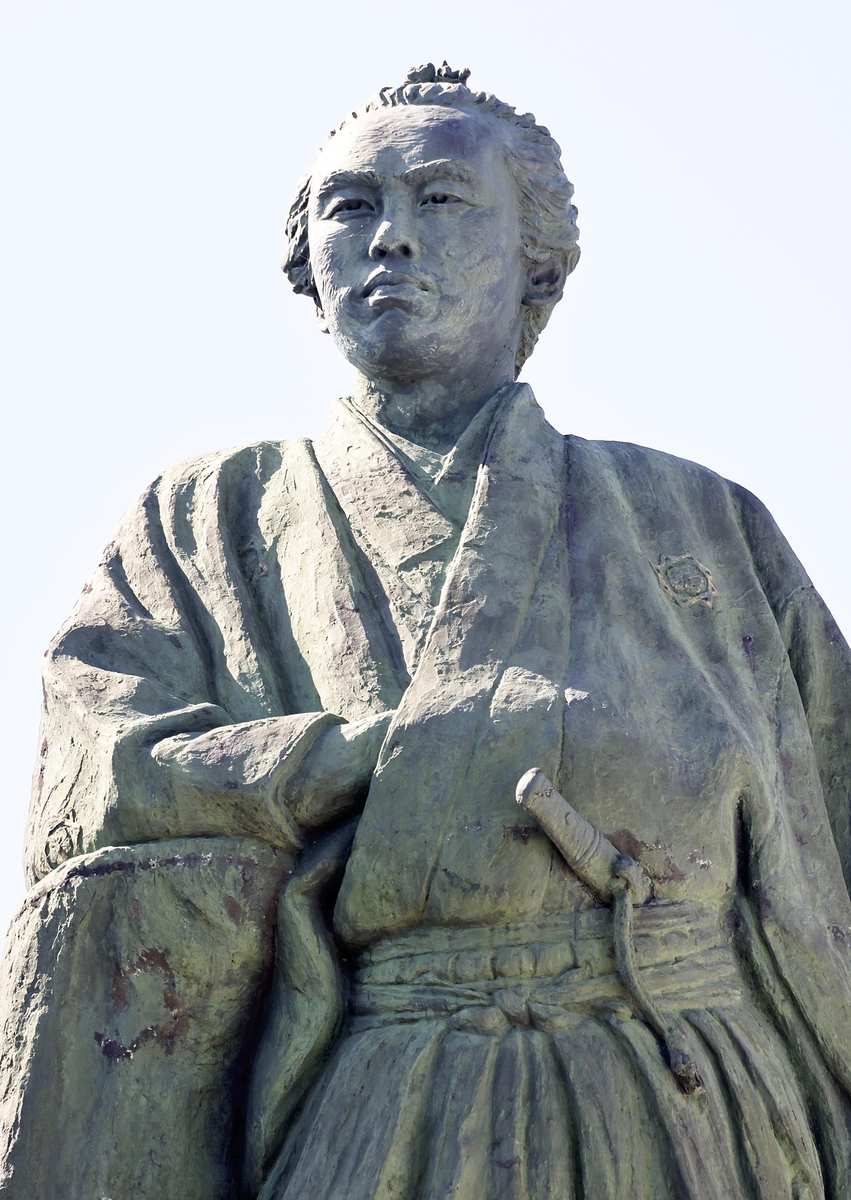
The statue of Ryoma seen from the front
In 1926, Yoshiyasu Irimajiri of Waseda University and three other students came up with the idea for the statue and started making plans to install it. A plaque on the pedestal reads, “Erected by the youth of Kochi Prefecture.”
At the time, Ryoma was not widely known. Calling him a “symbol of the youth,” the students rose up to honor his great deeds and make them known to the public. They chose Katsurahama Beach, which overlooks the Pacific Ocean, as the statue’s location.
The students launched a nationwide fundraising campaign asking for “donations equivalent to one pack of cigarettes.” Support grew, and they managed to raise about ¥25,000, which was equivalent to about 125,000 packs of cigarettes at that time.
The statue was created by portrait sculptor Hakuun Motoyama, a native of the prefecture, and an unveiling ceremony took place on May 27, 1928. To achieve balance when viewed from below, the statue’s face was sculpted slightly larger than Ryoma’s own.
The statue faces constant sea breezes, and its surface reaches 90 C in summer. As a result, it eventually started showing signs of long-term deterioration, so in 1998 volunteers raised funds to conduct restoration work.
“We wanted to honor the spirit of the young people who built it through donations,” said Ichiro Kaneko, 61, a Kochi city government official involved in the fundraising campaign. “Everyone felt that the statue was something significant that needed to be passed on to future generations.”
In February 1999, the statue was detached from its pedestal for the first time and restored.
Kaneko said that, at the time, he realized the true meaning of the statue’s gaze was that it was looking beyond the ocean horizon not toward tomorrow but toward the era to come.
Many people visit the statue at turning points in their lives.
“It’s a place for those who have grand aspirations and are about to spread their wings, like Ryoma, to strengthen their resolve,” said Natsuki Miura, 53, curator of the Kochi Prefecture Sakamoto Ryoma Memorial Museum.

Come meet popular sea lions
Katsurahama Aquarium, which opened in 1931, keeps and displays about 220 species totalling 4,000 creatures, primarily fish that inhabit Tosa Bay.

Popular sea lion Niko performs at Katsurahama Aquarium.
A pool shaped like Kochi Prefecture features a bridge modeled after Harimaya Bridge, a tourist destination in Kochi City. Visitors can feed penguins, capybaras, sea turtles and other creatures at eight feeding stations.
The aquarium shares updates on social media about the work of its care staff, and its merchandise is popular.
Two female sea lions, Nadeshiko, 14, and Niko, 11, regularly perform at the viewing area. “You can get up close to the creatures,” said staff member Kaori Mori, 35.

Bonito grilling experience
A specialty dish of Kochi Prefecture is katsuo tataki or katsuo no tataki— lightly grilled bonito served sliced. The fish dish seared with dried straw, called wara-yaki, is especially popular with tourists, and there are facilities where visitors can try grilling bonito themselves.

A katsuo tataki set menu meal
One of the facilities, Tosa Tataki Dojo, is located on the other side of Urado Ohashi Bridge, a 10-minute drive from Katsurahama Beach.
The establishment offers two options: katsuo tataki as a single dish (¥1,500) or a set meal of katsuo tataki with boiled whitebait and simmered green laver (¥1,800).
There is also the restaurant Katsuo-bune, which serves groups with reservations, on the second floor of the ship-shaped building. It offers a set meal of katsuo tataki, which comes with whitebait and egg tofu, priced at ¥2,640.
At both locations, visitors can savor bonito they grill themselves.
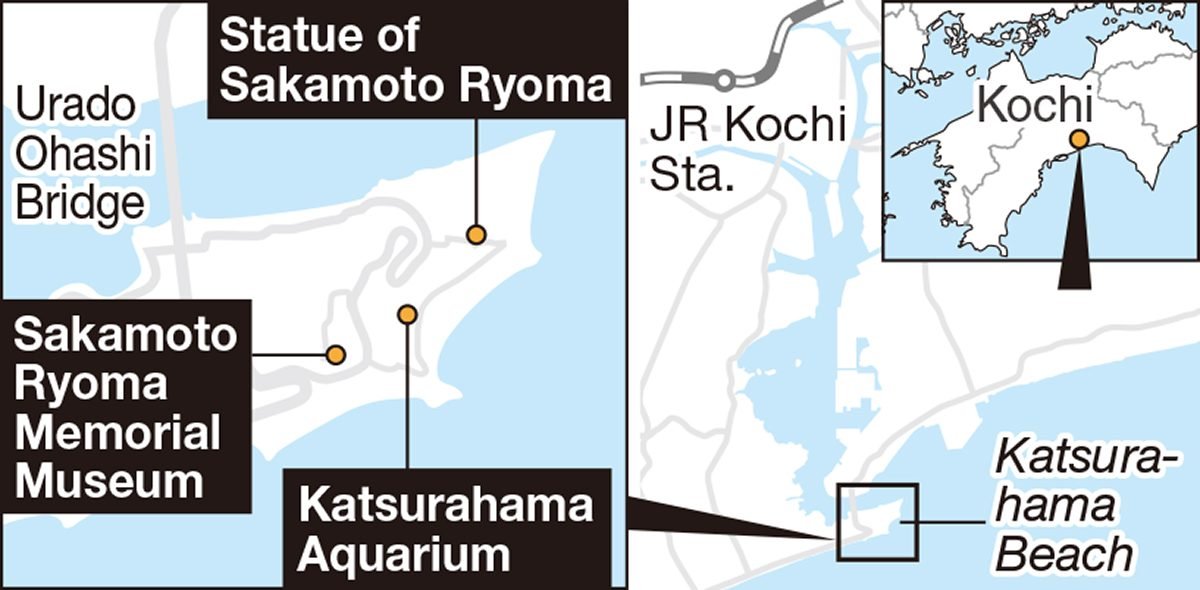
Sakamoto Ryoma statue
Take a Tosaden Traffic bus from JR Kochi Station and get off at the Katsurahama bus stop. In spring and autumn, events are held allowing visitors to ascend a stand set up nearby and gaze at the Pacific Ocean from Ryoma’s eye level.


Related Tags
Most Read
Popular articles in the past 24 hours
-
Japanese Shipping Giants Halt Strait of Hormuz Transit as Iran Co...
-

U.S. Launches Attacks on Iran: Avoid Escalation of Conflict by An...
-
Sawtooth Roof Factory Stands as Monument to Ashikaga Textile Hist...
-
Rental Lab Space in Tokyo Area More Than Doubles Since 2010, Offe...
-
Parents of Japanese Teen Shot in U.S. Strive for Gun Control
-
Disinformation Spreads About Team Mirai, Ballot Readers; Online P...
-
Asahi Breweries to Stage Comeback with New Product in April; Comp...
-
Bank of Japan Deputy Governor Says Rate Hikes Likely to Continue
Popular articles in the past week
-

Nepal Bus Crash Kills 19 People, Injures 25 Including One Japanes...
-
Milano Cortina 2026: Japanese Gold Medalist Figure Skater Miura S...
-
Tokyo Spends Big on Children, Wins Over Parents
-

McDonald's Japan Raises Prices; Big Mac to Cost ¥500, Double Chee...
-
‘Dry Bonsai’ Gives New Life to Withered Trees, Allows Free Artist...
-
Japan’s Miura, Kihara Announce Withdrawal from Figure Skating Wor...
-
Exhibition Featuring Yoshiharu Tsuge’s Manga World Underway in Ch...
-

Yokohama to Test Out Renewable-Powered Offshore Floating Data Cen...
Popular articles in the past month
-

Producer Behind Pop Group XG Arrested for Cocaine Possession
-

Japan PM Takaichi’s Cabinet Resigns en Masse
-

Man Infected with Measles Reportedly Dined at Restaurant in Tokyo...
-

Israeli Ambassador to Japan Speaks about Japan’s Role in the Reco...
-

Videos Plagiarized, Reposted with False Subtitles Claiming ‘Ryuky...
-

Man Infected with Measles May Have Come in Contact with Many Peop...
-

Prudential Life Insurance Plans to Fully Compensate for Damages C...
-
Woman with Measles Visited Hospital in Tokyo Multiple Times Befor...
Top Articles in Features
-
Tokyo’s New Record-Breaking Fountain Named ‘Tokyo Aqua Symphony’
-
Sapporo Snow Festival Opens with 210 Snow and Ice Sculptures at 3 Venues in Hokkaido, Features Huge Dogu
-
High-Hydration Bread on the Rise, Seeing Increase in Specialty Shops, Recipe Searches
-
Heirs to Kyoto Talent: Craftsman Works to Keep Tradition of ‘Kinran’ Brocade Alive Through Initiatives, New Creations
-

Maltese Pavilion’s Famous Ftira Bread Now Available in Osaka; Loaves Became Popular during 2025 Osaka-Kansai Expo
JN ACCESS RANKING
-
Producer Behind Pop Group XG Arrested for Cocaine Possession
-
Japan PM Takaichi’s Cabinet Resigns en Masse
-
Man Infected with Measles Reportedly Dined at Restaurant in Tokyo Station
-
Israeli Ambassador to Japan Speaks about Japan’s Role in the Reconstruction of Gaza
-
Videos Plagiarized, Reposted with False Subtitles Claiming ‘Ryukyu Belongs to China’; Anti-China False Information Also Posted in Japan