
Artwork at Museum Created Using Traditional Japanese Technique Gets Year-End Cleaning
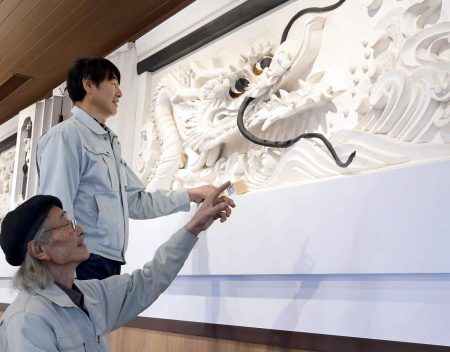
Kote-e artisans Katsunori Ishizaki, front, and his son remove dust from a kote-e work titled “Soryu” (Double dragons) at a museum in Imizu, Toyama Prefecture, on Dec. 20.
16:24 JST, January 7, 2026
IMIZU, Toyama — Kote-e artisans carefully removed a year’s worth of dust from a kote-e work at a museum in Imizu, Toyama Prefecture, during the year-end cleaning around the end of December.
Kote-e is a traditional Japanese handicraft in which plaster is layered using trowels of various sizes to create 3D images and patterns.
The Kosugi district in the city has long been a center for kote-e. It is also the birthplace of plasterer Genzo Takeuchi (1886-1942), whose works adorned a VIP room at the Imperial Hotel and other buildings.
Katsunori Ishizaki and his son, both kote-e artists from Nanto in the prefecture, brushed away accumulated dust from the work titled “Soryu” (Double dragons), which is more than 17 meters wide and features two white plaster dragons facing each other. The work is one of the largest of its kind in Japan.
In addition, they dusted mica powder onto a namako wall, which features a grid-like pattern created using white plaster, to add shine to the surface.
“We want to make the works as clean as possible so that many people will be able to appreciate them again next year,” Ishizaki said.


Related Tags




Most Read
Popular articles in the past 24 hours
-

Japan Figure Skating Legend Yuzuru Hanyu Is Proud Disaster Surviv...
-
Massive Sewer Pipe Found Jutting Out of Highway in Osaka
-

Japan-U.S. Summit Likely to Focus on Middle East; Takaichi to Fac...
-

15 Years since Great East Japan Earthquake: How Can Affected Area...
-
Japan Holds Memorial Events to Mark 15th Anniversary of 2011 Eart...
-

Japan’s Nikkei Stock Average Rise Lifted by AI Stocks, Easing Con...
-

Japan’s Mitsui O.S.K. Lines Container Ship Anchored in Persian Gu...
-

Parents in Japan to Get Instagram Notifications When Teens Repeat...
Popular articles in the past week
-

Ibaraki Pref.'s 1st Foreign Bus Driver Hired in Tsukuba
-

Nippon Life Insurance's U.S. Arm Sues OpenAI Over Legal Assistanc...
-
Govt to Utilize ODA for Ensuring Economic Security; Securing Ener...
-
Japan Figure Skating Legend Yuzuru Hanyu Is Proud Disaster Surviv...
-

Amid Strait of Hormuz Blockade, Shipping Companies Scramble to Ge...
-
Massive Sewer Pipe Found Jutting Out of Highway in Osaka
-
Japan Govt Survey Finds Just 10% of Workers Want Working Hours to...
-
Beckoning Cats Get Makeover to Fit Modern Lifestyles with Sleek D...
Popular articles in the past month
-

Producer Behind Pop Group XG Arrested for Cocaine Possession
-

Japan PM Takaichi’s Cabinet Resigns en Masse
-

Man Infected with Measles Reportedly Dined at Restaurant in Tokyo...
-

Videos Plagiarized, Reposted with False Subtitles Claiming ‘Ryuky...
-

iPS Treatments Pass Key Milestone, but Broader Applications Far f...
-

Sanae Takaichi Elected Prime Minister of Japan; Keeps All Cabinet...
-

Nepal Bus Crash Kills 19 People, Injures 25 Including One Japanes...
-

South Korea Tightens Rules on Foreigners Buying Homes in Seoul Me...
Top Articles in Features
-

Tokyo’s New Record-Breaking Fountain Named ‘Tokyo Aqua Symphony’
-

High-Hydration Bread on the Rise, Seeing Increase in Specialty Shops, Recipe Searches
-
Japanese Students Use Traditional Pickle to Create Novel Wagashi Confectionery
-
Heirs to Kyoto Talent: Craftsman Works to Keep Tradition of ‘Kinran’ Brocade Alive Through Initiatives, New Creations
-

My Spendthrift Mother Constantly Asks Me for Money
JN ACCESS RANKING
-
Producer Behind Pop Group XG Arrested for Cocaine Possession
-
Japan PM Takaichi’s Cabinet Resigns en Masse
-
Man Infected with Measles Reportedly Dined at Restaurant in Tokyo Station
-
Videos Plagiarized, Reposted with False Subtitles Claiming ‘Ryukyu Belongs to China’; Anti-China False Information Also Posted in Japan
-
iPS Treatments Pass Key Milestone, but Broader Applications Far from Guaranteed