
Kagawa Pref. Museums Hold Contemporary Art Exhibitions in Conjunction with Setouchi Triennale
16:30 JST, October 2, 2025
TAKAMATSU — Ahead of the Setouchi Triennale 2025, a triennial art festival held on the islands of the Setouchi Inland Sea, special exhibitions are being mounted at art museums across Kagawa, Okayama and Hyogo prefectures. Works by first-rate contemporary artists are drawing attention by sharing the appeal of fine art at three participating museums in Kagawa Prefecture.
‘Shinro Ohtake: Retina’
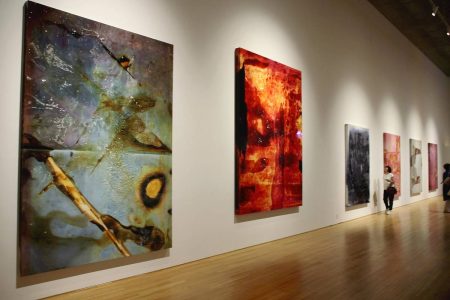
The “Retina” painting series by Shinro Ohtake are on display at the Marugame Genichiro-Inokuma Museum of Contemporary Art in Marugame, Kagawa Prefecture.
“Shinro Ohtake: Retina,” an exhibition of paintings by Shinro Ohtake at the Marugame Genichiro-Inokuma Museum of Contemporary Art in Marugame, Kagawa Prefecture, focuses on “Retina,” a signature series of Shinro Ohtake. Through the more than 300 works on display, the art show asks what vision, time and memory are. The exhibition runs through Nov. 24.
Ohtake first conceived the series in 1988. The works in it feature Polaroid films that are enlarged and coated with urethane resin. Like a transparent paint, resin can add changes such as sheen and rough texture to the film. The color surface and the resin layer on each image make you aware that seeing involves an image being focused in the brain through your retina.
The exhibition showcases a set of 12 new “Retina” works as well as other works from the series, the largest of which is 3 meters tall and about 2 meters wide. Some of the works are recreations using Polaroid films from 1989. Their colors are brighter than the original versions Ohtake created in the 1990s.
“The films’ original sheets went through chemical changes,” said Koichi Nakata, the museum’s deputy director who curated the exhibition. “You can say those shades were made by accumulated layers of time.”
Among the exhibits is an installation titled “Retinamnesia Filtration Shed,” which expands the world portrayed in the series into the third dimension.
‘Ishida Takashi: Between Tableau and Window’
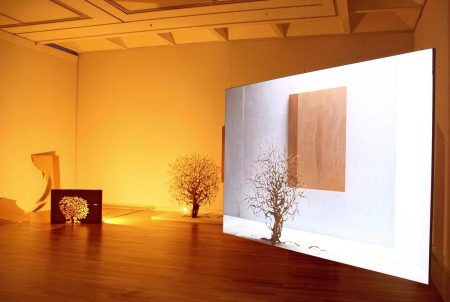
“Beyond the Garden” by Takashi Ishida is exhibited at the Takamatsu Art Museum in Takamatsu.
An interest in time is the origin of creative inspirations for artist Takashi Ishida, too. Takamatsu Art Museum in Takamatsu is holding an exhibition of his work, “Ishida Takashi: Between Tableau and Window,” until Sunday.
The exhibition is Ishida’s first large-scale exhibition in about 10 years and features about 80 works, including video art created with his “drawing animation” technique, which involves him drawing lines on a wall which are photographed frame by frame.
“Beyond the Garden” is an installation combining a video and light. Orange lighting slowly flickers and illuminates a tree made of wooden boards. The tree’s shadow repeatedly getting longer and shorter is meant to remind viewers of twilight. A large display shows a video of the tree growing thick.
“I want to draw time itself,” Ishida said.
His videos record the passage of time — paintings and sculptures in motion and flickering light coming through the window of his studio. In recent years, he has started working on oil paintings for the first time in 25 years in a bid to depict time and space being frozen. Looking around the exhibition venue, you can see the consistency of the theme in his creative outputs, from early paintings to his latest video art.
‘The Seven Wonders of Sanuki’
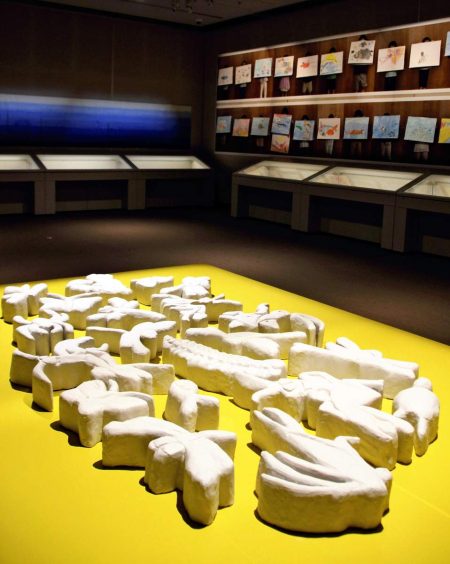
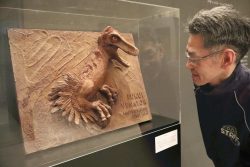
Tsuyoshi Ozawa’s works with images of living creatures on a seal case made of a narwhal tusk as motifs are on display at the Kagawa Museum in Takamatsu.
At the Kagawa Museum in Takamatsu, a special exhibition titled “The Seven Wonders of Sanuki” is being held through Oct. 13. Sanuki is the old name for Kagawa Prefecture. The exhibition features seven different types of wonders found in cultural properties from the museum’s collection, which were selected by artist Tsuyoshi Ozawa to introduce the local culture and history from his own perspective with a sense of humor.
A section of the exhibition includes an easy-to-comprehend presentation of a traditional seal case made of a narwhal’s tusk, which is engraved with countless miniature images of living creatures. The presentation is easy on the eyes as Ozawa made enlarged models of the images, using oil-based clay and other materials.
On display in another section are naked figurines bound by ropes, which are called “Jikishiko Goryugi Hijinawa Hinagata.” Even the museum curators have no idea why these figurines were made. Apparently, this is the first time for the figurines to be shown in public, although they have been part of the museum’s collection for a long time.
“I just followed my interest straightforwardly and came face-to-face with Sanuki,” Ozawa said, showing respect for the local culture.
Setouchi Triennale 2025, held at 17 areas on the islands and coastal areas of Kagawa and Okayama prefectures, opened in April. The festival period is split into three separate terms — spring, summer and autumn. The autumn term will be held from Oct. 3 to Nov. 9.


Related Tags



Most Read
Popular articles in the past 24 hours
-

Japan Seeks to Counter China's Expanding Influence in Pacific by ...
-
Exhibition Featuring Yoshiharu Tsuge’s Manga World Underway in Ch...
-

Tokyo Skytree Observation Deck Remains Closed for Inspection afte...
-
Japanese Watermelon Shipments Starts in Leading Production Distri...
-

Impact on Japanese Economy Unclear with Trump’s New Tariffs, Shif...
-

Takeshima Day: Persistently Demanding Resolution from South Korea...
-

Hanzomon Line Service Suspended between Kudanshita, Oshiage Stati...
-

CARTOON OF THE DAY (February 25)
Popular articles in the past week
-

Producer Behind Pop Group XG Arrested for Cocaine Possession
-

iPS Treatments Pass Key Milestone, but Broader Applications Far f...
-

Japan, U.S. Name 3 Inaugural Investment Projects; Reached Agreeme...
-
Tokyo Skytree's Elevator Stops, Trapping 20 People; All Rescued (...
-

Director Naomi Kawase's New Film Explores Heart Transplants in Ja...
-

Japan’s Major Real Estate Firms Expanding Overseas Businesses to ...
-

Milano Cortina 2026: Japanese Figure Skater Kaori Sakamoto’...
-

Baby Monkey Punch Captures Hearts at Chiba Pref. Zoo, on Social M...
Popular articles in the past month
-
Producer Behind Pop Group XG Arrested for Cocaine Possession
-

Japan PM Takaichi’s Cabinet Resigns en Masse
-

Japan Institute to Use Domestic Commercial Optical Lattice Clock ...
-

Man Infected with Measles Reportedly Dined at Restaurant in Tokyo...
-

Israeli Ambassador to Japan Speaks about Japan’s Role in the Reco...
-

Videos Plagiarized, Reposted with False Subtitles Claiming ‘Ryuky...
-

Man Infected with Measles May Have Come in Contact with Many Peop...
-

Prudential Life Insurance Plans to Fully Compensate for Damages C...
Top Articles in Culture
-

BTS to Hold Comeback Concert in Seoul on March 21; Popular Boy Band Releases New Album to Signal Return
-
Director Naomi Kawase’s New Film Explores Heart Transplants in Japan, Production Involved Real Patients, Families
-

‘Jujutsu Kaisen’ Voice Actor Junya Enoki Discusses Rapid Action Scenes in Season 3, Airing Now
-

Tokyo Exhibition Offers Inside Look at Impressionism; 70 of 100 Works on ‘Interiors’ by Monet, Others on Loan from Paris
-
Traditional Japanese Silk Hakama Tradition Preserved by Sole Weaver in Sendai
JN ACCESS RANKING
-
Producer Behind Pop Group XG Arrested for Cocaine Possession
-
Japan PM Takaichi’s Cabinet Resigns en Masse
-
Man Infected with Measles Reportedly Dined at Restaurant in Tokyo Station
-
Israeli Ambassador to Japan Speaks about Japan’s Role in the Reconstruction of Gaza
-
Videos Plagiarized, Reposted with False Subtitles Claiming ‘Ryukyu Belongs to China’; Anti-China False Information Also Posted in Japan