
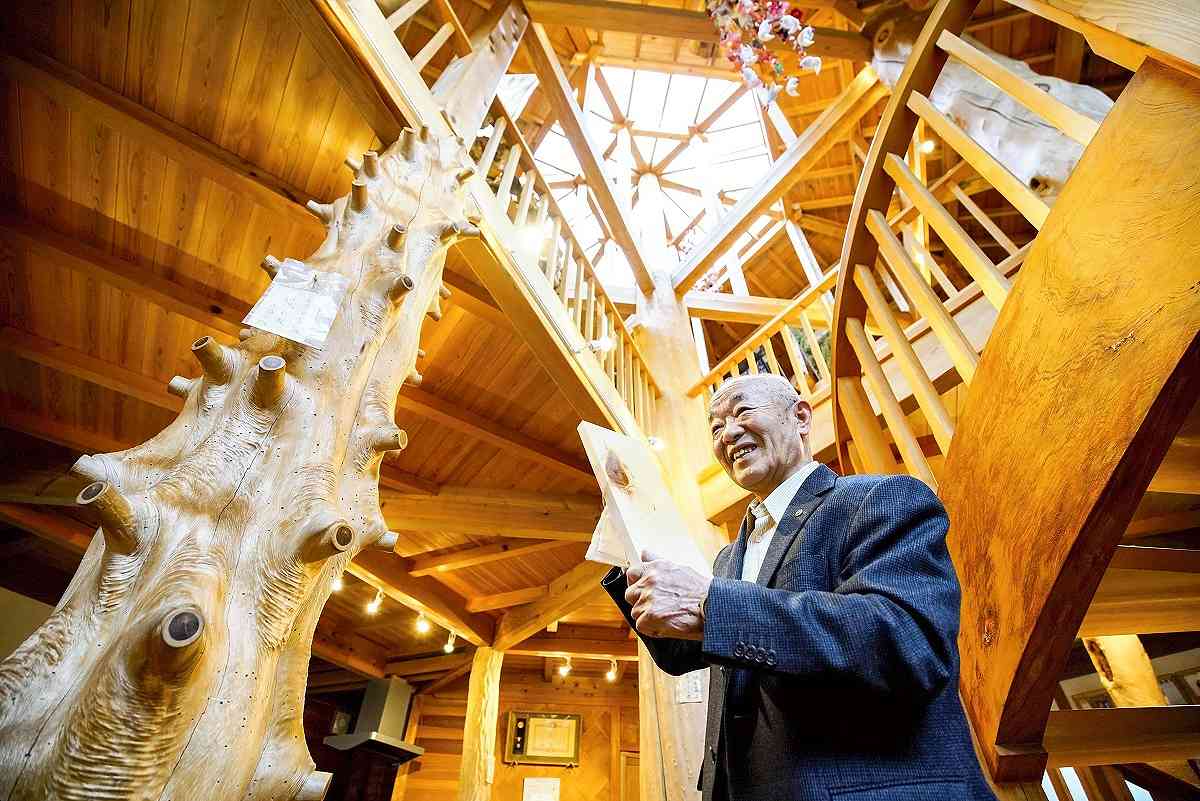
Tadao Otsuki smiles as he stands beside a wooden spiral staircase.
11:57 JST, January 12, 2021
Tadao Otsuki, 83, a former lumber company president, built the Kiryokukan museum in Saitama City because he wanted to show off the beauty of domestic timber.
The museum not only displays various types of timber but is also a work of art itself. The structure is constructed with domestic timber, such as hinoki cypress and sugi cedar, and was built using traditional techniques. Kiryokukan literally means “the house of the power of wood.”
The museum is a hexagonal two-story building with a main pillar that is a poplar log from Tochigi Prefecture. All of the pillars have holes bored into them for the beams to fit into. This construction method, called “toshinuki koho,” makes the building very stable.
Seeing a wooden spiral staircase is apparently extremely rare because it requires assembling curved pieces, which are all carved using planes and chisels.
“You think that’s a defect, don’t you?” Otsuki asked me, pointing to a split in one of the beams.
He told me splits that occur during the drying process are actually a good sign the timber has lost moisture and have become more firm and durable. To prevent cracks from appearing in pillars, a method called “sewari,” in which invisible cuts are made in the sides, is used. Another method used to avoid splits is to heat the timber at a high temperature. However, the smell of the timber and its ability to regulate humidity will be lost, Otsuki said.
He handed me a wooden board, and when I held it close to my nose I could smell the hinoki cypress. The scent only became stronger when I wet the surface with a towel. I did the same with another board that was heated at a high temperature, and its aroma was very faint.
The museum also has a section where visitors can compare domestic timber, such as cherry, pine and Japanese zelkova trees, with timber from around the world.
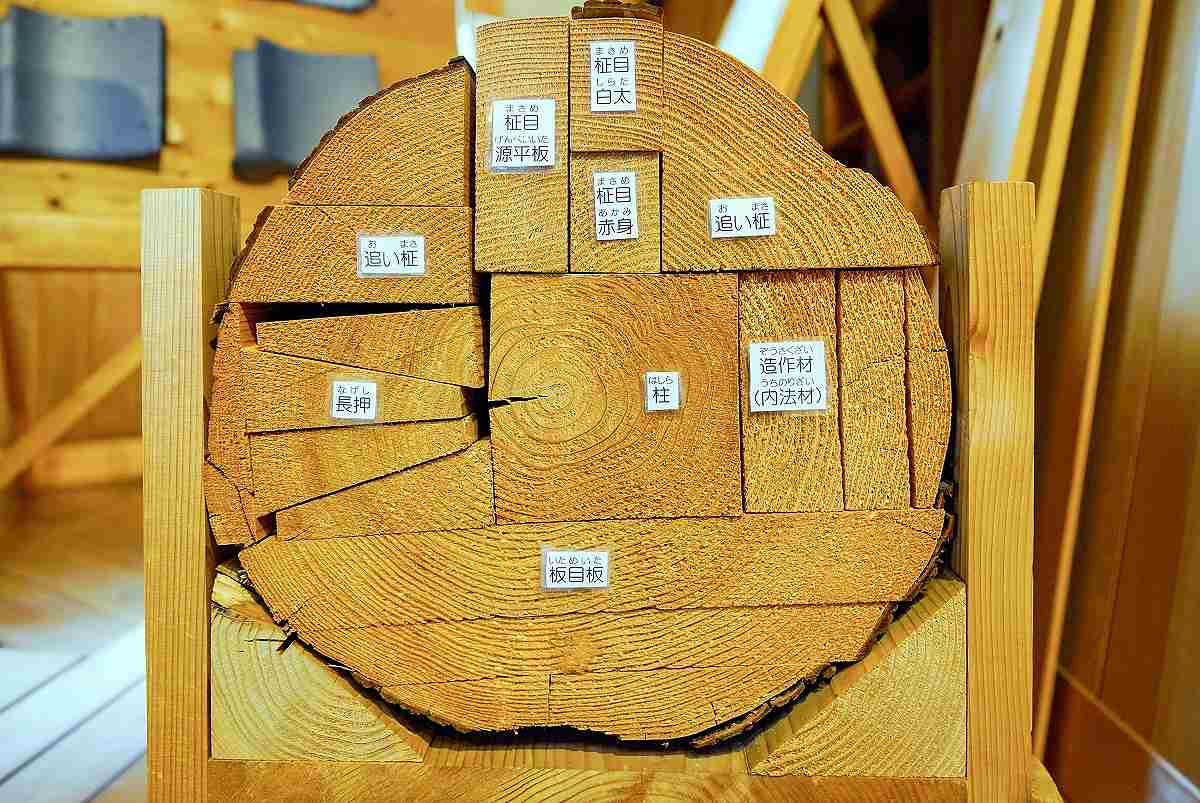
This exhibit shows the different types of timber that can come from one log, all with different grains and different purposes.
Otsuki holds a woodworking class at the museum to let participants feel the warmth of wood. He also gives presentations at elementary schools and has donated wooden tsumiki blocks to nursery schools in the neighborhood. He is actively engaged in promoting domestic timber.
“Trees that are decades old are still too young to be cut into timber because, at that point, it’s still their job to help the environment by taking in carbon dioxide,” said Otsuki. “When they have lived for at least 80 years, then they can finally become timber, like me.”
This museum is definitely filled with the enthusiasm of someone who used to run a lumber company.
Kiryokukan: 558-2 Niigatasuka, Iwatsuki Ward, Saitama City, Saitama Prefecture
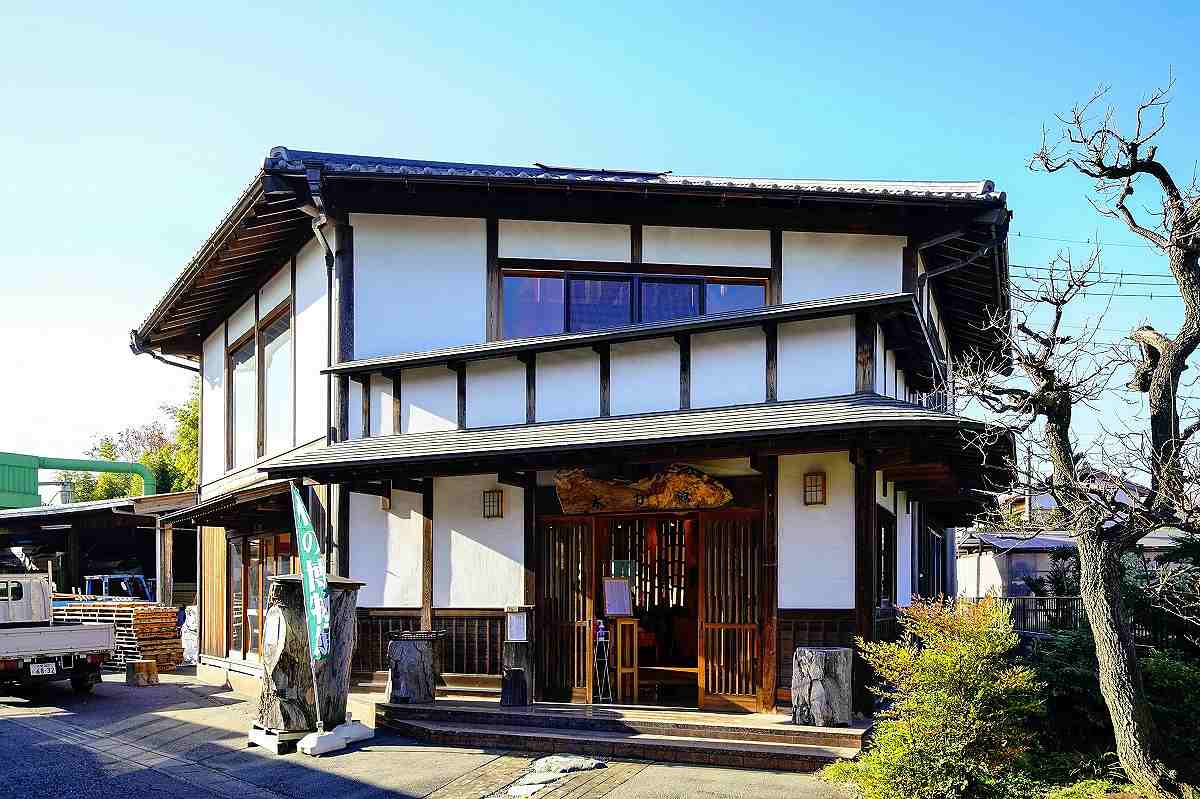
The exterior of Kiryokukan is seen in Saitama City.





Most Read
Popular articles in the past 24 hours
-

Strait of Hormuz Closure Shakes Markets; Prolonged Closure Could ...
-

Iran Situation: Japan Must Exert Diplomatic Efforts without Merel...
-
Japan Traditional Puppet Performance Held at Onsen Resort in Shiz...
-

2 of Japan's Opposition Parties Submit Bill to Revise Political F...
-

U.S. Urges Citizens to Immediately Depart over A Dozen Middle Eas...
-
Chiba Police to Arrest Japanese National in Midair; Man Accused o...
-

Trump Pursues Iranian Decapitation without a Plan for What Comes ...
-

Japanese Firms Ban Business Trips, Cancel Vacation Tours Amid Mid...
Popular articles in the past week
-
Milano Cortina 2026: Japanese Gold Medalist Figure Skater Miura S...
-
Tokyo Spends Big on Children, Wins Over Parents
-

Japan’s Miura, Kihara Announce Withdrawal from Figure Skating Wor...
-
Exhibition Featuring Yoshiharu Tsuge’s Manga World Underway in Ch...
-

Yokohama to Test Out Renewable-Powered Offshore Floating Data Cen...
-

BOJ Keeping Eye on Economy and Takaichi's ‘Proactive Fiscal Polic...
-
Tokyo Measles Patient Traveled to Fukuoka Aboard JAL Planes; Susp...
-

Japan’s Takaichi Speaks on New U.S. Tariff in Upper House, Says P...
Popular articles in the past month
-

Producer Behind Pop Group XG Arrested for Cocaine Possession
-

Japan PM Takaichi’s Cabinet Resigns en Masse
-

Man Infected with Measles Reportedly Dined at Restaurant in Tokyo...
-

Israeli Ambassador to Japan Speaks about Japan’s Role in the Reco...
-

Videos Plagiarized, Reposted with False Subtitles Claiming ‘Ryuky...
-

Prudential Life Insurance Plans to Fully Compensate for Damages C...
-
Woman with Measles Visited Hospital in Tokyo Multiple Times Befor...
-

iPS Treatments Pass Key Milestone, but Broader Applications Far f...
Top Articles in Culture
-

BTS to Hold Comeback Concert in Seoul on March 21; Popular Boy Band Releases New Album to Signal Return
-

Director Naomi Kawase’s New Film Explores Heart Transplants in Japan, Production Involved Real Patients, Families
-

Tokyo Exhibition Offers Inside Look at Impressionism; 70 of 100 Works on ‘Interiors’ by Monet, Others on Loan from Paris
-
Traditional Japanese Silk Hakama Tradition Preserved by Sole Weaver in Sendai
-
Exhibition Featuring Yoshiharu Tsuge’s Manga World Underway in Chofu, Tokyo; Unique, Surreal Works Draw Steady Crowds
JN ACCESS RANKING
-
Producer Behind Pop Group XG Arrested for Cocaine Possession
-
Japan PM Takaichi’s Cabinet Resigns en Masse
-
Man Infected with Measles Reportedly Dined at Restaurant in Tokyo Station
-
Israeli Ambassador to Japan Speaks about Japan’s Role in the Reconstruction of Gaza
-
Videos Plagiarized, Reposted with False Subtitles Claiming ‘Ryukyu Belongs to China’; Anti-China False Information Also Posted in Japan