
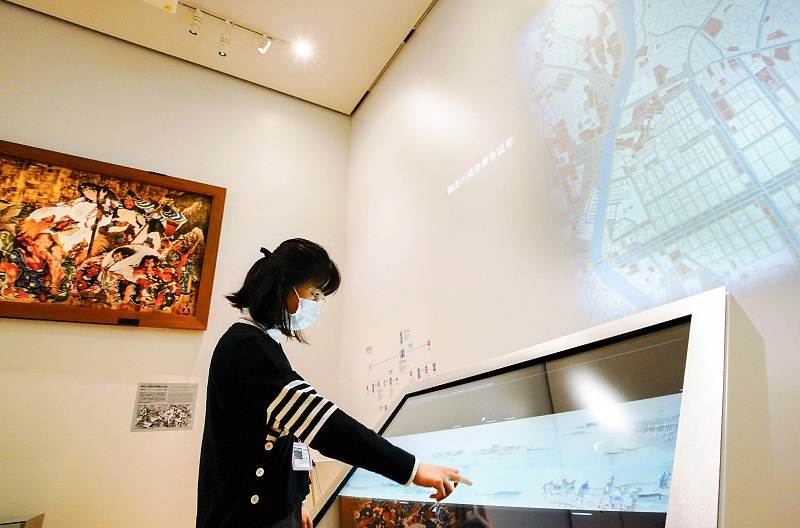
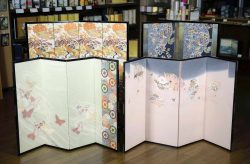
A staff member demonstrates how to use a touch panel through which visitors can learn about places connected to Hokusai. Hanging in the background is a replica of “Susanoo no Mikoto Yakujin Taiji no Zu (Susanoo no Mikoto Making a Pact with the Spirits of Disease),” a votive wooden tablet destroyed by fire during the Great Kanto Earthquake.
18:55 JST, August 3, 2021
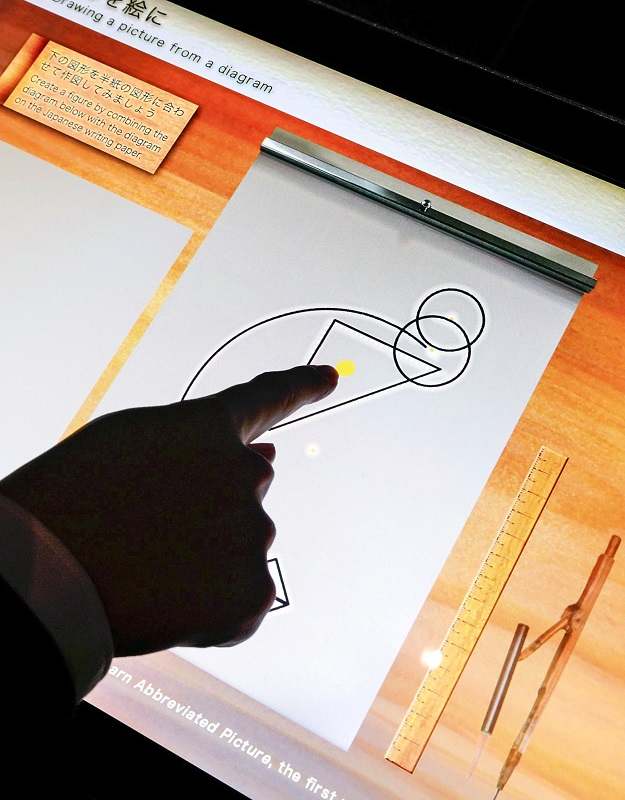
A visitor plays an illustration game based on materials left by Hokusai via a touch panel.
Celebrating the life and work of world-famous Edo period ukiyo-e artist Katsushika Hokusai (1760-1849), the Sumida Hokusai Museum stands in his birthplace of what is now the Kamezawa area in Tokyo’s Sumida Ward.
Officially opened in 2016, plans for the museum’s construction began back in 1989. However, due to the burst of the bubble economy, those plans fell through. The idea was later revisited but was once again put on hold due to soaring construction costs in the wake of the Great East Japan Earthquake.
It houses roughly 1,800 works of Hokusai and his disciples, including some procured from the family of late American print art researcher Peter Morse.
In the museum’s permanent exhibits, visitors can trace Hokusai’s life through 29 faithful reproductions of his original pieces.
Approaching the age of 90, Hokusai was quite long-lived for someone of that time. During his life, he mastered his painting techniques while moving to various areas near the Sumida River over 90 times.
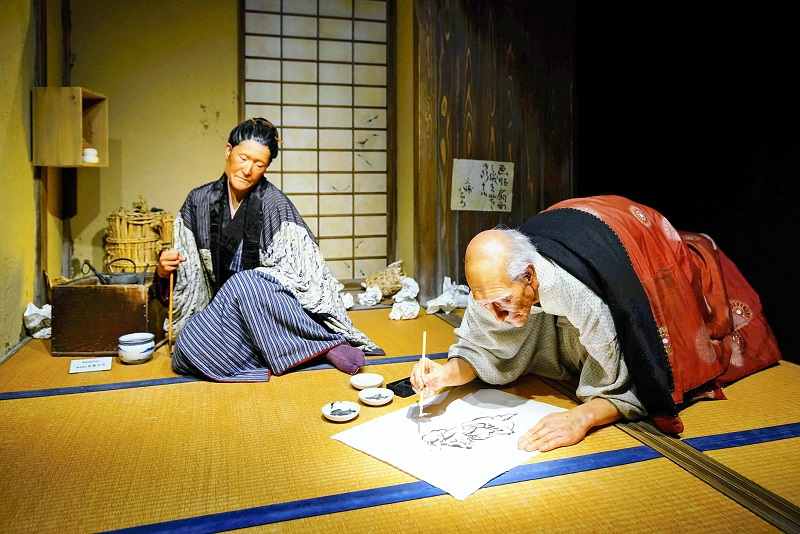
The full-scale reproduction of Hokusai’s workplace. Hokusai, in his 80s, is depicted at work while his daughter sits beside him.
Surprisingly, he was in his 70s when he painted “The Great Wave off Kanagawa,” part of the “Thirty-six Views of Mount Fuji” series.
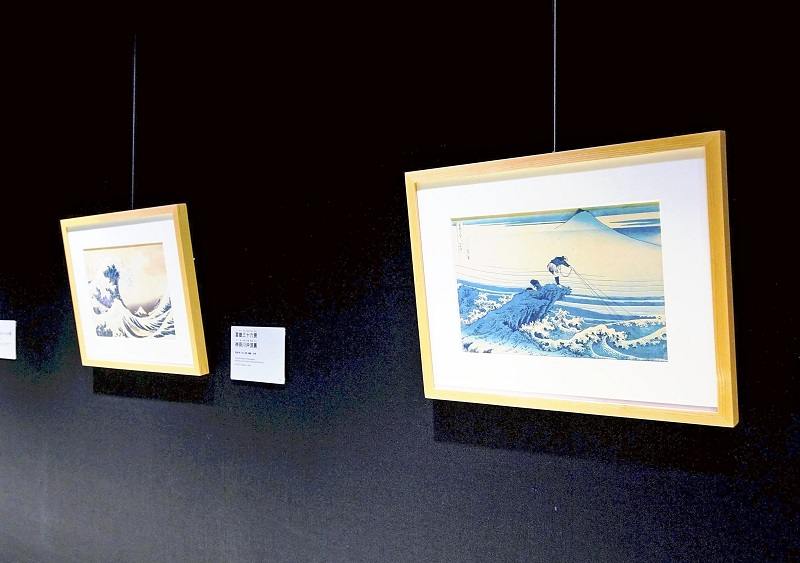
Faithful reproductions of pieces from the world-famous “Thirty-six Views of Mount Fuji” series, are displayed.
Displayed next to it is “Koshu Kajikazawa,” another piece in “Thirty-six Views of Mount Fuji,” in which a lone fisherman pulls a net from the raging waves, while Mt. Fuji imposingly stands still in the distance. Many visitors are captivated by the beauty of this scene, rendered in shades of indigo.
A full-scale replica of his atelier has also been created, based on sketches of Hokusai’s house left by his disciples. Inside, Hokusai in his later years is depicted, bundled up in a coverlet for a kotatsu heated table, brush in hand, while his third daughter Oei sits nearby. Even small details, such as the room’s sliding paper door having holes and crumpled pieces of paper littering the floor are depicted.
“Hokusai had no interest in anything that wasn’t painting pictures and it seems that he repeatedly cluttered up his room and then moved to a new house. Moving cost him [quite a bit of] money, so he lived a modest life,” explained Ena Nakayama, 25, a museum curator. His final words are said to have been, “If I had just five more years to live, I could have become a true artist.”
Many may only know Hokusai for his masterpiece “Thirty-six Views of Mount Fuji” series, but at the Sumida Hokusai Museum, visitors can learn about different aspects of Hokusai, who avidly pursued the art of painting in the same area about 170 years ago.
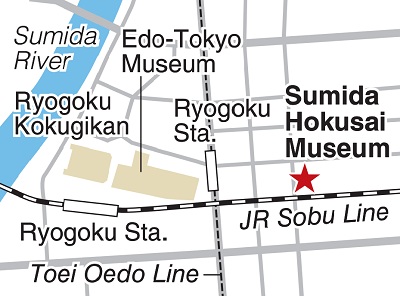
Sumida Hokusai Museum
Kamezawa, Sumida Ward, Tokyo






Most Read
Popular articles in the past 24 hours
-
15 Measles Patients Confirmed in Tokyo in Past 6 Days; 1 May Have...
-
‘King Kazu’ Discusses His Connection to Fukushima
-
JR Tokai Breaks Ground on Yamanashi Maglev Station; Will Be Part ...
-
Japan Closely Monitoring Situation around Hormuz Strait, Collecti...
-
Japan’s Gunma Official Suspended For Unauthorized Absence From Wo...
-

Milano Cortina 2026: Japan’s Alpine Skier Muraoka Extends P...
-
Rising Kabuki Star Works to Ensure Deaf Audience's Enjoyment of P...
-

White House Takes First Step toward Permanent Fix for Illegal Tar...
Popular articles in the past week
-
Japan Figure Skating Legend Yuzuru Hanyu Is Proud Disaster Surviv...
-

Nippon Life Insurance's U.S. Arm Sues OpenAI Over Legal Assistanc...
-
Govt to Utilize ODA for Ensuring Economic Security; Securing Ener...
-
Massive Sewer Pipe Found Jutting Out of Highway in Osaka
-
15 Measles Patients Confirmed in Tokyo in Past 6 Days; 1 May Have...
-
Beckoning Cats Get Makeover to Fit Modern Lifestyles with Sleek D...
-
Japan Govt Survey Finds Just 10% of Workers Want Working Hours to...
-
Japan Govt to Tighten Requirements to Receive Permanent Residency...
Popular articles in the past month
-

Producer Behind Pop Group XG Arrested for Cocaine Possession
-

Japan PM Takaichi’s Cabinet Resigns en Masse
-

Man Infected with Measles Reportedly Dined at Restaurant in Tokyo...
-

Videos Plagiarized, Reposted with False Subtitles Claiming ‘Ryuky...
-
Japan Figure Skating Legend Yuzuru Hanyu Is Proud Disaster Surviv...
-

iPS Treatments Pass Key Milestone, but Broader Applications Far f...
-

Sanae Takaichi Elected Prime Minister of Japan; Keeps All Cabinet...
-

Nepal Bus Crash Kills 19 People, Injures 25 Including One Japanes...
Top Articles in Culture
-

Director Naomi Kawase’s New Film Explores Heart Transplants in Japan, Production Involved Real Patients, Families
-
Beckoning Cats Get Makeover to Fit Modern Lifestyles with Sleek Designs to Match with Any Kind of Space
-
Exhibition Featuring Yoshiharu Tsuge’s Manga World Underway in Chofu, Tokyo; Unique, Surreal Works Draw Steady Crowds
-
Traditional Japanese Silk Hakama Tradition Preserved by Sole Weaver in Sendai
-
2 Unpublished Early Novellas by Japan’s Kenzaburo Oe Discovered, Show Budding Promise of Future Nobel Prize-Winning Author
JN ACCESS RANKING
-
Producer Behind Pop Group XG Arrested for Cocaine Possession
-
Japan PM Takaichi’s Cabinet Resigns en Masse
-
Man Infected with Measles Reportedly Dined at Restaurant in Tokyo Station
-
Videos Plagiarized, Reposted with False Subtitles Claiming ‘Ryukyu Belongs to China’; Anti-China False Information Also Posted in Japan
-
Japan Figure Skating Legend Yuzuru Hanyu Is Proud Disaster Survivor and Gold Medalist, Vows to Continue Support Efforts