
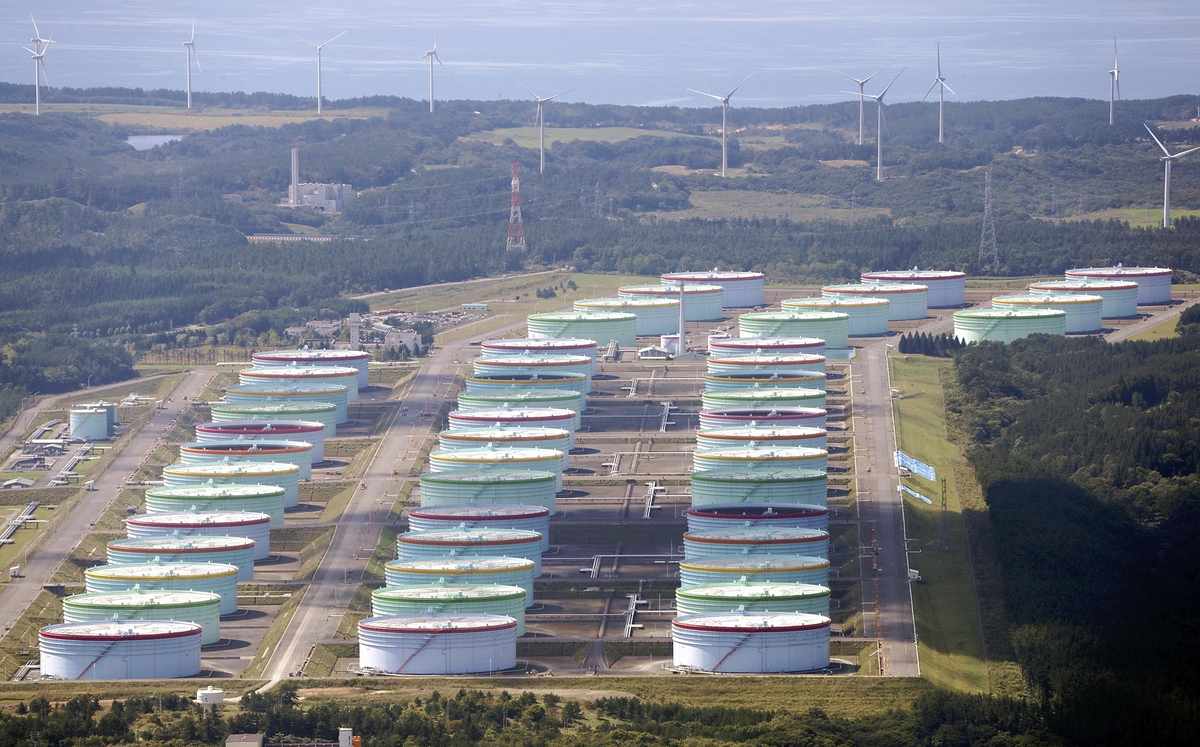
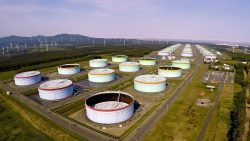
Mutsu Ogawara crude oil reserve tanks are seen in the village of Rokkasho, Aomori Prefecture.
21:00 JST, March 10, 2026
Finance ministers from the Group of Seven advanced nations held an emergency online meeting on Monday night Japan time, in response to the surge in crude oil prices following the U.S. and Israeli attacks on Iran.
The ministers issued a joint statement pledging to “support global supply of energy.” There was expected to be a meeting of energy ministers on Tuesday night Japan time to discuss specific measures, such as coordinated releases of oil reserves.
Monday’s meeting was also attended by the heads of the International Energy Agency, the International Monetary Fund, the World Bank and the Organization for Economic Cooperation and Development.
They discussed the impact of the Middle East conflict on the global economy and financial markets, as well as the protection of trade routes such as the Strait of Hormuz.
IEA Executive Director Fatih Birol called for urgent action on coordinated releases of oil reserves.
Japan’s Finance Minister Satsuki Katayama pointed out that maritime transport through the Strait of Hormuz is critically important for stable energy supplies to Asian countries, explaining that it is necessary to urge energy ministers to coordinate the releases of oil reserves among IEA member countries.
G7 Chair and French Finance Minister Roland Lescure stated that the situation in the Middle East is having a direct impact on household budgets, particularly gasoline prices, and that the G7 will closely monitor this situation. He added that the ministers agreed to take all necessary measures, including releasing reserves, to stabilize the overall market.
At a press conference after the meeting, Katayama said, “Reaching agreement on releasing oil reserves and taking other necessary measures is a very significant achievement.”
In 2022, when crude oil prices surged due to Russia’s aggression against Ukraine, IEA member countries including Japan, the United States and European nations launched coordinated releases of oil reserves. Japan released a total of 22.5 million barrels, equivalent to about 12 days of domestic demand.
As of the end of December last year, Japan held reserves equivalent to 254 days of consumption.




Most Read
Popular articles in the past 24 hours
-
Japan Govt Aims for 10-Fold Increase in Computing Power of Superc...
-

Reopened Fukushima Municipalities Lure New Residents with Educati...
-
Kesennuma, Miyagi Pref., Locals Raise Carp Streamers as Symbol of...
-
2 People Reportedly Found on Mt. Fuji; Hiking Trail Currently Clo...
-

Iran Situation: Significance of Rule of Law Must Be Conveyed
-
Japan's TEPCO to Raise Electricity Rates for Corporations in Apri...
-

Trump Says Iran Had a New Site for Developing Nuclear Weapons
-

Rapeseed Flowers Reach Peak Viewing Period at Tokyo's Showa Kinen...
Popular articles in the past week
-

Ibaraki Pref.'s 1st Foreign Bus Driver Hired in Tsukuba
-
Amid Strait of Hormuz Blockade, Shipping Companies Scramble to Ge...
-
Govt to Utilize ODA for Ensuring Economic Security; Securing Ener...
-
Japan Govt Survey Finds Just 10% of Workers Want Working Hours to...
-
Japan's 2nd Round of U.S. Investments May Be Worth Over $100 Bill...
-

Imperial Family Watches World Baseball Classic Game Against Austr...
-

Donald Keene’s Drinking Buddy and Translator Yukio Kakuchi Pays T...
-
Japan’s Govt Says No Immediate Impact on Oil Supply; No Releases ...
Popular articles in the past month
-

Producer Behind Pop Group XG Arrested for Cocaine Possession
-

Japan PM Takaichi’s Cabinet Resigns en Masse
-

Man Infected with Measles Reportedly Dined at Restaurant in Tokyo...
-

Videos Plagiarized, Reposted with False Subtitles Claiming ‘Ryuky...
-

iPS Treatments Pass Key Milestone, but Broader Applications Far f...
-

Sanae Takaichi Elected Prime Minister of Japan; Keeps All Cabinet...
-

Nepal Bus Crash Kills 19 People, Injures 25 Including One Japanes...
-

Japan's Govt to Submit Road Map for Growth Strategy in March, PM ...
Top Articles in Business
-

Japan, U.S. Name 3 Inaugural Investment Projects; Reached Agreement After Considerable Difficulty
-

Japan’s Major Real Estate Firms Expanding Overseas Businesses to Secure Future Growth, Focusing on Europe, U.S., Asia
-

Transport Companies See Opportunity in Narita Expansion; Airlines, Railways Prepare to Meet Expected Growth in Demand
-

Sony’s Entertainment Focus Becomes Even Clearer; Shift Away from Consumer Products Marks Move Toward Entertainment
-
Amid Strait of Hormuz Blockade, Shipping Companies Scramble to Get Japan-Linked Vessels out of Persian Gulf
JN ACCESS RANKING
-
Producer Behind Pop Group XG Arrested for Cocaine Possession
-
Japan PM Takaichi’s Cabinet Resigns en Masse
-
Man Infected with Measles Reportedly Dined at Restaurant in Tokyo Station
-
Videos Plagiarized, Reposted with False Subtitles Claiming ‘Ryukyu Belongs to China’; Anti-China False Information Also Posted in Japan
-
iPS Treatments Pass Key Milestone, but Broader Applications Far from Guaranteed