
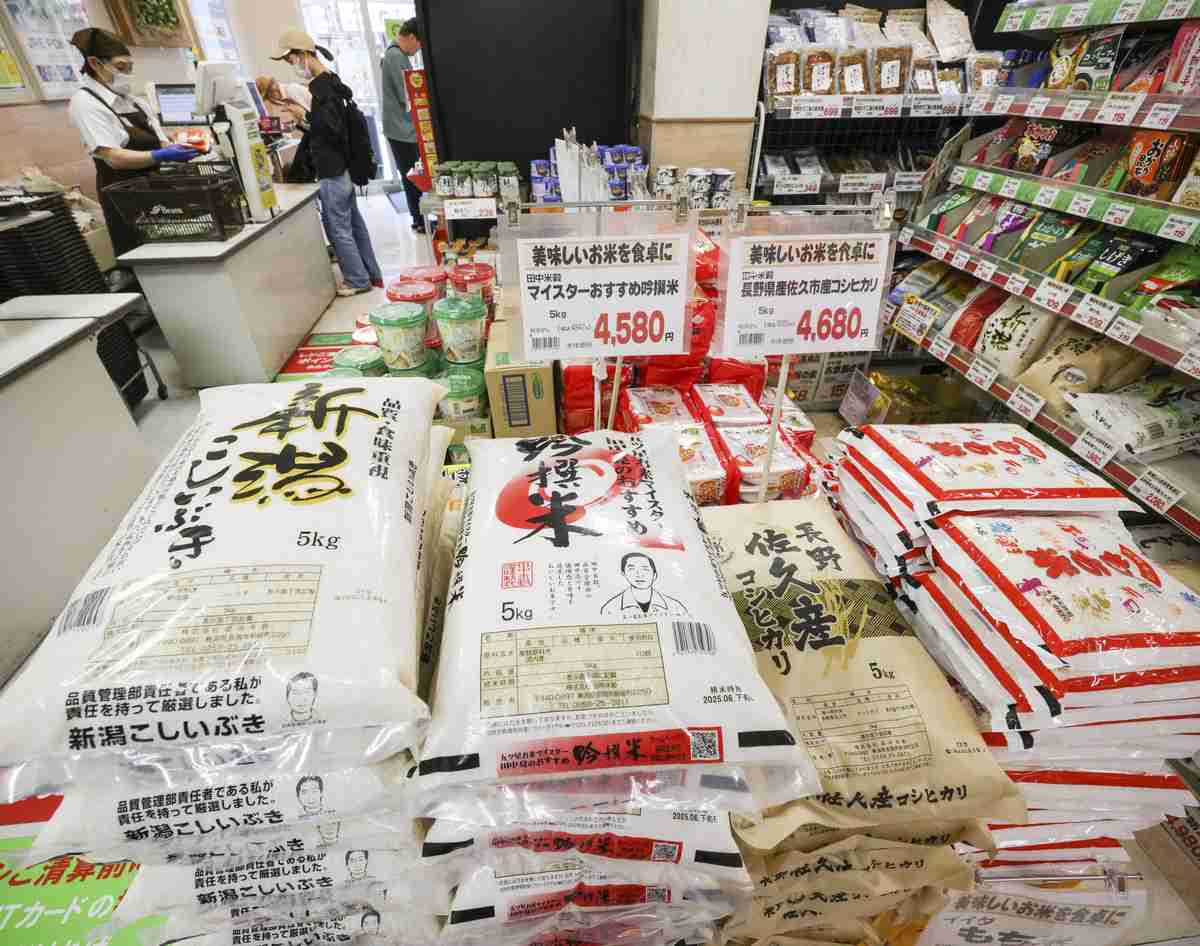
Expensive rice is seen at a supermarket in Kawasaki in July.
7:00 JST, November 13, 2025
Municipalities will be encouraged to take such steps as issuing premium shopping vouchers to help their residents cope with rising prices, according to a draft of the government’s comprehensive economic stimulus measures, which are to be compiled by the end of this month.
The central government will increase subsidies that local governments can use at their discretion. In addition to encouraging municipal authorities to distribute premium shopping vouchers, it plans to add subsidies for electricity and gas bills this winter.
To realize a strong Japanese economy, the government will enhance investments in strategic industrial fields including semiconductors and shipbuilding.
The economic stimulus package comprises three main pillars: implementing measures to encourage a sense of security in daily life and cope with rising prices; realizing a strong economy through investments in crisis management and measures for economic growth; and strengthening defense and diplomatic capabilities.
The central government pledges to implement the measures through all possible policy measures, including the government budget, taxation system reform and deregulation reform.
Among its measures to cope with rising prices, the central government will increase subsidies to local governments and encourage municipal authorities to issue premium shopping vouchers and My Number ID card points to boost personal consumption.
It will also consider utilizing shopping vouchers exclusively for buying rice, and assistance for small and midsize companies that are unable to receive preferential tax treatment for raising employees’ wages.
Regarding surging house prices, the draft of the economic stimulus measures includes raising the upper limits on lending amounts for the Flat 35, a government-assisted long-term housing loan scheme in which interest rates are fixed for up to 35 years.
As for raising the minimum amount of taxable annual income, the government plans to increase the basic tax deduction for income taxes in accordance with price levels.
For low-income earners and members of the middle class, the government will discuss introducing a refundable tax credit system so that the after-tax incomes of low-income earners and middle-class people can increase in accordance with their income levels.
Concerning investments in strategic industrial fields, the government aims to implement capital investments in a concentrated manner for mass-production of advanced semiconductor products. Demand for such products is expected to grow worldwide.
The government also aims to build or improve the electric power supply and other infrastructure needed to accommodate data centers. It plans to devise a road map toward the revitalization of the shipbuilding industry, and also consider the establishment of a fund to assist in the construction of production bases and research and development projects.
Concerning the $550 billion (about ¥85 trillion) in investments in the United States agreed to under a Japan-U.S. tariff deal, the government will implement necessary fiscal aid to the Japan Bank for International Cooperation and Nippon Export and Investment Insurance.
For companies whose sales or profit margins fell by 5% or more because of the negative impact of U.S. tariffs, the government plans for the Japan Finance Corporation to assist their cash management by extending loans at preferentially low interest rates.




Most Read
Popular articles in the past 24 hours
-
Japan Govt to Tighten Requirements to Receive Permanent Residency...
-

Tail of ANA Plane Struck Runway During Landing in Houston; No Inj...
-

Medical Care at Home and Disasters: Ensure Systems to Provide Con...
-

Samurai Japan Holds First Practice in Miami; Team Will Play again...
-

CARTOON OF THE DAY (March 12)
-

White House Takes First Step toward Permanent Fix for Illegal Tar...
-

Iran Targets Busiest International Airport as Top UN Body Demands...
-

Japan to Face Venezuela in World Baseball Classic Quarterfinals
Popular articles in the past week
-

Japan Figure Skating Legend Yuzuru Hanyu Is Proud Disaster Surviv...
-

Nippon Life Insurance's U.S. Arm Sues OpenAI Over Legal Assistanc...
-
Govt to Utilize ODA for Ensuring Economic Security; Securing Ener...
-
Massive Sewer Pipe Found Jutting Out of Highway in Osaka
-

Beckoning Cats Get Makeover to Fit Modern Lifestyles with Sleek D...
-
Japan Govt Survey Finds Just 10% of Workers Want Working Hours to...
-
Japan's 2nd Round of U.S. Investments May Be Worth Over $100 Bill...
-

Imperial Family Watches World Baseball Classic Game Against Austr...
Popular articles in the past month
-

Producer Behind Pop Group XG Arrested for Cocaine Possession
-

Japan PM Takaichi’s Cabinet Resigns en Masse
-

Man Infected with Measles Reportedly Dined at Restaurant in Tokyo...
-

Videos Plagiarized, Reposted with False Subtitles Claiming ‘Ryuky...
-
Japan Figure Skating Legend Yuzuru Hanyu Is Proud Disaster Surviv...
-

iPS Treatments Pass Key Milestone, but Broader Applications Far f...
-

Sanae Takaichi Elected Prime Minister of Japan; Keeps All Cabinet...
-

Nepal Bus Crash Kills 19 People, Injures 25 Including One Japanes...
Top Articles in Business
-
Nippon Life Insurance’s U.S. Arm Sues OpenAI Over Legal Assistance Provided by ChatGPT
-

Japan, U.S. Name 3 Inaugural Investment Projects; Reached Agreement After Considerable Difficulty
-

Japan’s Major Real Estate Firms Expanding Overseas Businesses to Secure Future Growth, Focusing on Europe, U.S., Asia
-

Transport Companies See Opportunity in Narita Expansion; Airlines, Railways Prepare to Meet Expected Growth in Demand
-

Amid Strait of Hormuz Blockade, Shipping Companies Scramble to Get Japan-Linked Vessels out of Persian Gulf
JN ACCESS RANKING
-
Producer Behind Pop Group XG Arrested for Cocaine Possession
-
Japan PM Takaichi’s Cabinet Resigns en Masse
-
Man Infected with Measles Reportedly Dined at Restaurant in Tokyo Station
-
Videos Plagiarized, Reposted with False Subtitles Claiming ‘Ryukyu Belongs to China’; Anti-China False Information Also Posted in Japan
-
Japan Figure Skating Legend Yuzuru Hanyu Is Proud Disaster Survivor and Gold Medalist, Vows to Continue Support Efforts