
Leadership Struggle for AI Governance Spreads in Southeast Asia as Counter to Chinese Inroads in Region
6:00 JST, August 18, 2025
Japan, the United States and Europe are in a leadership battle with China over rulemaking for artificial intelligence, and Southeast Asia has become a front line.
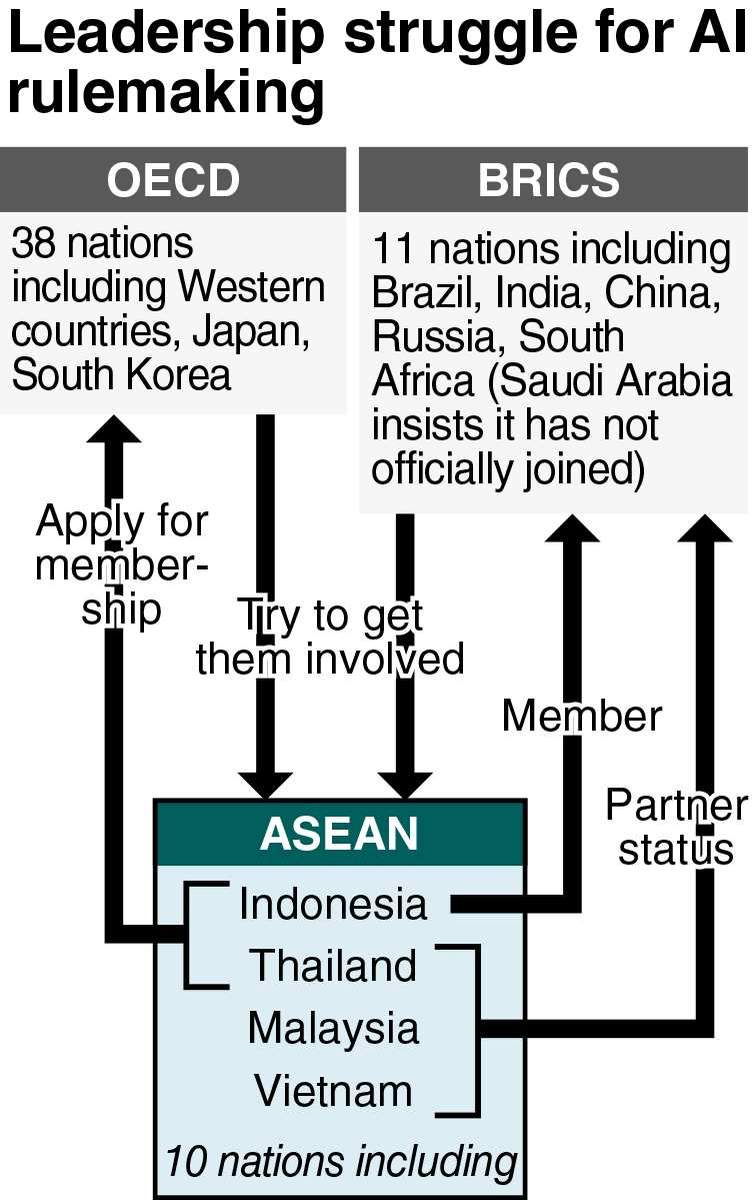
Japan is trying to draw the Association of Southeast Asian Nations into the rulemaking process by backing efforts by the Organization for Economic Cooperation and Development (OECD) to promote trustworthy AI.
On Aug. 6, about 30 ASEAN officials and AI experts gathered at the Japanese ambassador’s residence in Bangkok for a workshop to explain the OECD’s AI Policy Toolkit. The intention of the meeting was to give a hearing to the Southeast Asian countries’ opinions on the Toolkit, which will be announced next spring.
The OECD has established AI principles that emphasize a “human-centric” approach to AI and respect for human rights. The Toolkit includes a self-assessment questionnaire designed to help countries bridge the gap between the OECD AI Principles and their own policies. It also provides examples of how the principles are being applied in other countries.
Japan has been supporting workshops that use the Toolkit to promote the OECD AI Principles and that get ASEAN members involved in creating OECD-centered rules for AI governance. As international regulations will determine the future direction of AI development, Japan is trying to win over “like-minded companions” at the rulemaking stage.
“We must establish a reliable framework in terms of ethics and transparency,” Ambassador to Thailand Masato Otaka said at the meeting.
In the background of these efforts are similar moves by China, which has stressed the need to adopt the BRICS framework for AI governance. BRICS, a bloc of major emerging economies, has established a presence in Southeast Asia, with Indonesia recently becoming a member.
Following a BRICS summit in Brazil in July, a document summarizing the results of the event was released. The document stated that “Public Interest Comes First” in AI development. The OECD is wary that the statement reflects China’s desire to take the lead in rulemaking in the field of AI.
China is making inroads within ASEAN, with Chinese telecommunications giant Huawei Technologies Co. having expanded its market share in various countries in the region.
A participant in the August workshop expressed support for the OECD AI Principles, saying, “Technological innovation and reliability should go hand in hand.” However, they added: “Many groups besides the OECD have proposed AI rules. We need to consider which rules will best serve our national interests.”







Most Read
Popular articles in the past 24 hours
-

‘Dry Bonsai’ Gives New Life to Withered Trees, Allows Free Artist...
-

Japanese Students Use Traditional Pickle to Create Novel Wagashi ...
-

McDonald's Japan Raises Prices; Big Mac to Cost ¥500, Double Chee...
-

Nepal Bus Crash Kills 19 People, Injures 25 Including One Japanes...
-

Japan’s Nikkei Stock Average Rises as AI-Related Stocks Shine; Co...
-

Astellas Collaborates with Vir to Develop Its Experimental Prosta...
-

Early-Blooming Kawazu Cherry Blossoms Create Sea of Pink at Park ...
-

Joruri Bunraku Narrative Performed in Honor of Donald Keene by La...
Popular articles in the past week
-

Producer Behind Pop Group XG Arrested for Cocaine Possession
-

Japan PM Takaichi’s Cabinet Resigns en Masse
-

Sanae Takaichi Elected Prime Minister of Japan; Keeps All Cabinet...
-

Japan's Govt to Submit Road Map for Growth Strategy in March, PM ...
-

Bus Carrying 40 Passengers Catches Fire on Chuo Expressway; All E...
-

U.S. Firm to Build Training Hub in Fukushima N-plant for Debris R...
-

Japan, U.S. Name 3 Inaugural Investment Projects; Reached Agreeme...
-

Riku-Ryu Pair Wins Gold Medal: Their Strong Bond Leads to Major C...
Popular articles in the past month
-
Producer Behind Pop Group XG Arrested for Cocaine Possession
-
Japan PM Takaichi’s Cabinet Resigns en Masse
-

Japan Institute to Use Domestic Commercial Optical Lattice Clock ...
-

Man Infected with Measles Reportedly Dined at Restaurant in Tokyo...
-

Israeli Ambassador to Japan Speaks about Japan’s Role in the Reco...
-

Videos Plagiarized, Reposted with False Subtitles Claiming ‘Ryuky...
-

Man Infected with Measles May Have Come in Contact with Many Peop...
-

Prudential Life Insurance Plans to Fully Compensate for Damages C...
Top Articles in Business
-
Prudential Life Insurance Plans to Fully Compensate for Damages Caused by Fraudulent Actions Without Waiting for Third-Party Committee Review
-
Narita Airport, Startup in Japan Demonstrate Machine to Compress Clothes for Tourists to Prevent People from Abandoning Suitcases
-
Japan, U.S. Name 3 Inaugural Investment Projects; Reached Agreement After Considerable Difficulty
-

Toyota Motor Group Firm to Sell Clean Energy Greenhouses for Strawberries
-

SoftBank Launches AI Service for Call Centers That Converts Harsh Customer Voices into Softer Voices
JN ACCESS RANKING
-
Producer Behind Pop Group XG Arrested for Cocaine Possession
-
Japan PM Takaichi’s Cabinet Resigns en Masse
-
Japan Institute to Use Domestic Commercial Optical Lattice Clock to Set Japan Standard Time
-
Man Infected with Measles Reportedly Dined at Restaurant in Tokyo Station
-
Israeli Ambassador to Japan Speaks about Japan’s Role in the Reconstruction of Gaza