
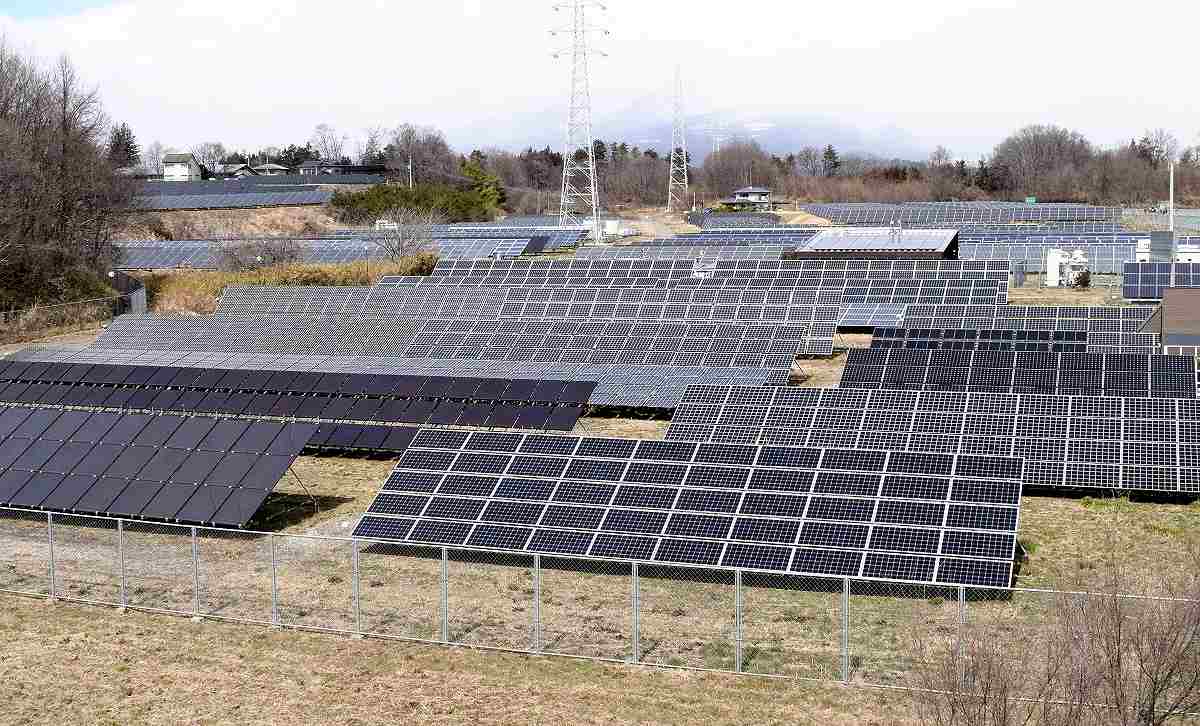
A solar power station operated by the municipal government of Hokuto, Yamanashi Prefecture
15:14 JST, December 21, 2020
The central government plans to require prefectural and other local governments to set targets for the introduction of renewable energy in their action plans for global warming countermeasures, the Yomiuri Shimbun has learned.
It will also set up a system to facilitate the smooth construction of renewable energy facilities. The aim is to encourage the introduction of renewable energy in regional areas to realize the government’s goal of net-zero carbon emissions by 2050.
The Environment Ministry will submit a draft amendment to the law concerning the promotion of measures to fight global warming to the ordinary Diet session next year.
The law requires all local governments to prepare an action plan for global warming countermeasures. However, the content of the plans varies. While there are precedents such as the Tokyo metropolitan government’s plan, which clearly states its goal of having renewable energy sources make up about 30% of its electricity usage by 2030, there are many plans that lack concrete measures.
The Environment Ministry is considering requiring prefectural governments as well as municipal governments such as of ordinance-designated cities to set targets, including the time frame and numerical values, for the realization of the measures to increase the effectiveness of the plans.
A new system to facilitate consensus building with local residents will be put in place, as there have been a number of cases where the construction of renewable energy generation facilities, such as solar and wind power stations, have been abandoned due to opposition from residents on the grounds of the facilities ruining the landscape and noise issues.
Currently, construction of power generating facilities and other related projects are approved by the central government, with local governments not involved in principle. Under the new system, local governments will be able to approve projects that provide benefits to the community, such as by supplying electricity in the event of a natural disaster, and take into consideration the environment including the landscape. The new system will be a part of the proposed law amendment.
As for businesses, provisions to encourage decarbonization will be included.
The law requires companies that emit 3,000 tons or more of greenhouse gases per year to calculate their emissions and report them to the government. Over 10,000 businesses report their emissions every year, but the data have not been made good use of by investors and consumers who place importance on the environmental activities of companies because it takes more than two years for the government to release the compiled results.
The amendment proposal will make electronic submission a principle in order to shorten the time it takes to announce the data, making it easier to use the information.






Most Read
Popular articles in the past 24 hours
-

Amid Strait of Hormuz Blockade, Shipping Companies Scramble to Ge...
-

Japan Drafts New Measures against Tech Leakage on Government Fund...
-

Ibaraki Pref.'s 1st Foreign Bus Driver Hired in Tsukuba
-

Honda to Reimport 2 U.S.-Made Models to Sell in Japan; Both Model...
-

Trump Fires Homeland Security Secretary Noem after Mounting Criti...
-
Japanese Nationals in 4 Gulf Countries to Be Evacuated with Chart...
-
Japan Foreign Minister Confirms Two Japanese Detained in Iran
-

Drone Show in Japan Features Horticultural Expo Mascot
Popular articles in the past week
-
South Korea Tightens Rules on Foreigners Buying Homes in Seoul Me...
-
Tokyo Spends Big on Children, Wins Over Parents
-
Japan’s Miura, Kihara Announce Withdrawal from Figure Skating Wor...
-
2 Unpublished Early Novellas by Japan's Kenzaburo Oe Discovered, ...
-

Strait of Hormuz Closure Shakes Markets; Prolonged Closure Could ...
-
Tourists Ignore Safety Barriers Near Famous Zao ‘Snow Monsters’ i...
-

Iran Situation: Japan Must Exert Diplomatic Efforts without Merel...
-
Measles Patient Visited Hospital in Bunkyo Ward, Tokyo, Metropoli...
Popular articles in the past month
-

Producer Behind Pop Group XG Arrested for Cocaine Possession
-

Japan PM Takaichi’s Cabinet Resigns en Masse
-

Man Infected with Measles Reportedly Dined at Restaurant in Tokyo...
-

Videos Plagiarized, Reposted with False Subtitles Claiming ‘Ryuky...
-

Prudential Life Insurance Plans to Fully Compensate for Damages C...
-

Woman with Measles Visited Hospital in Tokyo Multiple Times Befor...
-

iPS Treatments Pass Key Milestone, but Broader Applications Far f...
-

Sanae Takaichi Elected Prime Minister of Japan; Keeps All Cabinet...
Top Articles in Business
-
Prudential Life Insurance Plans to Fully Compensate for Damages Caused by Fraudulent Actions Without Waiting for Third-Party Committee Review
-

Japan, U.S. Name 3 Inaugural Investment Projects; Reached Agreement After Considerable Difficulty
-

Japan’s Major Real Estate Firms Expanding Overseas Businesses to Secure Future Growth, Focusing on Europe, U.S., Asia
-

SoftBank Launches AI Service for Call Centers That Converts Harsh Customer Voices into Softer Voices
-

Transport Companies See Opportunity in Narita Expansion; Airlines, Railways Prepare to Meet Expected Growth in Demand
JN ACCESS RANKING
-
Producer Behind Pop Group XG Arrested for Cocaine Possession
-
Japan PM Takaichi’s Cabinet Resigns en Masse
-
Man Infected with Measles Reportedly Dined at Restaurant in Tokyo Station
-
Videos Plagiarized, Reposted with False Subtitles Claiming ‘Ryukyu Belongs to China’; Anti-China False Information Also Posted in Japan
-
Prudential Life Insurance Plans to Fully Compensate for Damages Caused by Fraudulent Actions Without Waiting for Third-Party Committee Review