
Southwest Japan’s Challenges: Revitalization Efforts / Self-Driving Minibus Trialed in Fukuoka Pref. as Companies Build Bases for Technologies in Kyushu
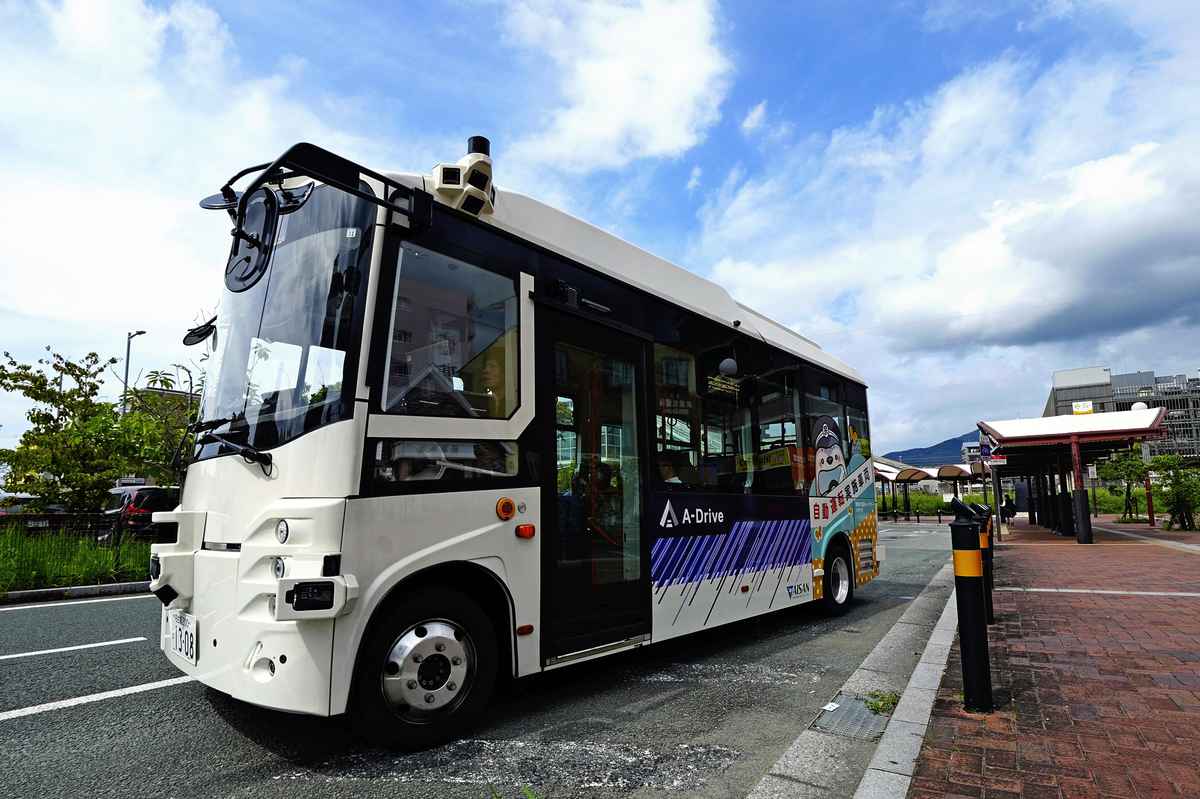
A sensor and cameras are mounted on a self-driving bus in Munakata, Fukuoka Prefecture, on Sept. 25.
7:00 JST, December 29, 2025
With the future of Kyushu as well as Yamaguchi and Okinawa prefectures in mind, this series of articles examines measures to solve the worsening labor shortage and build a vibrant society. This is the first installment in a three-part series.
***
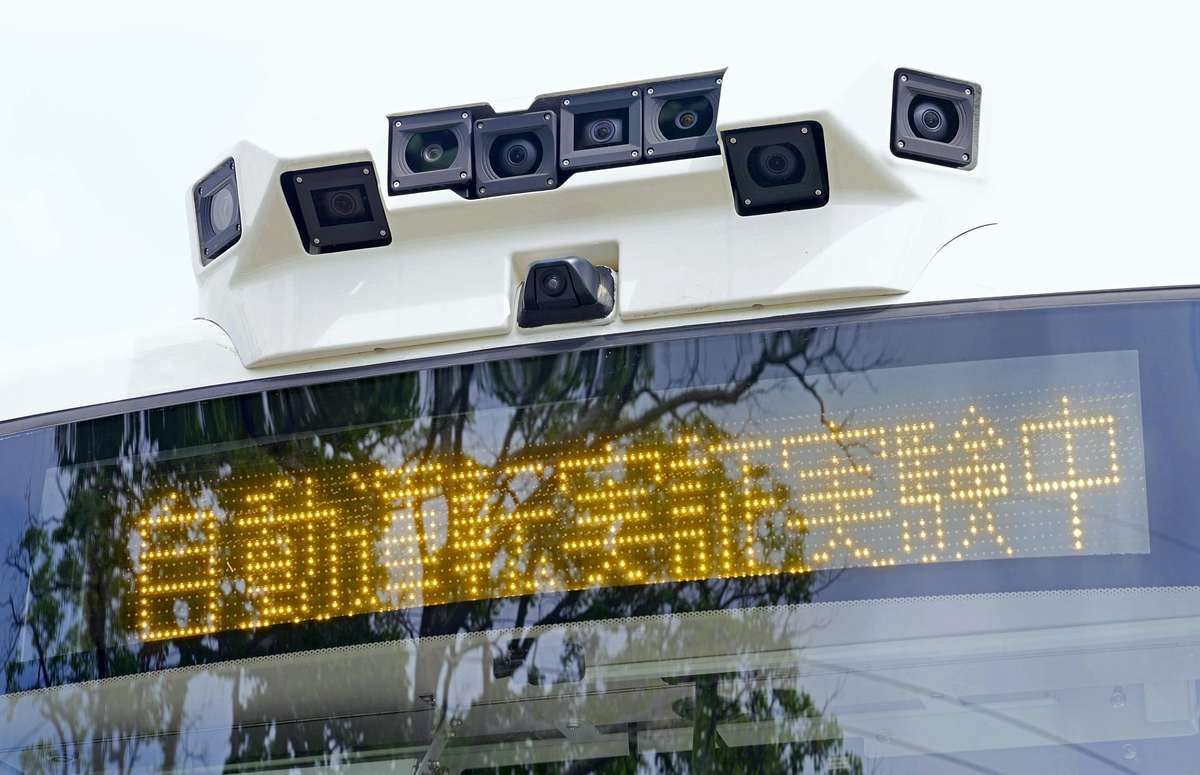
A sensor and cameras are mounted on a self-driving bus in Munakata, Fukuoka Prefecture, on Sept. 25.
The Munakata city government in Fukuoka Prefecture has been running trials of a self-driving minibus on a public road in the city.
On Sept. 25, a minibus without a human driver came to a stop before a traffic light on a 2-kilometer route around JR Akama Station. Having confirmed a vehicle was parked nearby, it then began moving again, slowly passing the vehicle. The minibus turned right using a turn signal after waiting for a car in the opposite lane to drive away.
The minibus’ steering wheel automatically moved, making small adjustments to ensure the bus maintained its position in the center of the lane, while running along at 35 kph. Participants in the minibus during the demonstration looked impressed with the series of moves.
The test runs were conducted along the route from August to September. The vehicle made five round trips on weekdays during the period.
The minibus drove autonomously for a total of 527.4 kilometers, accounting for 94.9% of the total distance it traveled over the period of about one month.
The vehicle is equipped with 18 cameras in all four directions as well as 14 infrared lasers and radio wave sensors. It detects the distance to people and objects up to 200 meters away in 360-degree, and determines their movements using artificial intelligence technology.
You may also like to read
Southwest Japan’s Challenges: Revitalization Efforts / Getting Latent Human Resources Back into Workforce: Homemakers, Seniors Have Strong Inclination to WorkThe brakes are applied even when a pedestrian ahead of the vehicle simply turns around, for instance. The vehicle slows down when it approaches intersections with poor visibility.
“The bus has a wide field of vision and drives cautiously,” said Masahiro Imamura, 52, of Nishi-Nippon Railroad Co., who sat in the driver’s seat of the minibus every day during the trial run to monitor autonomous operations. However, he added, “I felt the braking was often a little too strong, when compared to riding a bus driven by an experienced human driver.”
The total distance traveled by all buses on the fixed-route bus routes of the Nishitetsu Group, operating primarily within Fukuoka Prefecture, was about 100 million kilometers in fiscal 2024, down 36% from fiscal 1991. As of July, the Nishitetsu Group was short about 80 drivers.
The number of services offered in Munakata by Nishitetsu Bus has also continued to decrease.
To maintain bus routes amid a severe shortage of drivers, the city plans to begin passenger services in some areas in two years with buses capable of Level 4 autonomous driving, meaning under certain conditions a human is not required to be involved in controlling it.
In order to respond to situations such as an emergency on board, Nishitetsu Bus plans to remotely monitor self-driving buses or have a human driver present who does not have to have a license to drive passenger buses.
The minibus was developed by Tokyo-based startup Tier IV Inc., established in 2015. It was operated on a trial basis without a driver in Nagano Prefecture in January and February.
The bus will be tested at about 30 locations nationwide until the end of March with the aim of having the vehicle run a Level 4 autonomous driving system.
Continuous population decline
As a central solution to severe labor shortages, the government aims to widely introduce self-driving vehicles.
According to the Internal Affairs and Communications Ministry, the working age population — those aged 15 to 64 — in seven Kyushu prefectures as well as Yamaguchi and Okinawa prefectures was 8.57 million as of October last year, a decrease of about 20% from 2000. The National Institute of Population and Social Security Research estimated the working-age population will fall to 6.31 million in 2050 in those nine prefectures.
Across the country, it is estimated the working-age population will decrease to 55.4 million in 2050 from 73.73 million in October 2024.
With the aim of introducing self-driving operations in at least 100 locations nationwide by fiscal 2027, the government subsidized an experiment deploying driverless buses and taxis in Kumamoto City and 66 other locations in fiscal 2025.
Some other countries were quick to introduce self-driving in public transport systems. Unmanned taxis and other services are already available in San Francisco and Guangzhou, China, for instance.
“Autonomous driving services are about to be publicly available in Japan, too. In 10 years’ time, they may be familiar to us,” said Haruo Ishida, professor emeritus of the University of Tsukuba.
The challenge for the dissemination of this mode of transport is, according to Ishida, the high price tag. Self-driving minibuses cost at least ¥50 million per unit. “It is important for the relevant software and hardware companies and the government to collaborate to establish affordable and sustainable means to manufacture and maintain self-driving vehicles,” Ishida said.
It also has to be noted that accidents involving driverless vehicles have occurred both at home and abroad. Some have pointed out that criminal liability cannot be imposed on the operator of vehicles involved in accidents which occur during Level 4 operations, highlighting the need to clarify where legal responsibility lies in such cases.
Construction industry
The construction industry, often considered a difficult area to automate, is also keen to introduce such technology.
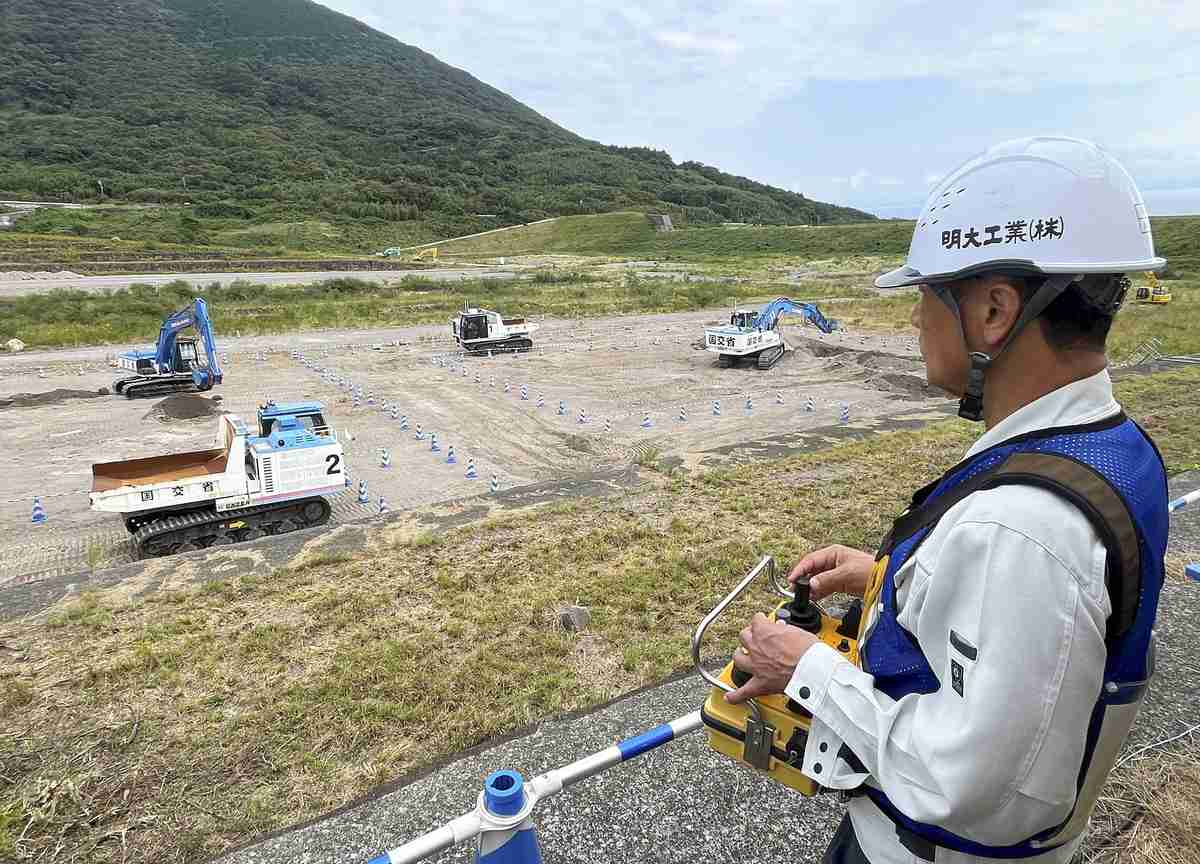
Machinery is remotely operated at a unmanned construction site in Minami-Shimabara, Nagasaki Prefecture, on Oct. 15.
On Oct. 15, unmanned machinery like excavators and crawler dumpers, which transport earth and sand, were in operation as part of a drill to facilitate construction work without humans at the wheel at a site in Minami-Shimabara, Nagasaki Prefecture. The drill was organized by the Land, Infrastructure, Transport and Tourism Ministry.
“We may see a construction site in the near future where one person can monitor multiple machines from a room,” said Eiji Kobayashi, 54, of Meidai Kogyo Ltd., a construction company in Beppu, Oita Prefecture. Kobayashi operated the heavy machinery remotely while watching a video stream.
Sensor technologies, logic chips
Japan excels in sensor technologies, which are crucial for automation, and the Kyushu region serves as a hub for them. The semiconductor industry is also concentrated in the region.
Sony Semiconductor Solutions Corp., a subsidiary of Sony Group Corp., ships sensors manufactured at its plant in Kikuyo, Kumamoto Prefecture, to automakers globally. By the end of fiscal 2025, its sensors are expected to be adopted by more than 80% of the world’s major manufacturers.
Taiwan Semiconductor Manufacturing Co. (TSMC), which opened a base of operations in Kikuyo, plans to manufacture logic semiconductors, which are used for vehicle control and other purposes, at its second plant in the prefecture. Construction of the plant’s main facility began on Oct. 24.
Shinnosuke Kikuchi, an assistant professor at the University of California San Diego, said automation is a field Japan should push to become a “winner” in. “Relying on foreign workers is simplistic. The country is good at introducing automation, which has broad industrial applications. Japan should pursue automation in every field,” said Kikuchi, who studies technology’s impact on employment, among other areas.
“In Japan, people are familiar with robots through anime such as ‘Mobile Suit Gundam’ and ‘Doraemon,’ for instance. It makes the country an easier place to introduce automation in various fields, compared to the United States and European nations. Such introductions will increase the wages of essential workers who are indispensable to society,” Kikuchi said. “The Kyushu region should take the lead in the nation’s efforts to fully introduce automation.”






Most Read
Popular articles in the past 24 hours
-

Trump Fires Homeland Security Secretary Noem after Mounting Criti...
-

China’s National People’s Congress Opens: Military Expansion Cont...
-

Japanese Nationals in 4 Gulf Countries to Be Evacuated with Chart...
-

Hanamaruki to Sell Liquid 'Shio-Koji' Seasoning to U.S. Consumers
-

Strawberry Prince’s Rinu Discusses His Dream of Voice Acting, Suc...
-

CARTOON OF THE DAY (March 6)
-

Donald Keene’s Drinking Buddy and Translator Yukio Kakuchi Pays T...
-

Japan Foreign Minister Confirms Two Japanese Detained in Iran
Popular articles in the past week
-

South Korea Tightens Rules on Foreigners Buying Homes in Seoul Me...
-
2 Unpublished Early Novellas by Japan's Kenzaburo Oe Discovered, ...
-

Strait of Hormuz Closure Shakes Markets; Prolonged Closure Could ...
-

Ibaraki Pref.'s 1st Foreign Bus Driver Hired in Tsukuba
-

Iran Situation: Japan Must Exert Diplomatic Efforts without Merel...
-

Amid Strait of Hormuz Blockade, Shipping Companies Scramble to Ge...
-
Measles Patient Visited Hospital in Bunkyo Ward, Tokyo, Metropoli...
-

Tokyo’s ‘Strawberry War’ Intensifies as Producers Vie to Become ‘...
Popular articles in the past month
-

Producer Behind Pop Group XG Arrested for Cocaine Possession
-

Japan PM Takaichi’s Cabinet Resigns en Masse
-

Man Infected with Measles Reportedly Dined at Restaurant in Tokyo...
-

Videos Plagiarized, Reposted with False Subtitles Claiming ‘Ryuky...
-

Prudential Life Insurance Plans to Fully Compensate for Damages C...
-

Woman with Measles Visited Hospital in Tokyo Multiple Times Befor...
-

iPS Treatments Pass Key Milestone, but Broader Applications Far f...
-

Sanae Takaichi Elected Prime Minister of Japan; Keeps All Cabinet...
Top Articles in Business
-
Prudential Life Insurance Plans to Fully Compensate for Damages Caused by Fraudulent Actions Without Waiting for Third-Party Committee Review
-

Japan, U.S. Name 3 Inaugural Investment Projects; Reached Agreement After Considerable Difficulty
-

Japan’s Major Real Estate Firms Expanding Overseas Businesses to Secure Future Growth, Focusing on Europe, U.S., Asia
-

SoftBank Launches AI Service for Call Centers That Converts Harsh Customer Voices into Softer Voices
-
Transport Companies See Opportunity in Narita Expansion; Airlines, Railways Prepare to Meet Expected Growth in Demand
JN ACCESS RANKING
-
Producer Behind Pop Group XG Arrested for Cocaine Possession
-
Japan PM Takaichi’s Cabinet Resigns en Masse
-
Man Infected with Measles Reportedly Dined at Restaurant in Tokyo Station
-
Videos Plagiarized, Reposted with False Subtitles Claiming ‘Ryukyu Belongs to China’; Anti-China False Information Also Posted in Japan
-
Prudential Life Insurance Plans to Fully Compensate for Damages Caused by Fraudulent Actions Without Waiting for Third-Party Committee Review