
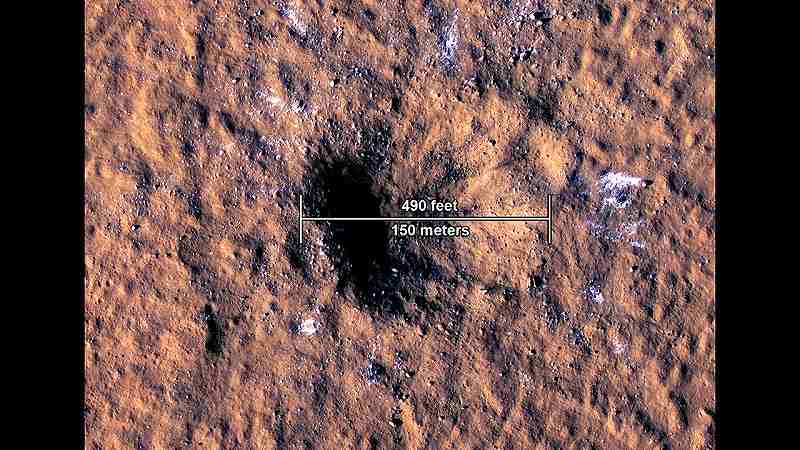
An impact crater about 150 meters across, formed on Dec. 24, 2021, by a space rock that struck Mars, is seen in this annotated image taken by the camera aboard the Mars Reconnaissance Orbiter.
16:58 JST, November 2, 2022
WASHINGTON (AFP-Jiji) — Scientists who study Mars on Oct. 27 revealed the remarkable Christmas gift they received from the planet last year.
On Dec. 24, 2021, a meteorite hit Mars’ surface, triggering magnitude 4 tremors, which were detected by NASA’s InSight spacecraft — which landed on the planet four years ago — some 3,500 kilometers away.
The true origin of this so-called marsquake was only confirmed when the Mars Reconnaissance Orbiter (MRO) was able to take a picture of the newly formed crater created by the hit when it flew over the impact site less than 24 hours later.
The image is impressive, showing blocks of ice that were spewed up onto the planet’s surface around the 150-meter wide and 21-meter deep hole.
The crater is the largest ever observed since the MRO began its Mars orbit 16 years ago.
And though meteorite impacts on Mars are not rare, “we never thought we’d see anything that big,” Ingrid Daubar, who works on the InSight and MRO missions, told reporters at a press conference Oct. 27.
Researchers estimate that the meteorite itself would have measured between 5 to 12 meters across. An object of that size would have disintegrated in Earth’s atmosphere before falling to the ground here.
“It is simply the biggest meteorite impact on the ground that we have heard since science has been done with seismographs or seismometers,” said planetology professor Philippe Lognonne, who participated in two studies related to the observation published in the journal Science on Oct. 27.
NASA released an audio recording of the collision, which was made by speeding up the vibrations collected by the seismometer.
The valuable information gathered in studying the crash will contribute to deeper knowledge of Mars’ interior and the history of how the planet was created, scientists said.
The presence of ice, in particular, is “surprising,” said Daubar, who also coauthored the two studies.
“This is the warmest spot on Mars, the closest to the equator, we’ve ever seen water ice,” she said.
In addition to the information this discovery offers about the Martian climate, the presence of water at this latitude — and not just near the poles — could prove “really useful” for future human visitors to Mars, director of NASA’s Planetary Science Division Lori Glaze said.
“We’d want to land the astronauts as near to the equator as possible,” she said, to take advantage of warmer temperatures.
“That ice could be converted into water, oxygen or hydrogen,” Glaze said.
The impact was powerful enough to generate seismic waves both down to the planet’s core and across its crust horizontally, making it possible to study Mars’ internal structure — revealing that the crust on which InSight sits is less dense than the crust the waves traveled over from the crater site.
The end of InSight’s mission — which recorded more than 1,300 marsquakes in total — could come in the next couple of months, according to Bruce Banerdt of NASA’s Jet Propulsion Lab, due to the expected accumulation of dust on the lander’s solar power panel.
It’s “sad,” he said, while celebrating that the probe worked “marvelously” for four years.






Most Read
Popular articles in the past 24 hours
-
Japanese High School Student Aims to Share Kaiten History Through...
-

Business Hotels Expanding into Regional Areas in Japan, Aiming to...
-

Milano Cortina 2026: Japan Sees Leap in Olympic Performance Throu...
-
Chronic Issues Erode Thailand’s Economy as Political Confusion Pe...
-
Milano Cortina 2026: Japan's Satoshi Furuno Places 4th in Men's S...
-

Milano Cortina 2026: Speed Skater Takagi Finishes 6th in the 1,50...
-

Osaka: 40 Ninjas Display Shuriken Throwing Skills at Japan Champi...
-

Fiji Defense Minister Hopes Japan Will Support Stabilization of P...
Popular articles in the past week
-

Japan PM Takaichi’s Cabinet Resigns en Masse
-

Man Infected with Measles Reportedly Dined at Restaurant in Tokyo...
-

Sanae Takaichi Elected Prime Minister of Japan; Keeps All Cabinet...
-

Japan's Govt to Submit Road Map for Growth Strategy in March, PM ...
-

Bus Carrying 40 Passengers Catches Fire on Chuo Expressway; All E...
-

Milano Cortina 2026: Figure Skaters Riku Miura, Ryuichi Kihara Pa...
-

Japan, U.S. Name 3 Inaugural Investment Projects; Reached Agreeme...
-

U.S. Firm to Build Training Hub in Fukushima N-plant for Debris R...
Popular articles in the past month
-
Japan PM Takaichi’s Cabinet Resigns en Masse
-

Japan Institute to Use Domestic Commercial Optical Lattice Clock ...
-

Israeli Ambassador to Japan Speaks about Japan’s Role in the Reco...
-
Man Infected with Measles Reportedly Dined at Restaurant in Tokyo...
-

Videos Plagiarized, Reposted with False Subtitles Claiming ‘Ryuky...
-

Man Infected with Measles May Have Come in Contact with Many Peop...
-

Prudential Life Insurance Plans to Fully Compensate for Damages C...
-

Woman with Measles Visited Hospital in Tokyo Multiple Times Befor...
Top Articles in Science & Nature
-
Japan Institute to Use Domestic Commercial Optical Lattice Clock to Set Japan Standard Time
-
Japan to Face Shortfall of 3.39 Million Workers in AI, Robotics in 2040; Clerical Workers Seen to Be in Surplus
-

Record 700 Startups to Gather at SusHi Tech Tokyo in April; Event Will Center on Themes Like Artificial Intelligence and Robotics
-

iPS Treatments Pass Key Milestone, but Broader Applications Far from Guaranteed
-
iPS Cell Products for Parkinson’s, Heart Disease OK’d for Commercialization by Japan Health Ministry Panel
JN ACCESS RANKING
-
Japan PM Takaichi’s Cabinet Resigns en Masse
-
Japan Institute to Use Domestic Commercial Optical Lattice Clock to Set Japan Standard Time
-
Israeli Ambassador to Japan Speaks about Japan’s Role in the Reconstruction of Gaza
-
Man Infected with Measles Reportedly Dined at Restaurant in Tokyo Station
-
Videos Plagiarized, Reposted with False Subtitles Claiming ‘Ryukyu Belongs to China’; Anti-China False Information Also Posted in Japan