
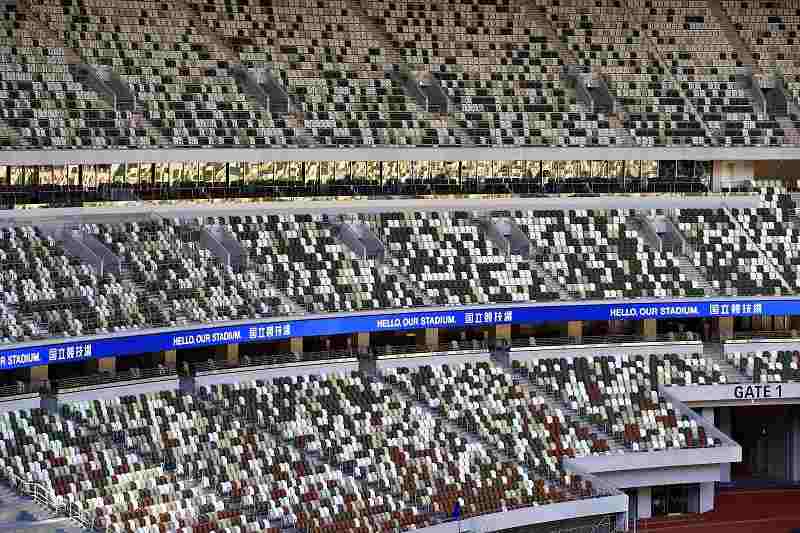
Spectator seating is seen at the National Stadium in Shinjuku Ward, Tokyo.
15:12 JST, July 8, 2021
With only two weeks left to go until the start of the Tokyo Olympic and Paralympic Games, the Games’ organizing committee finds itself in the extraordinary position of being unable to make a decision on what to do about tickets to events. As Tokyo heads into another state of emergency rather than ending the emergency-level priority measures in the capital on July 11 as scheduled, the upper limit on spectators formerly decided in June is now looking increasingly up in the air.
The Tokyo Organizing Committee of the Olympic and Paralympic Games had initially considered April to be the cutoff for carrying out ticketing-related operations according to the original plan. But as a result of the ever-evolving coronavirus pandemic, it was not until June 21 that five-party talks decided that the permissible number of spectators would be “10,000 people or 50% of venue capacity, whichever is less.” The eleventh-hour nature of the decision precluded implementation of the official ticket resale system, which would have let ticket holders sell their tickets at an authorized fixed price.
Committee Director General Toshiro Muto had previously indicated that under the 10,000-spectator cap, ticket revenue was likely to be less than half of the nearly ¥90 billion originally forecasted for the Games. With official resale channels off the table, further revenue loss is inevitable as due to ticket holders refunds that were not part of the original calculus.
The lingering issue of what to do about spectators — including the option of holding the Games without spectators at all — is on the docket for another upcoming five-way meeting between the organizing committee, Japan’s government, the International Olympic Committee and other concerned parties.
A central question for the five-way meeting will be whether to treat the spectator issue in venues in Tokyo differently from venues in regions excluded from a state of emergency.
A decision at the meeting to bar spectators, in principle, would not only deal a further blow to the Games’ finances, but would also dash plans to share the world’s top sporting event with our children. All the preparations made by volunteers who were to guide spectators at the venues will have been for nothing, as will the no longer needed spectator guidelines and transportation plan between stations and venues.






Most Read
Popular articles in the past 24 hours
-
Japanese High School Student Aims to Share Kaiten History Through...
-
Business Hotels Expanding into Regional Areas in Japan, Aiming to...
-
Milano Cortina 2026: Japan Sees Leap in Olympic Performance Throu...
-
Milano Cortina 2026: Japan's Satoshi Furuno Places 4th in Men's S...
-
Milano Cortina 2026: Speed Skater Takagi Finishes 6th in the 1,50...
-
Osaka: 40 Ninjas Display Shuriken Throwing Skills at Japan Champi...
-

Fiji Defense Minister Hopes Japan Will Support Stabilization of P...
-

Milano Cortina 2026: Malinin Highlights Dangers of Social Media i...
Popular articles in the past week
-

Japan PM Takaichi’s Cabinet Resigns en Masse
-

Man Infected with Measles Reportedly Dined at Restaurant in Tokyo...
-

Sanae Takaichi Elected Prime Minister of Japan; Keeps All Cabinet...
-

Japan's Govt to Submit Road Map for Growth Strategy in March, PM ...
-

Bus Carrying 40 Passengers Catches Fire on Chuo Expressway; All E...
-

Milano Cortina 2026: Figure Skaters Riku Miura, Ryuichi Kihara Pa...
-

Japan, U.S. Name 3 Inaugural Investment Projects; Reached Agreeme...
-

U.S. Firm to Build Training Hub in Fukushima N-plant for Debris R...
Popular articles in the past month
-
Japan PM Takaichi’s Cabinet Resigns en Masse
-

Japan Institute to Use Domestic Commercial Optical Lattice Clock ...
-

Israeli Ambassador to Japan Speaks about Japan’s Role in the Reco...
-
Man Infected with Measles Reportedly Dined at Restaurant in Tokyo...
-

Videos Plagiarized, Reposted with False Subtitles Claiming ‘Ryuky...
-

Man Infected with Measles May Have Come in Contact with Many Peop...
-

Prudential Life Insurance Plans to Fully Compensate for Damages C...
-

Woman with Measles Visited Hospital in Tokyo Multiple Times Befor...
Top Articles in Sports
-
Aonishiki Tops Atamifuji in Playoff to Win New Year Grand Sumo Tournament in Ozeki Debut
-
Milano Cortina 2026: Figure Skaters Riku Miura, Ryuichi Kihara Pair Win Gold; Dramatic Comeback from 5th Place in SP
-

Milano Cortina 2026: Kokomo Murase Comes Out on Top After Overcoming Obstacles, Aiming for Greater Heights in Competition
-
Milano Cortina 2026: Riku Miura, Ryuichi Kihara Clinch Japan’s 1st Gold in Pairs Figure Skating, Rebounding from Disappointing Short Program
-

Milano Cortina 2026: Olympics-Torch Arrives in Co-Host Cortina on Anniversary of 1956 Games
JN ACCESS RANKING
-
Japan PM Takaichi’s Cabinet Resigns en Masse
-
Japan Institute to Use Domestic Commercial Optical Lattice Clock to Set Japan Standard Time
-
Israeli Ambassador to Japan Speaks about Japan’s Role in the Reconstruction of Gaza
-
Man Infected with Measles Reportedly Dined at Restaurant in Tokyo Station
-
Videos Plagiarized, Reposted with False Subtitles Claiming ‘Ryukyu Belongs to China’; Anti-China False Information Also Posted in Japan