
Crowdfunding Campaign Propels Hopping Surface Explorer to Moon; Project Proves Small, Midsized Firms Can Go to Space
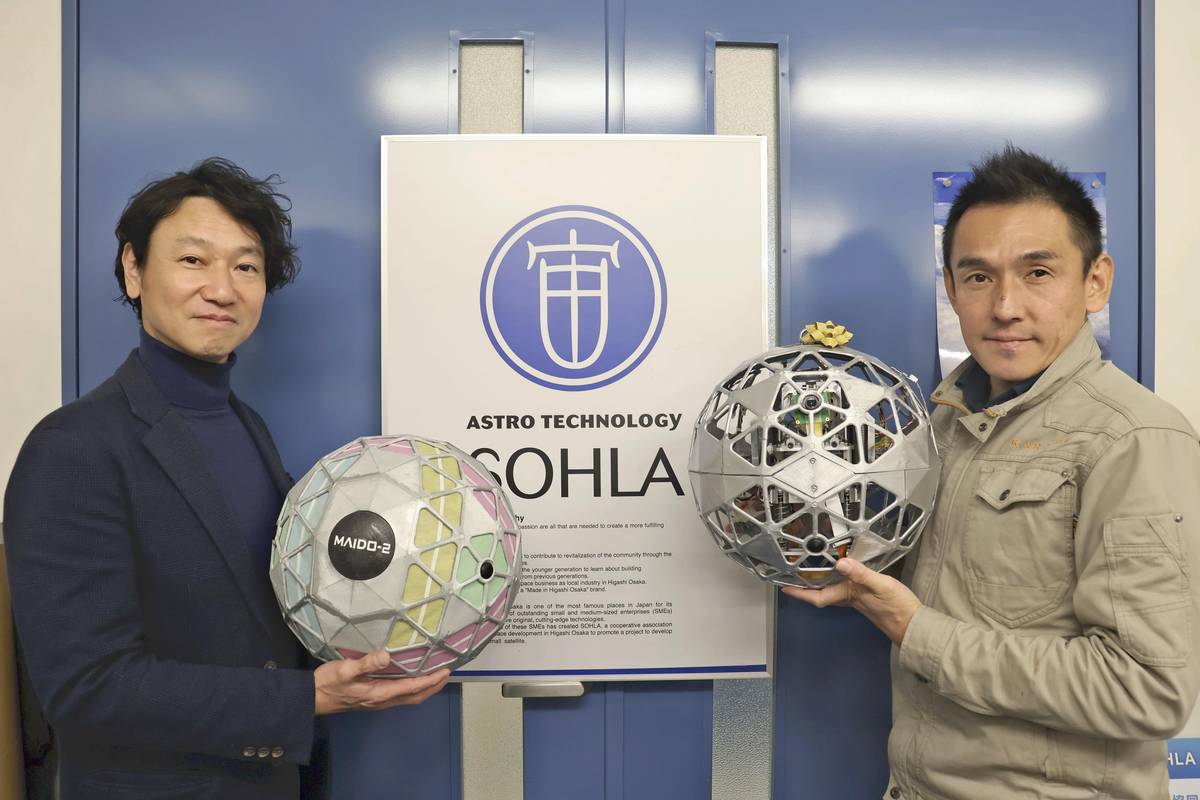
Yasuhisa Tomita, left, and Munenaga Yoda hold prototypes of the Maido 2 lunar exploration robot in Higashiosaka, Osaka Prefecture.
12:45 JST, January 18, 2026
HIGASHIOSAKA, Osaka — A group of small and midsize companies based in Higashiosaka is crowdfunding the development of a lunar exploration robot, with the aim of launching the device by around 2030.
The group, named Sohla, is an organization comprising businesses based in the renowned manufacturing city. In 2009, Sohla successfully launched a small satellite called the “Maido 1.” It hopes that sending the “Maido 2” to the moon will prove once again that even small factories “can aim to reach space.”
Sohla was established in 2002 and has expanding to include companies based outside Osaka Prefecture. The Maido 2, a spherical robot, will collect data while hopping along the moon’s surface. The robot’s leg structure uses springs made from a shape-memory alloy that returns to its original form when heated.
A prototype exhibited at the 2025 Osaka-Kansai Expo drew considerable attention.
“We got a positive reaction, with many expo visitors telling us our robot was amazing,” said Munenaga Yoda, a representative of Higashiosaka-based mechanical design firm Karakuri, Inc., which is involved in developing the jump mechanism and a Sohla member. “That really spurred us on.”
Companies reportedly reached out after the exhibition, keen to lend a hand in developing the robot.
Sohla is running a crowd-funding campaign until the end of this month to help cover the costs of conducting trials in an environment similar to what the Maido 2 will encounter in space. As of 9 a.m. Tuesday, the group had raised about ¥1.68 million, almost half of its ¥4 million target. Sohla has prepared thank-you gifts for donors, such as full-scale models of the Maido 2.
The Maido 1, which launched from the Tanegashima Space Center in Kagoshima Prefecture, completed tasks such as monitoring lightning and taking photos of Earth. The project inspired people across Japan, showing that even small and midsize enterprises can set their sights on space-related projects.
The satellite has completed its mission and is now orbiting Earth while gradually losing altitude. It is expected to plunge into Earth’s atmosphere in 20 to 40 years and burn up.
Yasuhisa Tomita, an official at Sohla, said, “We want to make the Maido 2 project a success and prove to many people that Japanese technologies are incredible.”






Most Read
Popular articles in the past 24 hours
-
Kesennuma, Miyagi Pref., Locals Raise Carp Streamers as Symbol of...
-

Iran Situation: Significance of Rule of Law Must Be Conveyed
-

Toyota Advancing Plant-Based Biofuel Development in Fukushima Tow...
-

Trump Says Iran Had a New Site for Developing Nuclear Weapons
-
2 People Reportedly Found on Mt. Fuji; Hiking Trail Currently Clo...
-

CARTOON OF THE DAY (March 10)
-

Rapeseed Flowers Reach Peak Viewing Period at Tokyo's Showa Kinen...
-

Japan's TEPCO to Raise Electricity Rates for Corporations in Apri...
Popular articles in the past week
-

Ibaraki Pref.'s 1st Foreign Bus Driver Hired in Tsukuba
-

Amid Strait of Hormuz Blockade, Shipping Companies Scramble to Ge...
-
Govt to Utilize ODA for Ensuring Economic Security; Securing Ener...
-
Japan Govt Survey Finds Just 10% of Workers Want Working Hours to...
-

Japan's 2nd Round of U.S. Investments May Be Worth Over $100 Bill...
-

Imperial Family Watches World Baseball Classic Game Against Austr...
-

Nippon Life Insurance's U.S. Arm Sues OpenAI Over Legal Assistanc...
-

Beckoning Cats Get Makeover to Fit Modern Lifestyles with Sleek D...
Popular articles in the past month
-

Producer Behind Pop Group XG Arrested for Cocaine Possession
-

Japan PM Takaichi’s Cabinet Resigns en Masse
-

Man Infected with Measles Reportedly Dined at Restaurant in Tokyo...
-

Videos Plagiarized, Reposted with False Subtitles Claiming ‘Ryuky...
-

iPS Treatments Pass Key Milestone, but Broader Applications Far f...
-

Sanae Takaichi Elected Prime Minister of Japan; Keeps All Cabinet...
-

Nepal Bus Crash Kills 19 People, Injures 25 Including One Japanes...
-

South Korea Tightens Rules on Foreigners Buying Homes in Seoul Me...
Top Articles in Society
-
Producer Behind Pop Group XG Arrested for Cocaine Possession
-
Man Infected with Measles Reportedly Dined at Restaurant in Tokyo Station
-

Bus Carrying 40 Passengers Catches Fire on Chuo Expressway; All Evacuate Safely
-

Tokyo Skytree’s Elevator Stops, Trapping 20 People; All Rescued (Update 1)
-
Ibaraki Pref.’s 1st Foreign Bus Driver Hired in Tsukuba
JN ACCESS RANKING
-
Producer Behind Pop Group XG Arrested for Cocaine Possession
-
Japan PM Takaichi’s Cabinet Resigns en Masse
-
Man Infected with Measles Reportedly Dined at Restaurant in Tokyo Station
-
Videos Plagiarized, Reposted with False Subtitles Claiming ‘Ryukyu Belongs to China’; Anti-China False Information Also Posted in Japan
-
iPS Treatments Pass Key Milestone, but Broader Applications Far from Guaranteed