
Earthquake-Affected Areas in Japan’s Noto Region See Continued Outflow in Child-Rearing, Working Population
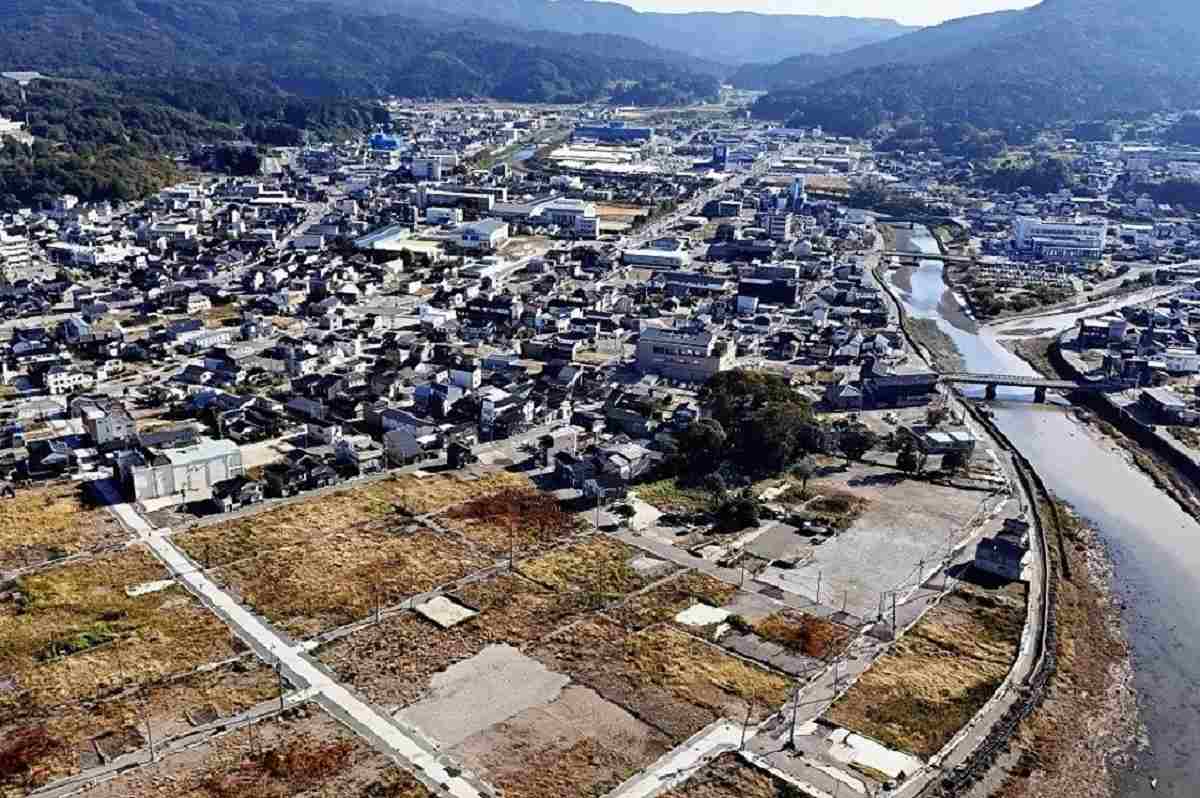
Publicly funded post-quake demolition work progresses in Wajima, Ishikawa Prefecture, with vacant lots becoming noticeable. Shown in front is the area where the Wajima Morning Market, which was destroyed in the quake, used to be located.
2:00 JST, January 2, 2026
WAJIMA, Ishikawa — The population continues to decline in areas affected by the Noto Peninsula Earthquake. More than 10% of the population, or about 7,300 people, has decreased from the pre-quake levels in the Oku-Noto region, which consists of the four municipalities of Wajima, Suzu, Noto and Anamizu in Ishikawa Prefecture, which suffered extensive damage. The number of those in their 40s and younger has dropped by nearly 20%, twice the rate of those 50 and older, due to poorer child-rearing environments and fewer job opportunities.
In the four municipalities, residents aged 65 or older account for 50% of the population —significantly higher than the national average of 29.3%.
Better new environments
“Returning to my hometown wasn’t realistic,” said Masaaki Tone, 48, with a sigh. His house in the Machino-machi district in Wajima was partially damaged, forcing him to evacuate to Kanazawa.
In February in 2024, he and three family members moved into a privately owned apartment rented by the Wajima municipal government for the city’s quake victims, about 5 kilometers from Kanazawa Station. He found employment at a construction company in Kanazawa and, six months later, purchased a pre-owned house near the apartment for about 30 million yen.
His parents, both in their 70s, still live in their home in Wajima. Although Tone wants to stay connected to Wajima, including helping its recovery, he decided to settle in Kanazawa. The main reason is that his 14-year-old daughter, a second-year junior high student, and his 11-year-old son, a sixth-grade elementary school student, had adapted to their new schools.
The daughter, who used to say, “I want to see my friends from Wajima,” is now the captain of the badminton club at her new school. The son has become passionate about playing tennis.
Tone said, “The current environment is good, as they can make many friends. Moving again would break their hearts.”
In the four municipalities, the number of residents in their 40s and younger has declined drastically.
According to the Basic Resident Register, the number declined by 19.2% between January 2024 and November 2025, while the number for those in their 50s and older declined by 9.5%.
According to a neighborhood association of the Kawai-machi district in central Wajima, the number of residents has halved. Most of those remaining are elderly.
Mitsuo Koshido, 75, a member of the association, sadly said, “We may not be able to continue holding the traditional Kiriko Festival in the future.”
Fewer schools, fewer jobs
Efforts to reorganize schools are also accelerating.
In the four municipalities, the number of elementary and junior high schools, including compulsory education schools that provide integrated elementary and junior high education, is to be 26 in April, decreasing from 35 by nine, which consists of eight in Wajima and one in Noto.
Expressing a concern about the decline in households raising children, Wajima Mayor Shigeru Sakaguchi said, “We cannot stop parents who want to move to places where they feel secure about the well-being of their children.”
The shortage of jobs is another reason the working population is not returning.
According to data provided by the chambers of commerce and industry and the societies of commerce and industry of the four municipalities, 314 businesses, or 12.2% of the total, have gone out of business since the earthquake occurred until Dec. 1 last year.
Yoshinobu Sode, 53, secretary general of the Suzu Chamber of Commerce and Industry, says that some business owners are hesitant to restart their operations due to the slow pace of infrastructure restoration.
“The people who continue living in the city are also aging. It’s clear the local workforce will dwindle,” he lamented.
Prospects for rebuilding life essential
About 18,300 people of about 9,000 households are still living in temporary housing. There is a plan to build 2,986 public housing units in nine municipalities for disaster victims. However, as of November last year, construction had begun on only about 5% of the units, located in three of the municipalities. Some of the units still do not have construction timelines.
According to a survey by the Wajima municipal government of its citizens who took shelter after the quake and currently live in private housing outside of Wajima that the government has rented, only half of about 400 households that responded say they were considering either moving into public housing for the quake victims to be built in the city, or rebuilding or repairing their own homes.
“Quake victims won’t be motivated to return home without prospects for rebuilding their lives there,” warned Junichi Tanaka, a professor specializing in disaster sociology of Hokuriku Gakuin University in Kanazawa. “It’s crucial to create an environment where young people can settle down and continue working.”








Most Read
Popular articles in the past 24 hours
-

3,000 Accounts Posting, Spreading Content Critical of Japan on X;...
-

Milano Cortina 2026: Sakamoto Serves as Flag Bearer; Japan Earns ...
-

Milano Cortina 2026: There Were Cheers across the Country, after ...
-

A Packed Bus Plunges off a Nepal Highway, Killing 19 and Injuring...
-

Luna Sea Drummer Shinya Dies at 56; Powerful Drummer Behind ‘Desi...
-

Milano Cortina 2026: ‘Magical’ Italian Games Close wi...
-

Milano Cortina 2026: Riku-Ryu Duo Stick Together During Closing C...
-

Emperor Receives Well-Wishes from Public on His 66th Birthday
Popular articles in the past week
-

Japan PM Takaichi’s Cabinet Resigns en Masse
-

Man Infected with Measles Reportedly Dined at Restaurant in Tokyo...
-

Sanae Takaichi Elected Prime Minister of Japan; Keeps All Cabinet...
-

Japan's Govt to Submit Road Map for Growth Strategy in March, PM ...
-

Bus Carrying 40 Passengers Catches Fire on Chuo Expressway; All E...
-

U.S. Firm to Build Training Hub in Fukushima N-plant for Debris R...
-

Japan, U.S. Name 3 Inaugural Investment Projects; Reached Agreeme...
-

Riku-Ryu Pair Wins Gold Medal: Their Strong Bond Leads to Major C...
Popular articles in the past month
-
Japan PM Takaichi’s Cabinet Resigns en Masse
-

Japan Institute to Use Domestic Commercial Optical Lattice Clock ...
-

Israeli Ambassador to Japan Speaks about Japan’s Role in the Reco...
-
Man Infected with Measles Reportedly Dined at Restaurant in Tokyo...
-

Videos Plagiarized, Reposted with False Subtitles Claiming ‘Ryuky...
-

Man Infected with Measles May Have Come in Contact with Many Peop...
-

Prudential Life Insurance Plans to Fully Compensate for Damages C...
-

Woman with Measles Visited Hospital in Tokyo Multiple Times Befor...
Top Articles in Society
-

Producer Behind Girls Group XG Arrested for Cocaine Possession
-
Man Infected with Measles Reportedly Dined at Restaurant in Tokyo Station
-
Man Infected with Measles May Have Come in Contact with Many People in Tokyo, Went to Store, Restaurant Around When Symptoms Emerged
-
Woman with Measles Visited Hospital in Tokyo Multiple Times Before Being Diagnosed with Disease
-
Australian Woman Dies After Mishap on Ski Lift in Nagano Prefecture
JN ACCESS RANKING
-
Japan PM Takaichi’s Cabinet Resigns en Masse
-
Japan Institute to Use Domestic Commercial Optical Lattice Clock to Set Japan Standard Time
-
Israeli Ambassador to Japan Speaks about Japan’s Role in the Reconstruction of Gaza
-
Man Infected with Measles Reportedly Dined at Restaurant in Tokyo Station
-
Videos Plagiarized, Reposted with False Subtitles Claiming ‘Ryukyu Belongs to China’; Anti-China False Information Also Posted in Japan