
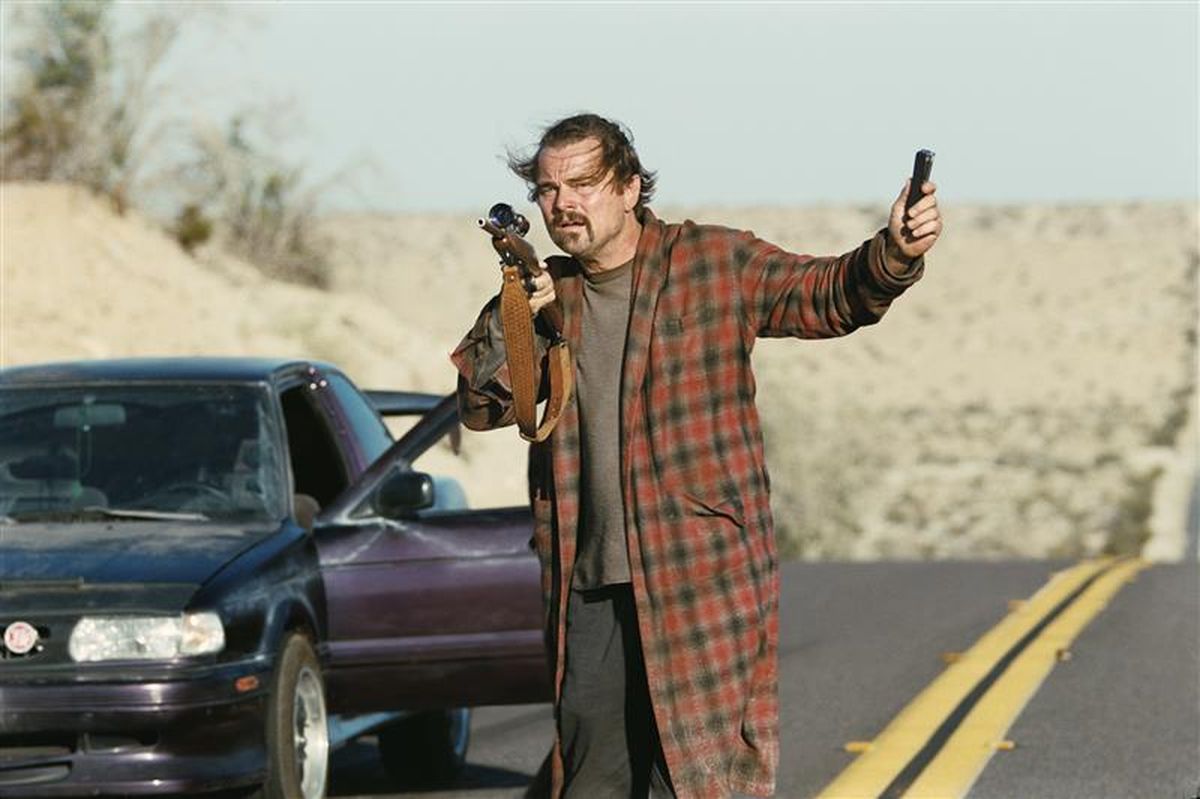
An image from “One Battle After Another,” starring Leonardo DiCaprio
10:30 JST, October 17, 2025
The American film “One Battle After Another,” now in theaters, is one of this year’s most talked-about films, offering a full dose of cinematic pleasure.
Starring Leonardo DiCaprio and written and directed by Paul Thomas Anderson, it tells the “after” story of Bob (played by DiCaprio), a man who once engaged in armed struggle and passionate love as a revolutionary.
Sixteen years after he attempted to leave his past behind for various reasons, his daughter Willa (Chase Infiniti), whom he has raised alone, has grown into a spirited teenager. Bob has become an old-fashioned, stubborn father — in other words, an ordinary middle-aged man — precisely because of the peace in his life. But when his archenemy launches a surprise attack and kidnaps Willa, Bob can no longer stay in his ordinary ways.
Thus begins a dynamic chase filled with thrills, laughs and excitement. It depicts the standoff with his archenemy, military man Lockjaw (Sean Penn), camaraderie with the ever-reliable karate dojo “Sensei” Sergio (Benicio Del Toro) and heartfelt bond with Willa — all through action-packed sequences (particularly the car chase at the location the film’s production dubbed “the River of Hills”).
In fact, the women in the film, Bob’s wife, the charismatic revolutionary Perfidia (Teyana Taylor), and his comrade Deandra (Regina Hall), are also standouts. The story also focuses on how their passion for justice is passed on to Willa, with Bob as conduit.
During the film, the song “The revolution will not be televised” can be heard. It’s by Gil Scott-Heron, often called the godfather of rap, whose musical career intertwined with sociopolitical spheres.
Currently on display in Tokyo is “Innervisions,” a solo exhibition by Portuguese director Pedro Costa, who had once been set to make a film with Scott-Heron but was unable to complete it as the musician died during production. It is a unique exhibition where visitors can engage with Costa’s life’s work — films about African immigrants — in a completely darkened exhibition room. The exhibition runs through Dec. 7 at the Tokyo Photographic Art Museum.
The title is taken from Stevie Wonder’s 1973 album, which had a major influence on Costa. Wonder, too, was an admirer of Scott-Heron. The worlds of Anderson’s and Costa’s films could appear distant, but connections are there. I felt the connections when I heard Scott-Heron’s song in the film.





Most Read
Popular articles in the past 24 hours
-
Japanese High School Student Aims to Share Kaiten History Through...
-

PM Takaichi Spells out Plans to Advance Bold Policy Shifts in Spe...
-

Chronic Issues Erode Thailand’s Economy as Political Confusion Pe...
-

Tottori: 95-Year-Old Japanese Descendent from Philippines Visits ...
-

Japan to Monitor Trump Administration's Response to U.S. Supreme ...
-

Milano Cortina 2026: Speed Skater Takagi Finishes 6th in the 1,50...
-

Osaka: 40 Ninjas Display Shuriken Throwing Skills at Japan Champi...
-

Miyazaki: Japanese Woman Walks in Footsteps of Samurai Ancestor W...
Popular articles in the past week
-

Japan PM Takaichi’s Cabinet Resigns en Masse
-

Man Infected with Measles Reportedly Dined at Restaurant in Tokyo...
-

Sanae Takaichi Elected Prime Minister of Japan; Keeps All Cabinet...
-

Japan's Govt to Submit Road Map for Growth Strategy in March, PM ...
-

Bus Carrying 40 Passengers Catches Fire on Chuo Expressway; All E...
-

Milano Cortina 2026: Figure Skaters Riku Miura, Ryuichi Kihara Pa...
-

Japan, U.S. Name 3 Inaugural Investment Projects; Reached Agreeme...
-

U.S. Firm to Build Training Hub in Fukushima N-plant for Debris R...
Popular articles in the past month
-
Japan PM Takaichi’s Cabinet Resigns en Masse
-

Japan Institute to Use Domestic Commercial Optical Lattice Clock ...
-

Israeli Ambassador to Japan Speaks about Japan’s Role in the Reco...
-
Man Infected with Measles Reportedly Dined at Restaurant in Tokyo...
-

Videos Plagiarized, Reposted with False Subtitles Claiming ‘Ryuky...
-

Man Infected with Measles May Have Come in Contact with Many Peop...
-

Prudential Life Insurance Plans to Fully Compensate for Damages C...
-

Woman with Measles Visited Hospital in Tokyo Multiple Times Befor...
Top Articles in Culture
-
BTS to Hold Comeback Concert in Seoul on March 21; Popular Boy Band Releases New Album to Signal Return
-

Lifestyle at Kyoto Traditional Machiya Townhouse to Be Showcased in Documentary
-

Director Naomi Kawase’s New Film Explores Heart Transplants in Japan, Production Involved Real Patients, Families
-

‘Jujutsu Kaisen’ Voice Actor Junya Enoki Discusses Rapid Action Scenes in Season 3, Airing Now
-

Tokyo Exhibition Offers Inside Look at Impressionism; 70 of 100 Works on ‘Interiors’ by Monet, Others on Loan from Paris
JN ACCESS RANKING
-
Japan PM Takaichi’s Cabinet Resigns en Masse
-
Japan Institute to Use Domestic Commercial Optical Lattice Clock to Set Japan Standard Time
-
Israeli Ambassador to Japan Speaks about Japan’s Role in the Reconstruction of Gaza
-
Man Infected with Measles Reportedly Dined at Restaurant in Tokyo Station
-
Videos Plagiarized, Reposted with False Subtitles Claiming ‘Ryukyu Belongs to China’; Anti-China False Information Also Posted in Japan