
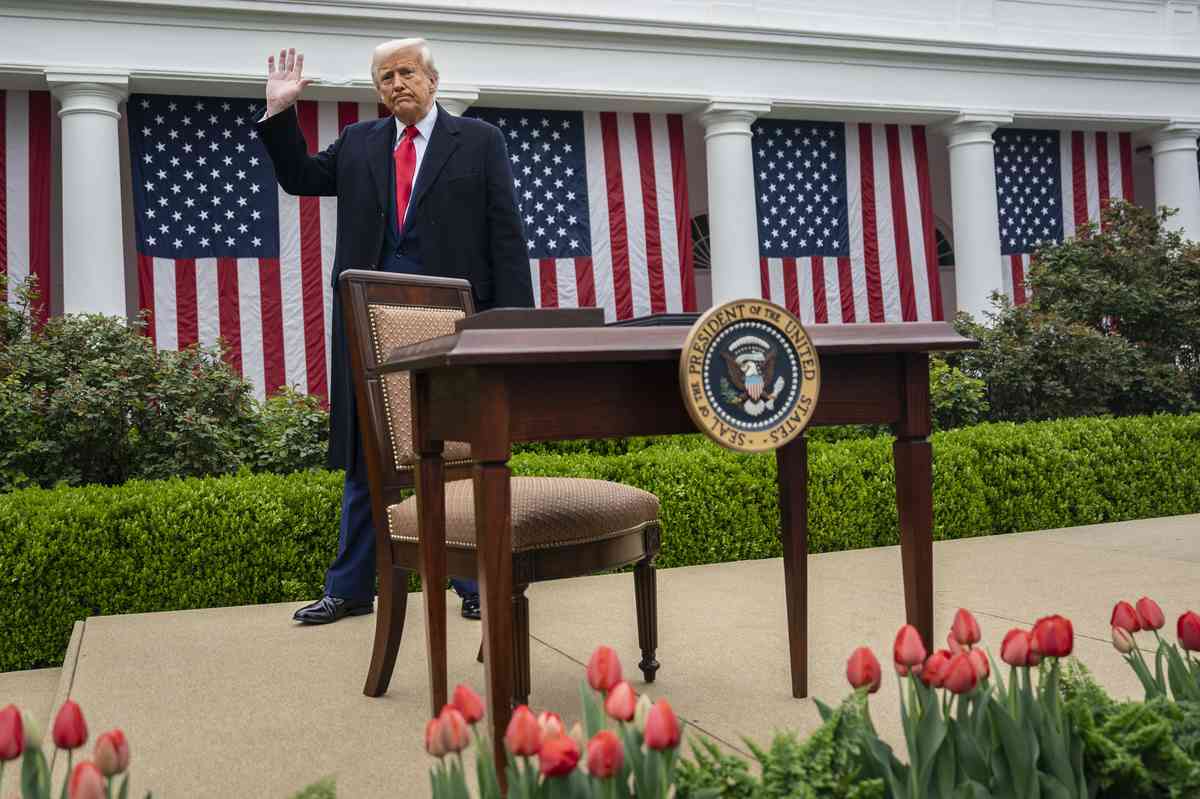
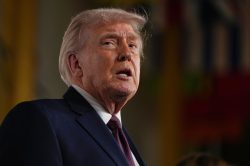
President Donald Trump prepares to sign executive orders on tariffs in the Rose Garden in April.
15:03 JST, September 10, 2025
The Supreme Court on Tuesday announced it will quickly weigh the legality of most of President Donald Trump’s sweeping tariffs, a far-reaching case that could determine the fate of a cornerstone of the president’s agenda and alter the course of the U.S. economy and global trade.
The justices asked the government and a group of small businesses and states to expedite briefings in the case, setting a deadline of Sept. 19 to submit them. The case has been set for argument the first week in November.
The Trump administration asked the justices last week to quickly overturn a split decision by a federal appeals court that ruled the president could not impose the import taxes under a 1977 law that grants him emergency powers over the economy.
The tariffs have been the central feature of the tumultuous trade war that has defined Trump’s second term, creating wide-ranging and unpredictable effects for businesses and consumers alike as the president has repeatedly announced – then paused or modified – levies on goods from other nations.
Trump has argued tariffs will help end the fentanyl crisis, rebuild American manufacturing and save jobs, but the moves have unsettled investors and stoked concerns about the U.S. economy and inflation.
The case, which has been on a fast track through the courts, is among the most significant involving Trump to reach the justices to date. It’s a major test of Trump’s assertion of sweeping executive authority.
The administration has largely been successful in a flood of cases on the high court’s emergency docket, persuading the justices to allow it to strip migrants of deportation protections, fire heads of federal agencies and freeze grants while legal challenges play out regarding actions in the lower courts.
Unlike those cases, which resulted in temporary rulings, the high court is likely to make a more lasting decision on the legality of Trump’s tariffs because the case concerns a lower court’s ruling that the tariffs were illegal. That decision was later stayed by an appeals court.
Trump began imposing tariffs in February, declaring a series of emergencies under the International Emergency Economic Powers Act (IEEPA), which allows the president to take steps to “to deal with any unusual and extraordinary threat” to the economy from abroad by declaring an emergency. He is the first president to assert such an authority in the nearly 50-year history of the IEEPA.
Trump announced levies of 10 to 25 percent on goods from China, Mexico and Canada for allegedly failing to stem the flow of fentanyl and other illegal drugs into the United States. In April, Trump imposed a universal 10 percent import tax on all trading partners and higher rates on roughly 60 countries, dubbing it “Liberation Day.”
Trump wrote in the latter executive order that “large and persistent” U.S. trade deficits constitute “an unusual and extraordinary threat to the national security and economy of the United States.” He has consistently said other countries have imposed unfair trade barriers that have contributed to the hollowing out of America’s industrial base.
As of early August, the Yale Budget Lab said the effective tariff rate on imports was nearly 19 percent – the highest since the Great Depression. The typical tariff rate has hovered between 2 and 3 percent in the modern era. The nonpartisan group estimated price increases caused by the tariffs could cost American households $2,400 per year.
A handful of small businesses and a group of states filed separate lawsuits against the tariffs in April, saying they would cause widespread economic harm. The small businesses called Trump’s imposition of worldwide tariffs a “power grab.”
“Congress, not the President alone, has the constitutional power to impose tariffs,” Jeffrey Schwab, an attorney for some of the plaintiffs, said in a statement Tuesday.
The plaintiffs argued that the IEEPA does not grant the president the authority to impose tariffs, that there is no national emergency warranting Trump’s actions, and that his moves violate the Constitution’s separation of powers and run afoul of the Supreme Court’s “major questions doctrine.”
The doctrine, which the high court established in a 2022 case dealing with the Environmental Protection Agency’s ability to regulate greenhouse gases, requires that the president have explicit authorization by Congress to regulate issues of great economic or political significance.
The Supreme Court cited the principle to block President Joe Biden’s $400 billion in student loan forgiveness, attempts to curb carbon dioxide emissions and impose vaccine mandates on some businesses during the pandemic.
“President Trump has chosen to wield IEEPA to impose tariffs on the world at his whim, muddled by threats, additions, exceptions, exemptions, and pauses,” the states wrote in their lawsuit. “The direct consequence has been an erratic financial market and a destabilized U.S. and global economy.”
A three-judge panel of the specialized Court of International Trade in New York issued a summary judgment in the small-business and state cases in May, finding that Trump did not have the authority to impose trafficking tariffs or the worldwide import taxes under the IEEPA.
“We do not read IEEPA to delegate an unbounded tariff authority to the President,” the panel found. “We instead read IEEPA’s provisions to impose meaningful limits on any such authority it confers.”
The U.S. Court of Appeals for the Federal Circuit then paused that decision and agreed to hear a government appeal on an expedited basis. Last month, the court ruled 7-4 that Trump had overstepped his authority in imposing tariffs under the IEEPA.
The court paused its ruling to give the Trump administration time to appeal to the Supreme Court.
“The statute bestows significant authority on the President to undertake a number of actions in response to a declared national emergency, but none of these actions explicitly include the power to impose tariffs, duties, or the like, or the power to tax,” the majority wrote in their ruling. “Absent a valid delegation by Congress, the President has no authority to impose taxes.”
Trump officials have said in interviews and court filings that an adverse ruling by the high court could force the administration to refund up to $1 trillion in tariffs it has collected, if the justices were to issue a decision by June.
Administration officials want the court to act much sooner to avoid such a scenario. White House spokesman Kush Desai said in a statement Tuesday that Trump is acting within his rights as president.
“The fact of the matter is that President Trump has acted lawfully by using the tariff powers granted to him by Congress in IEEPA to deal with national emergencies and to safeguard our national security and economy,” Desai said. “We look forward to ultimate victory on this matter with the Supreme Court.”
The Supreme Court on Tuesday consolidated the cases brought by small businesses and states with another case. That lawsuit was brought by two educational toy makers, who claim the tariffs will force them to raise prices and could devastate sales.
Since announcing the tariffs, Trump has negotiated frameworks for trade deals with about a dozen countries and the European Union to scale back the import taxes. An adverse ruling could also upend those negotiations.
Even if the president loses at the high court, he could impose similar tariffs using authorities under other trade laws, but that would take time and require the government to complete various procedural steps. The Trump administration is reportedly exploring its options.






Most Read
Popular articles in the past 24 hours
-

‘Dry Bonsai’ Gives New Life to Withered Trees, Allows Free Artist...
-

Japanese Students Use Traditional Pickle to Create Novel Wagashi ...
-

McDonald's Japan Raises Prices; Big Mac to Cost ¥500, Double Chee...
-

Nepal Bus Crash Kills 19 People, Injures 25 Including One Japanes...
-

Japan’s Nikkei Stock Average Rises as AI-Related Stocks Shine; Co...
-

Astellas Collaborates with Vir to Develop Its Experimental Prosta...
-

Early-Blooming Kawazu Cherry Blossoms Create Sea of Pink at Park ...
-

Joruri Bunraku Narrative Performed in Honor of Donald Keene by La...
Popular articles in the past week
-

Producer Behind Pop Group XG Arrested for Cocaine Possession
-

Japan PM Takaichi’s Cabinet Resigns en Masse
-

Sanae Takaichi Elected Prime Minister of Japan; Keeps All Cabinet...
-
Japan's Govt to Submit Road Map for Growth Strategy in March, PM ...
-

Bus Carrying 40 Passengers Catches Fire on Chuo Expressway; All E...
-
U.S. Firm to Build Training Hub in Fukushima N-plant for Debris R...
-
Japan, U.S. Name 3 Inaugural Investment Projects; Reached Agreeme...
-

Riku-Ryu Pair Wins Gold Medal: Their Strong Bond Leads to Major C...
Popular articles in the past month
-
Producer Behind Pop Group XG Arrested for Cocaine Possession
-
Japan PM Takaichi’s Cabinet Resigns en Masse
-

Japan Institute to Use Domestic Commercial Optical Lattice Clock ...
-

Man Infected with Measles Reportedly Dined at Restaurant in Tokyo...
-

Israeli Ambassador to Japan Speaks about Japan’s Role in the Reco...
-

Videos Plagiarized, Reposted with False Subtitles Claiming ‘Ryuky...
-

Man Infected with Measles May Have Come in Contact with Many Peop...
-

Prudential Life Insurance Plans to Fully Compensate for Damages C...
Top Articles in News Services
-
Survey Shows False Election Info Perceived as True
-
Hong Kong Ex-Publisher Jimmy Lai’s Sentence Raises International Outcry as China Defends It
-
Japan’s Nikkei Stock Average Touches 58,000 as Yen, Jgbs Rally on Election Fallout (UPDATE 1)
-
Japan’s Nikkei Stock Average Falls as US-Iran Tensions Unsettle Investors (UPDATE 1)
-
Trump Names Former Federal Reserve Governor Warsh as the Next Fed Chair, Replacing Powell
JN ACCESS RANKING
-
Producer Behind Pop Group XG Arrested for Cocaine Possession
-
Japan PM Takaichi’s Cabinet Resigns en Masse
-
Japan Institute to Use Domestic Commercial Optical Lattice Clock to Set Japan Standard Time
-
Man Infected with Measles Reportedly Dined at Restaurant in Tokyo Station
-
Israeli Ambassador to Japan Speaks about Japan’s Role in the Reconstruction of Gaza