
Number of Trains Running on Japan’s Tokaido Shinkansen Bullet Train Line Hits Highest Ever at 383 Per Day on Average
16:37 JST, September 8, 2025
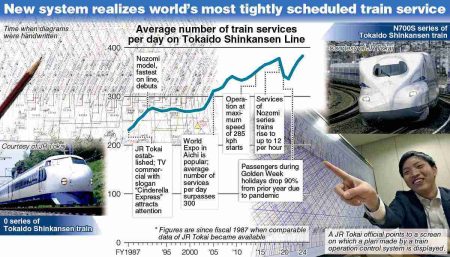
The Tokaido Shinkansen bullet train line between Tokyo and Shin-Osaka is said to be “the world’s most tightly scheduled,” with fiscal 2024 seeing the highest number of trains running on the line ever, at 383 per day on average.
While the number of bullet trains available for use is limited, the frequency at which trains are run has increased. This is possible because of a new train operation control system that Central Japan Railway Co. (JR Tokai) introduced in spring last year.
Handwriting years
Many people think that Tokaido Shinkansen trains run at the same times and in the same places every day. However, this is not true. The operation diagrams for the train line change frequently based on factors such as season, day of the week and one-day events like live concerts by popular artists.
When the Tokaido Shinkansen Line opened in 1964, 60 trains ran each day. The number has continued to increase since then.
In fiscal 1989, the figure reached 252 per day on average, surpassing the 250 mark for the first time. The number rose to more than 300 in fiscal 2005 and to 350 a day on average in fiscal 2014.
Although the number temporarily decreased during the coronavirus pandemic, it has been rising again.
The operation schedules are completed by drawing many lines to indicate the movements of the Shinkansen trains on diagrams displaying departure times and station names. Then, JR Tokai officials analyze which trains among a total of about 170 will be allocated to each service.
By increasing factors such as the number of round trips a train makes, the trains can be operated more efficiently and the number of train services can be increased.
In the past, the allocation process was typically done using rulers to manually draw lines to connect existing lines on the diagrams.
An incredible amount of work was necessary to connect all the lines by hand while considering the various conditions. During busy times of year, such as the Bon Festival summer holiday, sometimes it took 20 hours to complete an operation diagram for a single day.
New system saves time, labor
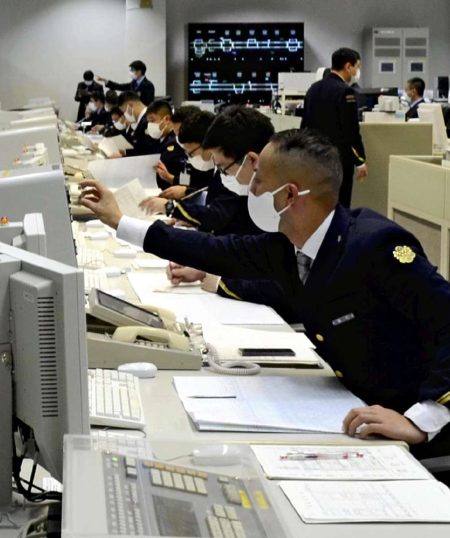
Employees manage the operation of Shinkansen trains from an alternative management center as a part of a drill in Osaka in Dec. 2021.
JR Tokai needed to improve work efficiency, and the company began systematizing operation plans in 2017. In the spring of 2024, seven years after the start of its development, JR Tokai began using new system.
Staff members input into the system preset conditions such as “diagrams made daily” or “positions of the day’s first trains.” Within no more than three minutes, the message on the computer screen changes from “searching for solution” to “searching completed.”
Then, the computer screen displays an operation plan for a specific day in which the lines of the diagram are connected to allow for the same train cars to be used.
During busy periods such as Golden Week, the Bon Festival and the year-end of the New Year period, workers put the finishing touches on the plans by adding detailed revisions, which takes about two hours.
On weekdays, when there are often fewer trains running, the Shinkansen trains are sometimes operated in line with plans made by the computer system only after a human check.
The new system has been able to significantly reduce the staff’s working time and workload.
Record 483 trains per day
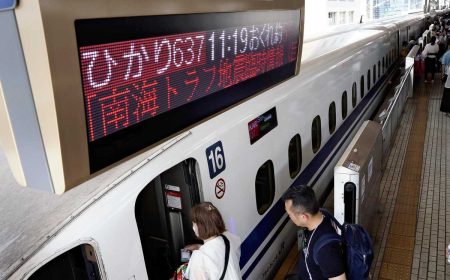
The signage shows a delay in Shinkansen service due to the issuance of a Nankai Trough Earthquake Extra Information at JR Nagoya Station in Aug. 2024.
For Aug. 9 last year, JR Tokai made a plan to run a record 483 trains on the Tokaido Shinkansen Line. The company predicted that trains would be crowded with passengers going to their hometowns for the Bon Festival holiday and businesspeople would ride them because it was a weekday.
Such a high number was not anticipated when the system was developed, and JR Tokai officials said the scale would have been difficult to realize by the deadline if humans did the work.
However, on Aug. 8, a magnitude 7.1 earthquake occurred in the Hyuganada Sea off Miyazaki Prefecture. In addition, a Nankai Trough Earthquake Extra Information for megaquake attention was issued.
Under company rules, JR Tokai decreased Shinkansen train speeds on some track sections. On Aug. 9, delays in the schedule because of speed reductions continued until the day’s last train, but all of the scheduled trains ran.
“In addition to the strong efforts undertaken by station workers, [running all of the transit] was possible largely thanks to the fact that we were able to precisely draw up an operation plan using the system,” said Kazuhiko Hosokawa, 46, the JR Tokai official who was in charge of the day’s train operation control.
For the duration of the 2025 Osaka-Kansai Expo, which opened in April, JR Tokai has increased the number of train services of the Nozomi series of Shinkansen trains. Mainly on weekends when trains are predicted to be crowded, JR Tokai increased the number of Nozomi trains that depart stations in the Tokyo metropolitan area from 6 a.m. to 6:59 a.m to 14.
Demand for the Tokaido Shinkansen Line is predicted to continue to rise.
“I want to respond to the number of train services that will increase year by year with the system and make operation plans which are convenient for passengers,” said Masahide Koizumi, 38, a JR Tokai employee who was engaged in the development of the operation control system.
AI to be used for train control
Railway companies need to work quickly if trains are delayed, and schedules must be altered due to accidents or other troubles.
NEC Corp. developed an artificial intelligence system that can generate the most suitable diagrams in a short time after such issues.
The company has repeatedly conducted tests to raise the accuracy of the AI system, aiming to put it into practical use as soon as possible.
To minimize the negative effects on diagrams of successive trains, revising the diagrams requires both speed and accuracy. However, in recent years, an increasing number of railway companies have begun jointly operate connected services, in which one company’s trains directly run on another firm’s rail lines. As a result, the types of trains, the number running and other operational factors have become complicated.
In addition, in the workplaces in charge of making diagrams, the number of veteran employees with extensive knowledge of the work is decreasing. Therefore, a labor shortage has become a serious problem.
When developing the AI system, NEC adopted “enforced learning,” a method that is also used for shogi plays between AI programs to increase their performance.
While obtaining cooperation from railway company officials, NEC made the AI system respond to records of various cases in the past for normalizing train diagrams. Through the process, NEC had the AI system learn how to output optimal solutions.
Kyushu Railway Co. (JR Kyushu) and Hitachi, Ltd. are jointly working to utilize AI technologies for the revision of diagrams in the event of any issues.
“While reducing the burden on employees, we want to shorten the time until the train schedule will be established and improve the quality of our transportation services,” said a JR Kyushu official.


Related Tags





Most Read
Popular articles in the past 24 hours
-

Narita Airport, Startup in Japan Demonstrate Machine to Compress ...
-
Foreign Snowboarder in Serious Condition After Hanging in Midair ...
-
Japanese App Developers Condemn Apple, Google for New Commissions...
-

Hakone Ekiden Running Relay Opens Up to More Universities, a Move...
-
Imperial Hotel, Kyoto, to Open in March; Hotel Housed in Historic...
-

Online Shopping: What Should be Done to Eliminate Malicious Busin...
-

Man Randomly Attacks 4 Passersby Near Station in Japan; Suspect o...
-

Japanese Govt to Require Confirmation of Identity of Buyers of Da...
Popular articles in the past week
-
Record-Breaking Snow Cripples Public Transport in Hokkaido; 7,000...
-

North Korea Possibly Launches Ballistic Missile
-

Aonishiki Tops Atamifuji in Playoff to Win New Year Grand Sumo To...
-

Japan Institute to Use Domestic Commercial Optical Lattice Clock ...
-
JR Tokai, Shizuoka Pref. Agree on Water Resources for Maglev Trai...
-
Lifestyle at Kyoto Traditional Machiya Townhouse to Be Showcased ...
-

Sakie Yokota, Last Surviving Parent of a North Korea Abductee, Ur...
-
Japan to Face Shortfall of 3.39 Million Workers in AI, Robotics i...
Popular articles in the past month
-

Univ. in Japan, Tokyo-Based Startup to Develop Satellite for Disa...
-

JAL, ANA Cancel Flights During 3-day Holiday Weekend due to Blizz...
-

Snow Expected in Tokyo, Neighboring Prefectures from Jan. 2 After...
-

China Confirmed to Be Operating Drilling Vessel Near Japan-China ...
-

Tokyo, Yokohama Observe First Snowfall of Season; 1 Day Earlier t...
-

China Eyes Rare Earth Foothold in Malaysia to Maintain Dominance,...
-
M6.2 Earthquake Hits Japan's Tottori, Shimane Prefectures; No Tsu...
-

Japan, Qatar Ministers Agree on Need for Stable Energy Supplies; ...
Top Articles in JN Specialities
-

The Japan News / Weekly Edition (1/9-1/15)
-

The Japan News / Weekly Edition (1/16-1/22)
-

Tokyo University of the Arts Now Offering Free Guided Tour of New Storage Building, Completed in 2024
-

The Japan News / Weekly Edition (1/23-1/29)
-
Prevent Accidents When Removing Snow from Roofs; Always Use Proper Gear and Follow Safety Precautions
JN ACCESS RANKING
-
Univ. in Japan, Tokyo-Based Startup to Develop Satellite for Disaster Prevention Measures, Bears
-
JAL, ANA Cancel Flights During 3-day Holiday Weekend due to Blizzard
-
China Confirmed to Be Operating Drilling Vessel Near Japan-China Median Line
-
China Eyes Rare Earth Foothold in Malaysia to Maintain Dominance, Counter Japan, U.S.
-
M6.2 Earthquake Hits Japan’s Tottori, Shimane Prefectures; No Tsunami Threat (Update 4)