
Tour of Retired Antarctic Research Ship ‘Shirase 5002’ Details Its Adventures; Reality of Life on Board Revealed of Record-Holding Vessel
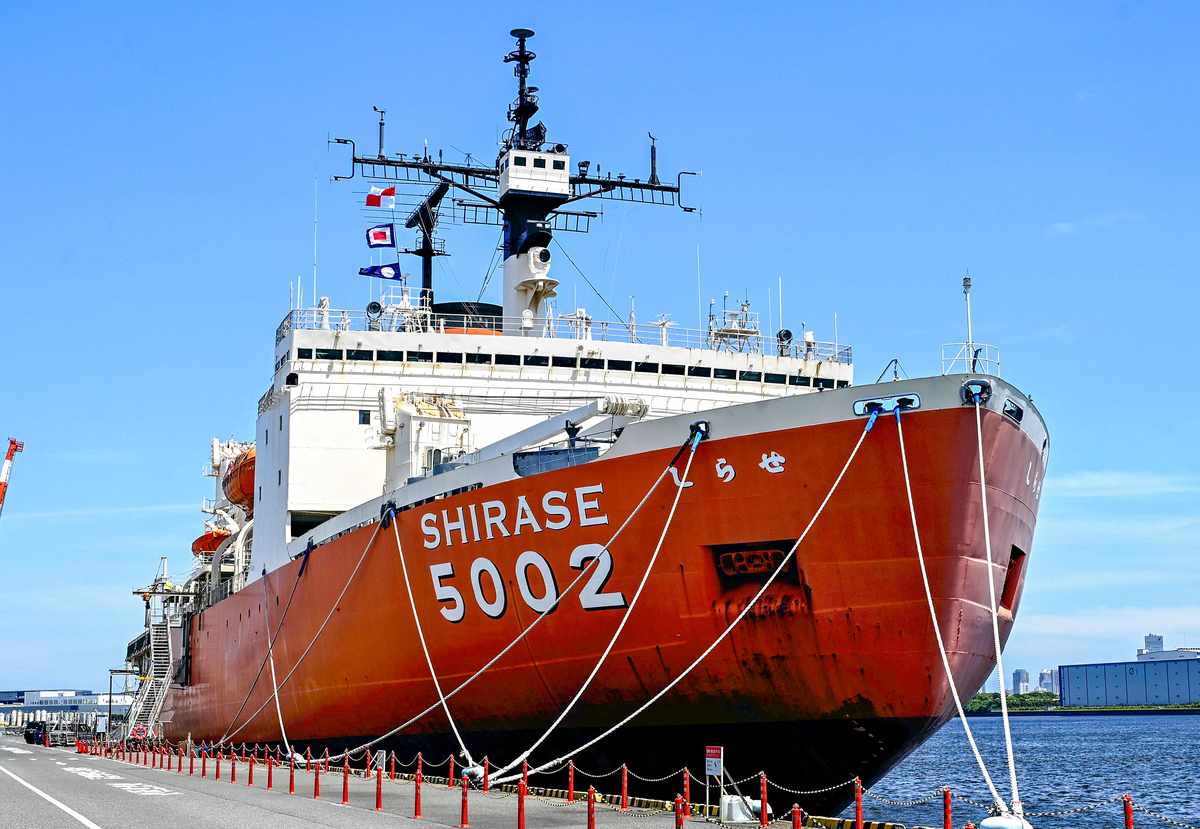
The Shirase 5002 moored at the port
16:18 JST, August 26, 2025
FUNABASHI, Chiba — Against the backdrop of a blue sky, the majestic orange hull of the Shirase 5002 stands out. Its rounded bow is very different from the straight form of cruise ships, an instant indicator of its special mission. Even 17 years following its retirement, the ship retains the same dignity from when it was making many Antarctic research expeditions.
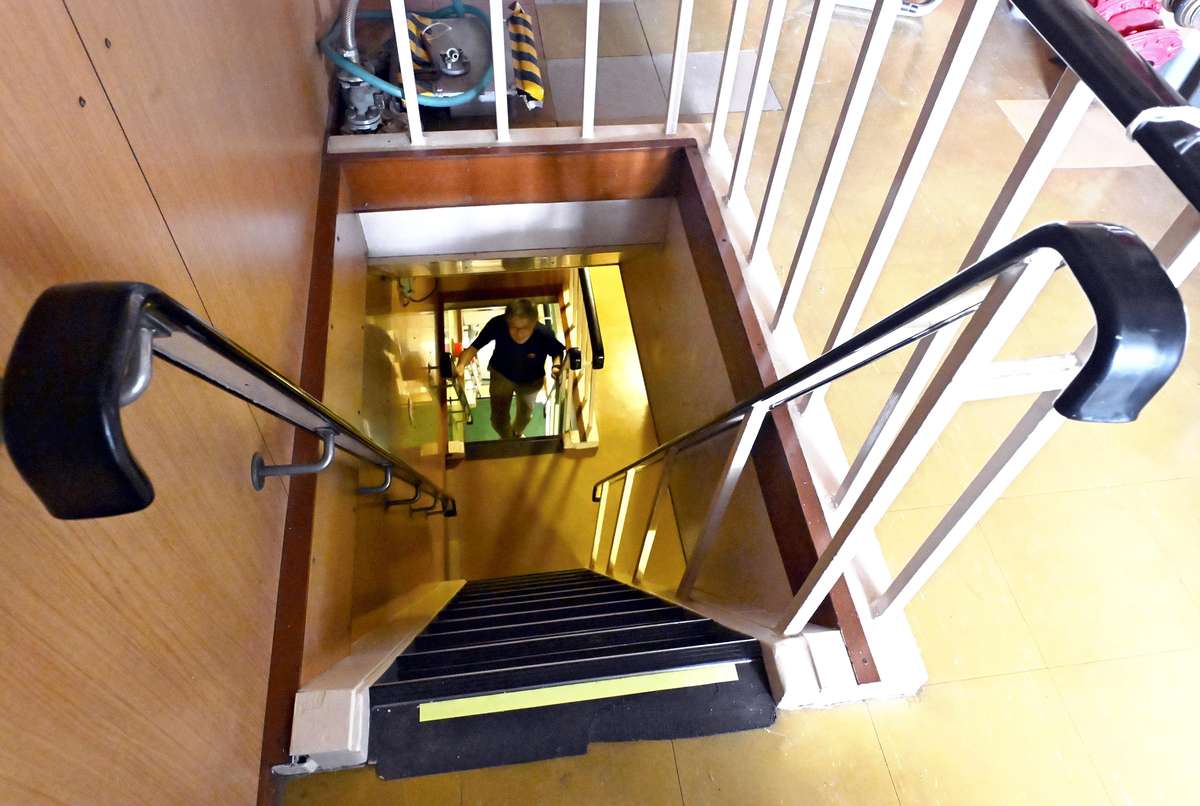
The stairs inside the ship have a steep 50-degree incline.
From 1983, the Shirase made 25 round trips between Japan and Showa Station in Antarctica over the course of 25 years. While in active service, it belonged to the Maritime Self-Defense Force. Its ownership was transferred to weather information company Weathernews Inc. in Chiba upon retirement in 2010. Since 2013, it has been owned by the WNI Kisho Bunka Sozo Center, a general incorporated foundation and affiliate of the company.
“Out of its 25 expeditions, the ship docked at Showa Station 24 times. It isn’t easy to reach the station due to the thick ice. This record is unmatched among research ships throughout history,” Shigeru Saigusa, 55, secretary general of the foundation, said proudly. Saigusa is a former Antarctic expedition and research team member.
Guided by Saigusa, I went to the bridge, where the ship was steered. The spacious area has a steering wheel similar to that of a car, and a lever to adjust the propeller’s rotation speed.
“The unique maneuvering technique called ‘charging,’ also ‘ramming,’ was also performed here,” said Saigusa. Charging is a navigation method to break through ice when the ship’s path is blocked by ice; the ship first withdraws, then moves forward to climb onto the ice and crush it to continue navigating. During one expedition, the ship performed charging as many as 4,000 times. Hearing this, I imagined how difficult and daunting it was to sail to Antarctica.
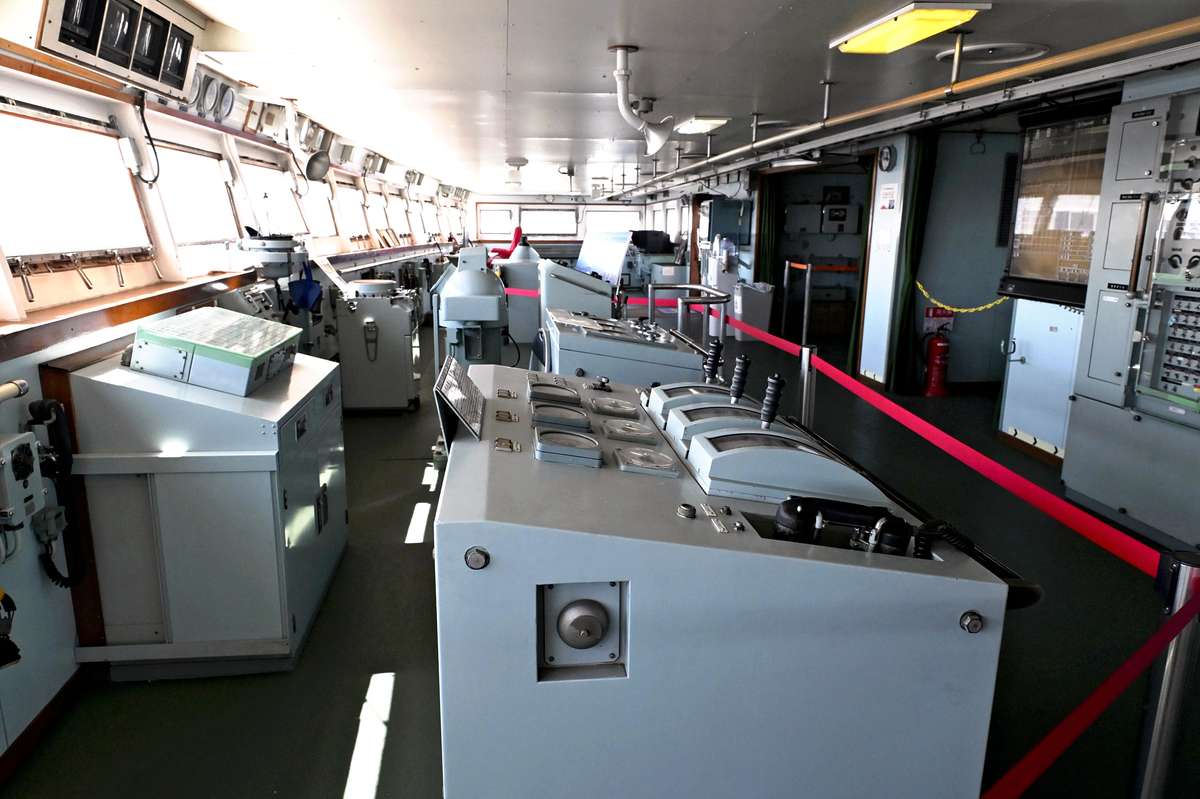
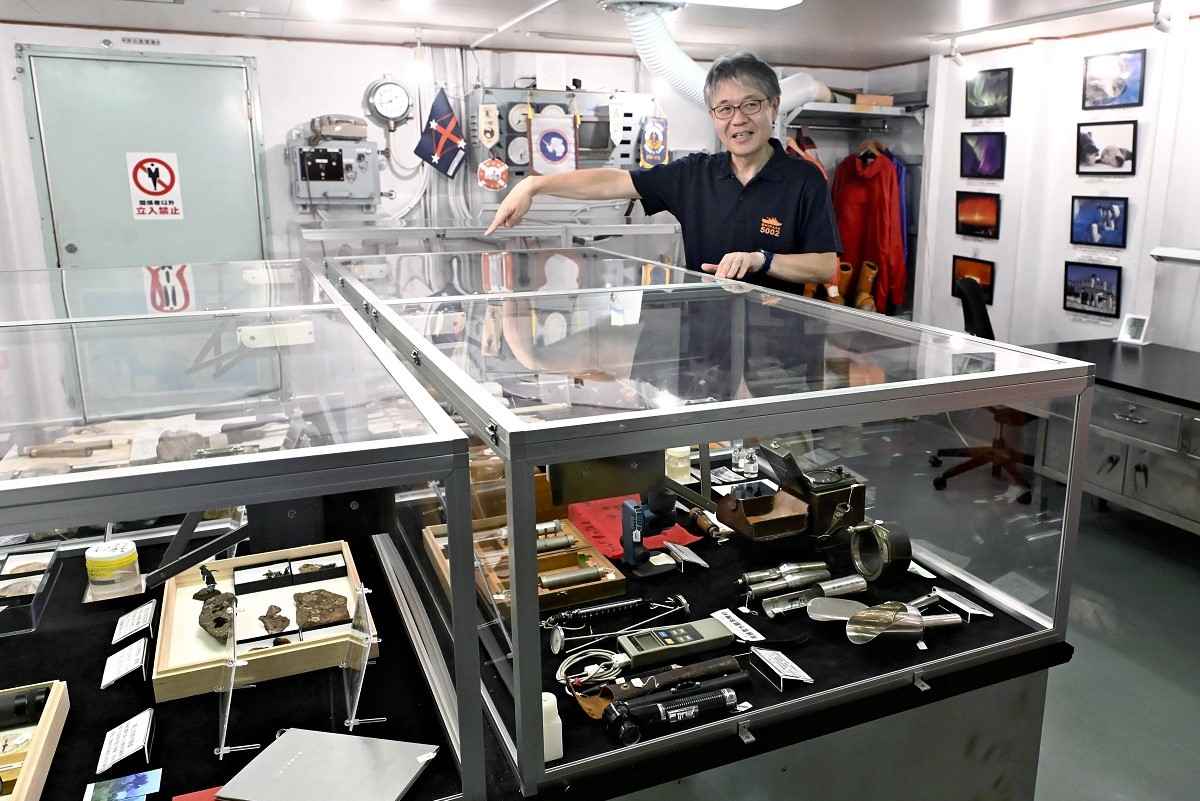
Left: The bridge with steering equipment Right: Shigeru Saigusa explains Antarctic research equipment
Next, we moved to the crew’s living quarters.
The Shirase carried about 170 MSDF officers tasked with navigation duties and about 60 research team members, including researchers and engineers.
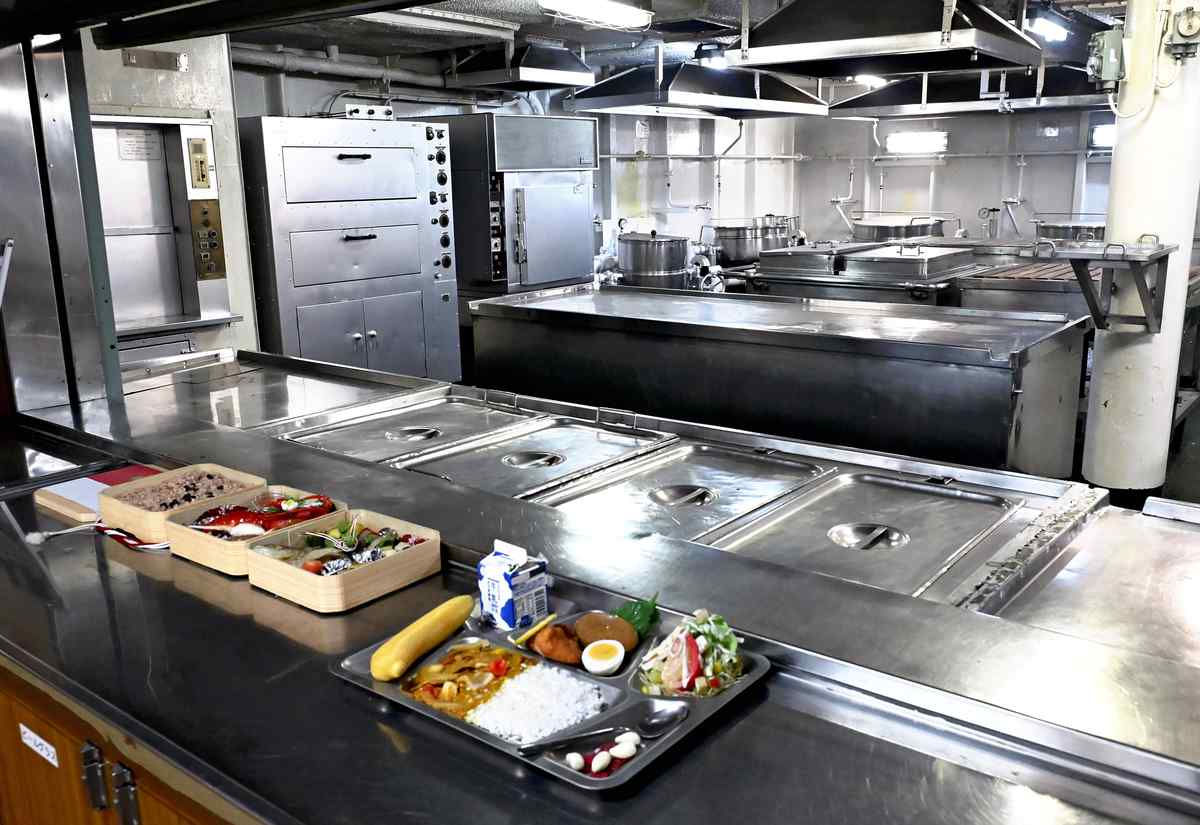
The spacious kitchen, where steam and electricity were used for cooking without fire
First, we visited the room where MSDF officers held meetings and ate meals. In line with MSDF tradition, curry rice was served for lunch on Fridays. Traditional osechi New Year’s Day dishes were also served for the holiday. The chairs were designed to hook onto fixtures underneath the tables in order to withstand intense rocking.
The Shirase holds the record for being the MSDF’s ship with the most tilting capabilities: 53 degrees to the left and 41 degrees to the right. While its tapered, narrow bottom provided high icebreaking capability, the design also facilitated tilting.
“I took motion sickness medication, but it gradually stopped working,” Saigusa said.
On the same floor is the medical room, well-equipped with an operating table. It was mostly used for dental treatment. Operations for bone fractures and appendicitis were also performed.
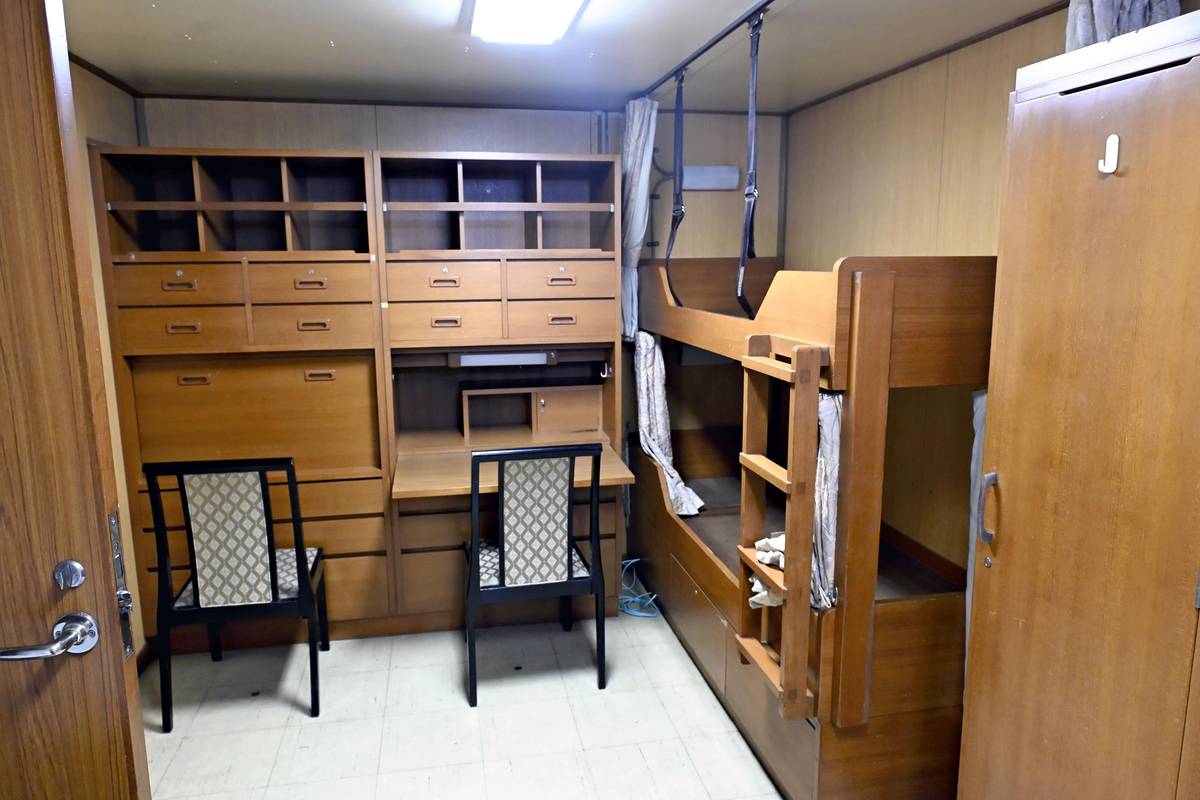
A bunkroom for team members
Nearby is the barber shop. A sign at the entrance read “Tiger Cut House Shirase Main Store.”
Saigusa explained the origin of the shop’s bold name: “With no barber on board, the crew cut each other’s hair. We couldn’t do elaborate hairstyles, so buzz cuts were popular. They weren’t professional, so the hair ended up being unevenly cropped, looking like tiger stripes. That’s why it’s known as tiger cut.”
Hearing about the sense of humor alongside the harsh life on board, I felt closer to the expedition team.
***
Shirase trivia
The ship was named after the Shirase Glacier, located southwest of Showa Station. The glacier itself was named after Lt. Nobu Shirase, the first Japanese national to explore Antarctica.
MSDF ships conducting oceanographic research have ship numbers in the 5000s, with only icebreakers having a single digit after 500. The number of “Fuji,” the immediate predecessor of Shirase, was 5001.
The Shirase was built as the third Antarctic research ship following the “Soya” and the “Fuji,” with the former having started the orange hull tradition.
Toward the end of each voyage, there would be a shortage of fresh vegetables. In response, bean sprouts and radish sprouts were grown on the Shirase.


Related Tags

Most Read
Popular articles in the past 24 hours
-
3 Brazilians Arrested for Stealing Toyota Land Cruiser; Trio Also...
-
Special Diet Session to Consider Budget, Proposed National Intell...
-

Japan, U.S. Name 3 Inaugural Investment Projects; Reached Agreeme...
-

Japan’s Nikkei Stock Average Rises on Tech Rally and Takaichi's S...
-

Security Services Law Unconstitutional: Do Not Restrict Career Ch...
-
New Leader of Japan's CRA Opposition Party Faces Challenge of For...
-

Takaichi Expected to Express Desire for Constitutional Revision P...
-
Tokyo Exhibition Featuring VR Walk Through 2025 Osaka-Kansai Expo...
Popular articles in the past week
-

Japan PM Takaichi’s Cabinet Resigns en Masse
-

Man Infected with Measles Reportedly Dined at Restaurant in Tokyo...
-

Videos Plagiarized, Reposted with False Subtitles Claiming ‘Ryuky...
-

Sanae Takaichi Elected 105th Prime Minister of Japan; Keeps All C...
-

Japan's Govt to Submit Road Map for Growth Strategy in March, PM ...
-

Milano Cortina 2026: Figure Skaters Riku Miura, Ryuichi Kihara Pa...
-
Tokyo’s New Record-Breaking Fountain Named ‘Tokyo Aqua Symphony’
-

Bus Carrying 40 Passengers Catches Fire on Chuo Expressway; All E...
Popular articles in the past month
-
Japan PM Takaichi’s Cabinet Resigns en Masse
-

Japan Institute to Use Domestic Commercial Optical Lattice Clock ...
-

Israeli Ambassador to Japan Speaks about Japan’s Role in the Reco...
-
Man Infected with Measles Reportedly Dined at Restaurant in Tokyo...
-

Man Infected with Measles May Have Come in Contact with Many Peop...
-

Prudential Life Insurance Plans to Fully Compensate for Damages C...
-
Videos Plagiarized, Reposted with False Subtitles Claiming ‘Ryuky...
-

Woman with Measles Visited Hospital in Tokyo Multiple Times Befor...
Top Articles in JN Specialities
-
Tokyo University of the Arts Now Offering Free Guided Tour of New Storage Building, Completed in 2024
-
Exhibition Shows Keene’s Interactions with Showa-Era Writers in Tokyo, Features Newspaper Columns, Related Materials
-

The Japan News / Weekly Edition (1/30-2/5)
-

Step Back in Time at Historical Estate Renovated into a Commercial Complex in Tokyo
-
Prevent Accidents When Removing Snow from Roofs; Always Use Proper Gear and Follow Safety Precautions
JN ACCESS RANKING
-
Japan PM Takaichi’s Cabinet Resigns en Masse
-
Japan Institute to Use Domestic Commercial Optical Lattice Clock to Set Japan Standard Time
-
Israeli Ambassador to Japan Speaks about Japan’s Role in the Reconstruction of Gaza
-
Man Infected with Measles Reportedly Dined at Restaurant in Tokyo Station
-
Man Infected with Measles May Have Come in Contact with Many People in Tokyo, Went to Store, Restaurant Around When Symptoms Emerged