
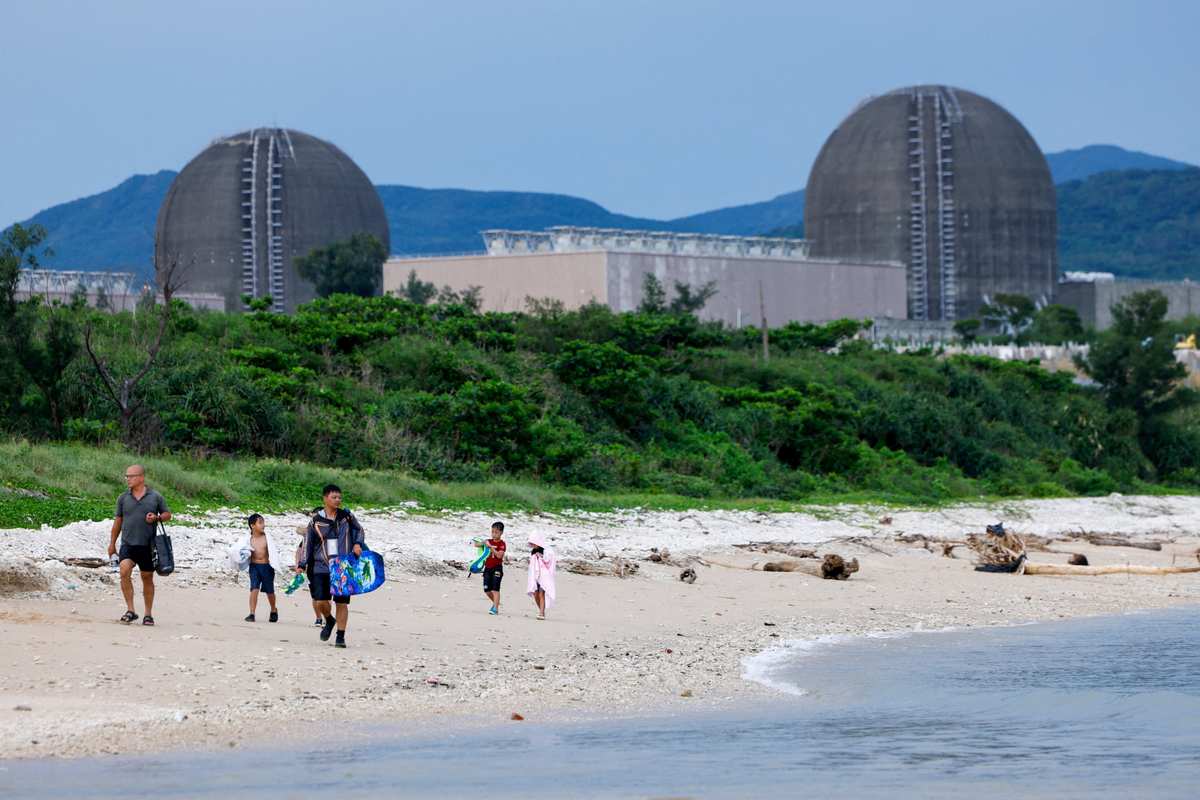
People walk on the beach as the Maanshan Nuclear Power Plant stands in the background, ahead of a referendum on whether to restart the closed facility, in Pingtung, Taiwan August 20, 2025.
10:44 JST, August 24, 2025
TAIPEI, Aug 23 (Reuters) – A referendum to push for the re-opening of Taiwan’s last nuclear plant failed on Saturday to reach the legal threshold to be valid, though the president said the island could return to the technology in the future if safety standards improve.
The plebiscite, backed by the opposition, asked whether the Maanshan power plant should be re-opened if it was “confirmed” there were no safety issues. The plant was closed in May as the government shifts to renewables and liquefied natural gas.
The small Taiwan People’s Party (TPP) proposed the referendum earlier this year, and with the backing of the much larger Kuomintang (KMT) passed the legislation for the vote, saying Taiwan needs reliable power supplies and not to be so reliant on imports.
Around 4.3 million people voted in favour of the plant’s re-opening in the referendum, a clear majority over the 1.5 million who voted against, figures from the Central Election Commission showed.
But the motion needed the backing of one quarter of all registered electors – around 5 million people – to get through under electoral law, meaning the plant on Taiwan’s southern tip will not re-open.
Taiwan’s government says there are major safety concerns around generating nuclear power in earthquake-prone Taiwan and handling nuclear waste.
Taiwan President Lai Ching-te told reporters on Saturday evening that while the referendum had failed, he understood “society’s expectations for diverse energy options”.
“If in the future, the technology becomes safer, nuclear waste is reduced, and societal acceptance increases, we will not rule out advanced nuclear energy,” he added.
In a separate vote on Saturday, electors rejected the recall of seven KMT lawmakers.
A larger recall vote, to try and oust 24 lawmakers from the same party, also failed last month.
Civic groups who had run the recall campaigns, with the backing of Taiwan’s ruling Democratic Progressive Party (DPP), accused the lawmakers of being too close to China and intentionally trying to snarl government spending and legislation, charges the legislators strongly denied.
Lai said Premier Cho Jung-tai had asked many times to resign after the failure of the recall votes in July, but he had asked Cho to stay on.
There will be a cabinet reshuffle to make the team more efficient and governance more effective, Lai added.
The two opposition parties together form a majority in parliament, though the DPP controls the presidency and hence the government in Taiwan’s system.









Most Read
Most read in the last 24 hours
-

Japan Monitoring Situation Surrounding Revocation of Taiwan Presi...
-

3 Japanese Megabanks Mull Loaning ¥3.6 Tril. as Part of Huge Inve...
-

Japan Should Serve as Bridge between Nuclear, Non-nuclear States,...
-

Promote Support, Respect to Help Prevent Harassment of Athletes
-

Japanese Company Zoom Wins ¥180 Mil. Lawsuit Against U.S. Operat...
-
29 New Infections Confirmed in Measles Outbreak at Elementary Sch...
-

Yamato Museum Reopens in Hiroshima Pref. Following Extensive Reno...
-

Charm of Meiji-Era Poet Takuboku Examined from Viewpoint of Donal...
Most read in the last 7 days
-
Earthquake Hits Japan's Tohoku Region; 3-meter Tsunami Warning Is...
-

Trump Extends the Ceasefire with Iran but Keeps the Blockade
-

China, South Korea Object to Japanese PM Takaichi's Ritual Offeri...
-

India's Arms Indigenization Quest for Self-Reliance / New Delhi S...
-

Japan to Ban Use of Portable Chargers on Airplanes from April 24,...
-

¥1,000 Coins to Be Issued to Mark Anniversary of Beginning of Jap...
-

Most Serious Cyberattacks against the UK Now from Russia, Iran an...
-

Trump Opposes United–American Merger, Signals Support for Spirit
Most read in the last 30 days
-
Earthquake Hits Japan's Tohoku Region; 3-meter Tsunami Warning Is...
-
Police Find Child's Shoe During Search for Missing Boy in Nantan,...
-
Body Found in Nantan, Kyoto Prefecture, During Search for 11-Year...
-

Cherry Blossoms, Rapeseed Flowers Perform Colorful ‘Duet’ in Niig...
-
Trump Extends the Ceasefire with Iran but Keeps the Blockade
-

Olympic Gold Medal-Winning Figure Skaters Riku-Ryu Announce Retir...
-
China, South Korea Object to Japanese PM Takaichi's Ritual Offeri...
-

Japanese Prime Minister Takaichi Speaks to Pakistani Prime Minist...
Top Articles in News Services
-
Trump Extends the Ceasefire with Iran but Keeps the Blockade
-
Most Serious Cyberattacks against the UK Now from Russia, Iran and China, Cyber Chief Says
-
Trump Opposes United–American Merger, Signals Support for Spirit
-

Florida Launches Criminal Probe into OpenAI and ChatGPT over Deadly Shooting
-

Trump Picks a University of Minnesota Professor to Lead His Economic Council
JN ACCESS RANKING
-
Earthquake Hits Japan’s Tohoku Region; 3-meter Tsunami Warning Issued (Update 1)
-
Police Find Child’s Shoe During Search for Missing Boy in Nantan, Kyoto Prefecture
-
Body Found in Nantan, Kyoto Prefecture, During Search for 11-Year-Old Boy in Area (Update 1)
-
Cherry Blossoms, Rapeseed Flowers Perform Colorful ‘Duet’ in Niigata
-
Trump Extends the Ceasefire with Iran but Keeps the Blockade
Most read in the last 24 hours
-
Japan Monitoring Situation Surrounding Revocation of Taiwan Presi...
-
3 Japanese Megabanks Mull Loaning ¥3.6 Tril. as Part of Huge Inve...
-
Japan Should Serve as Bridge between Nuclear, Non-nuclear States,...
-
Promote Support, Respect to Help Prevent Harassment of Athletes
-
Japanese Company Zoom Wins ¥180 Mil. Lawsuit Against U.S. Operat...
Most read in the last 7 days
-
Earthquake Hits Japan's Tohoku Region; 3-meter Tsunami Warning Is...
-
Trump Extends the Ceasefire with Iran but Keeps the Blockade
-
China, South Korea Object to Japanese PM Takaichi's Ritual Offeri...
-
India's Arms Indigenization Quest for Self-Reliance / New Delhi S...
-
Japan to Ban Use of Portable Chargers on Airplanes from April 24,...
Most read in the last 30 days
-
Earthquake Hits Japan's Tohoku Region; 3-meter Tsunami Warning Is...
-
Police Find Child's Shoe During Search for Missing Boy in Nantan,...
-
Body Found in Nantan, Kyoto Prefecture, During Search for 11-Year...
-
Cherry Blossoms, Rapeseed Flowers Perform Colorful ‘Duet’ in Niig...
-
Trump Extends the Ceasefire with Iran but Keeps the Blockade